

Description
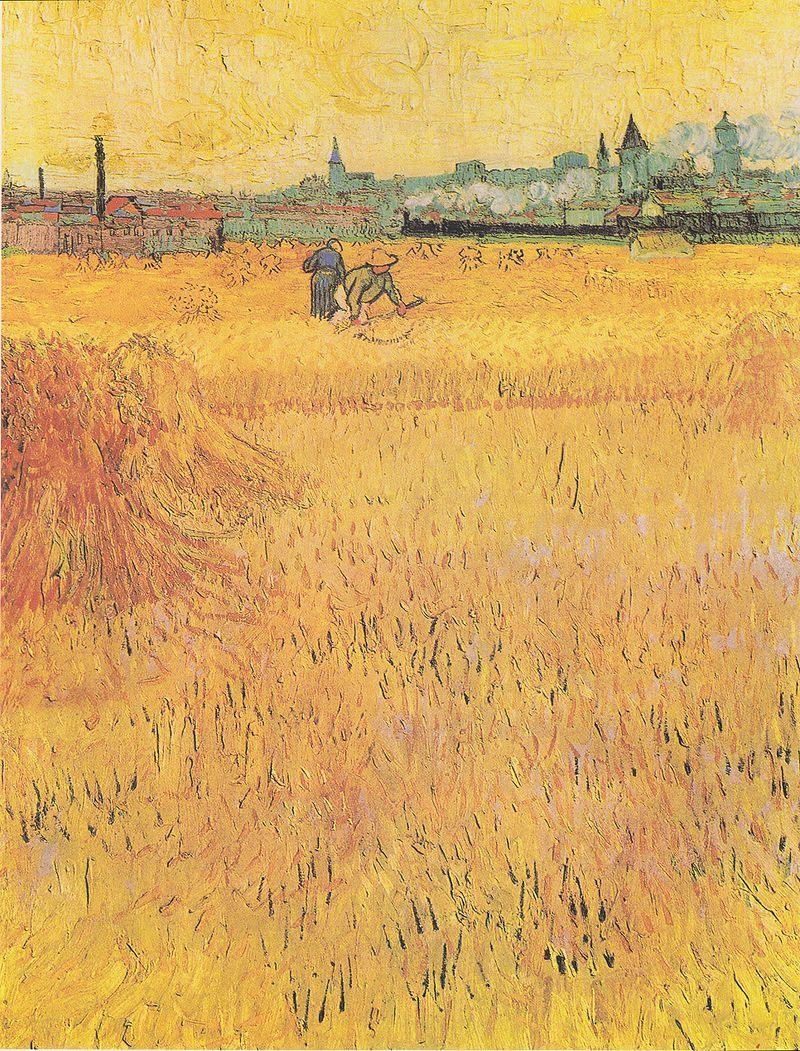
The painting shows a panoramic view of Arles seen from a vast expanse of wheat fields. Golden and ochre ground fills almost the entire foreground, articulated by brushstrokes that sweep across the land in vertical and diagonal directions. At the center, two workers break up the openness of the field: one stands more upright, while the other bends toward the ground, hard at work. Behind them, a dense band of trees and shrubs separates the cultivated land from a settlement of houses, rooftops, and several elevated structures that stand out against the horizon.
The landscape places the scene in the countryside around Arles, a historic city in the south of France, in the region of Provence. The work belongs to a tradition of depicting the countryside in which agricultural activity is not a secondary detail, but a way of showing the everyday relationship between people and the land. The two figures bring a human scale to the panorama and link the city in the background with the work that sustains rural life. In Vincent van Gogh’s pictorial world, wheat fields and farm labor are especially fertile subjects for exploring color, rhythm, and the intensity of nature.
The presence of the workers focuses the meaning of the scene on the concrete experience of cultivating the land. Their bent bodies and gestures directed toward the ground convey continuity, effort, and attention, while the breadth of the field introduces a more open and fertile dimension. The settlement on the horizon provides a counterpoint: the houses and towers offer a point of reference for community and inhabited life amid the agricultural expanse. In this way, the landscape brings together three realms—human labor, the countryside, and the city—without fully separating them. The band of trees acts as a visual transition that softens this passage and organizes the perception of distance.
The composition is predominantly horizontal, but the central figures and the vertical structures along the horizon create points of tension that prevent monotony. The golden field draws the eye from the foreground toward the trees, houses, and towers, establishing a simple yet effective sense of depth. Against this warm backdrop, the vegetation’s bluish greens and the sky’s grayish tones introduce contrasts that bring freshness to the surface. The settlement’s brick reds, oranges, and browns extend the terrain’s earthy palette, while the visible brushwork adds movement to an apparently motionless scene. Yellow light envelops the whole scene, making color the primary means of creating space and atmosphere.
Vincent van Gogh’s style is recognizable in the energetic brushwork, intense color, and expressive contrast between yellows, ochres, and bluish greens. The painting does not present the landscape as a distant backdrop, but as a living surface whose rhythm can be felt in the furrows of the field, the vegetation, and the sky. The work’s appeal lies in transforming a rural view of Arles into a dynamic chromatic experience, in which human labor, the land, and the city remain united. Notice how the 2 small figures anchor the center of the composition: thanks to them, the golden expanse takes on a human scale, and the horizon becomes the visual destination of everyday work.
Have questions about our oil painting reproductions? See our frequently asked questions.