

Description
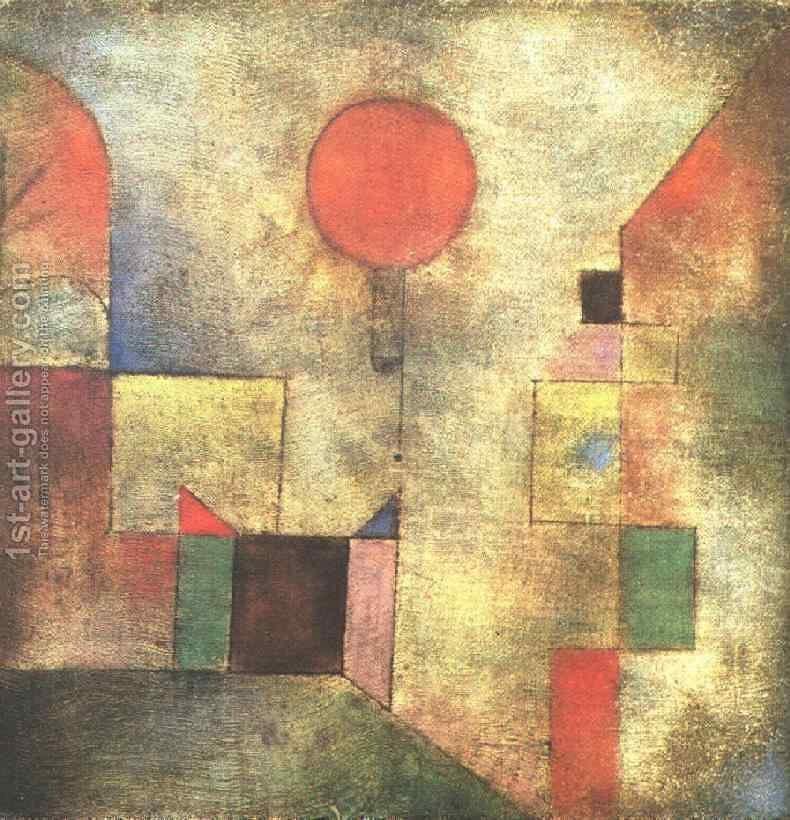
The painting presents a red balloon suspended in the upper area of an abstract composition, surrounded by rectangles, squares, triangles, and planes of color. A thin vertical line descends from the circle, establishing a visual connection with the center of the work, while various red, green, blue, pink, black, and yellow forms are distributed across a field of ochre, beige, gray, and muted green tones. There are no human figures or conventional narrative scene: the recognizable motif appears in isolation within an architecture of forms and chromatic relationships.
In Red Balloon, an everyday object is transformed into a visual sign. The balloon does not function as part of a developed anecdote, but as a suspended presence that organizes the abstract space around it. The composition thus proposes an image between figurative evocation and geometric construction: the circle and its descending line alone are enough to suggest lightness, elevation, and vertical tension, while the lower blocks keep the eye connected to the surface. The central motif remains legible without abandoning the work’s synthetic language.
The red circle immediately draws the eye and acts as the painting’s chromatic core. Its intensity contrasts with the earthy background and the less saturated greens, grays, and beiges, giving the balloon an almost sign-like presence. The line accompanying it suggests the balloon’s string and, at the same time, functions as an axis extending its energy toward the center. Around it, rectangles and triangles create an environment of tensions, pauses, and counterpoints. The muted palette lends a quiet, timeworn feel that makes the red accent all the more vivid.
The vertical, asymmetrical structure keeps the composition from becoming static. The upper focal point is balanced by clusters of forms in the left, central, and right areas, while a large gray-green diagonal occupies the lower section and adds visual weight. The planes seem to overlap or link together like pieces of an open structure, without a rigid grid. Textured areas in the background introduce an irregular vibrancy against the geometric contours, softening their precision. The eye shifts between the dominant circle, the descending line, and the small blocks of color, following a rhythm of upward movement, pauses, and lateral shifts.
The work is consistent with a widely recognized strand of Paul Klee, in which line, color, and geometric forms come together in a style of figuration reduced to signs within an abstract, lyrical construction. Its appeal lies in turning a simple motif into the focus of a complex chromatic structure: the balloon provides an immediately recognizable image, while the rest of the surface transforms it into rhythm, balance, and contrast. Notice how the red at the top is not isolated, but finds echoes in the blocks distributed below; between these two extremes, the line serves as both a bridge and a thread guiding the entire viewing experience.
Have questions about our oil painting reproductions? See our frequently asked questions.