

Description
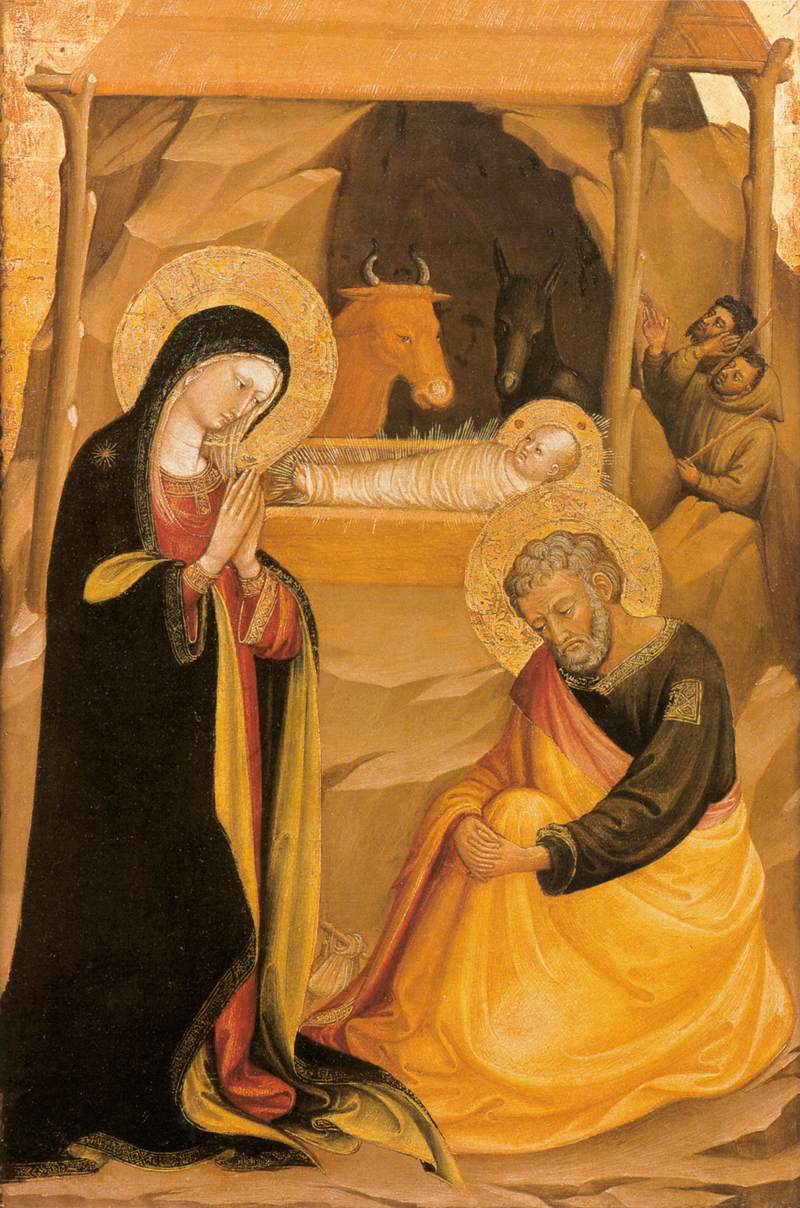
The painting depicts the Nativity inside a simple stable, built from wooden beams and posts that frame the scene. At the center, the Infant Jesus lies horizontally on a wooden structure, wrapped in light-colored bands and surrounded by a golden halo. Mary kneels on the left, leaning toward him in a gesture of devotion, while Saint Joseph occupies the right foreground, seated with his head bowed. An ox and the donkey traditionally associated with the scene appear behind the Infant, and two human figures complete the background beside the side post. The uneven ground and ochre tones place all the figures in an austere, contemplative setting.
The work depicts the birth of Jesus Christ, a central episode in Christian tradition. Mary and Joseph gather beside the newborn in a humble setting, far removed from any sign of wealth or grandeur. The manger and simple architecture place the event in an everyday shelter, while the grouping of the figures turns this modest place into a space for contemplation. The scene does not rely on complex action: its narrative force comes from the closeness of the figures and their shared attention, which converges on the Infant.
The golden halos visually structure the spiritual dimension of the composition and distinguish the sacred figures within the stable’s earthy surroundings. Positioned at the center, the Infant serves as the focus of every gaze: Mary leans toward him, Joseph directs his attention the same way, and the animals form a silent presence behind them. The ox and donkey belong to the traditional iconography of the Nativity and reinforce the idea of a humble, intimate and deeply human celebration. The wood, bare ground and compact scale of the scene heighten the contrast between the shelter’s material poverty and the solemnity of the event.
The vertical structure guides the eye from bottom to top. The large dark mass of Mary's mantle balances Joseph's reddish, yellow, and dark garments, while the Child stands out through his lighter tones and central position. The ochres, browns, and golds unify the ground, wood, and animals, creating chromatic continuity that makes the figures seem part of the same shelter. The sloping roof and posts create a stable geometric frame; within it, the inclinations of the heads and restrained gestures draw attention to the small, illuminated body at the center. The halos introduce luminous circles that balance the density of the forms and articulate different levels of depth.
In keeping with the late Gothic Florentine religious tradition associated with Bicci Di Lorenzo, the work combines defined contours, warm colors, golden halos, and a clearly legible narrative. The simplicity of the setting does not diminish the intensity of the episode: the concentration of figures, animals, and architecture turns the stable into a setting for devotion. The image thus brings together narrative clarity and spiritual gravity without separating the everyday from the sacred. When viewing it, it is worth following the gazes toward the Child and observing how the contrast between the humble wood, the dark mantles, and the luminous halos transforms an intimate birth into an image of sacred solemnity.
Have questions about our oil painting reproductions? See our frequently asked questions.