


Description
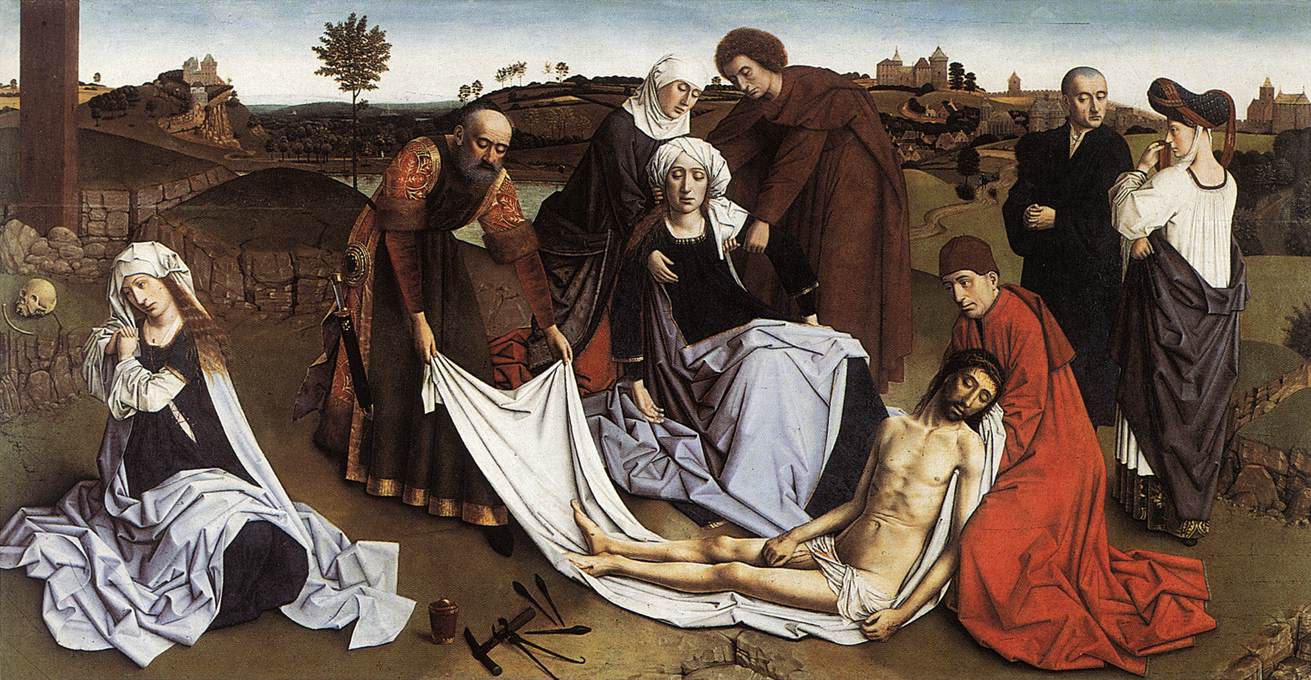
The painting depicts The Lamentation in an open landscape densely populated with figures. Christ’s naked, wounded body lies diagonally in the foreground, partially covered by a large white cloth that several people hold and arrange. Men and women gather around him in various attitudes of mourning: a veiled woman sits on the left, a bearded man leans forward with the cloth in his hands, and a female figure stands at the center with one hand extended over his torso. Other figures bend forward, kneel, or clasp their hands, forming a human arc around the body. Elongated metal objects, stones, and a small skull lie on the ground; beyond them, roads, hills, trees, walls, and fortified buildings extend the scene to the horizon.
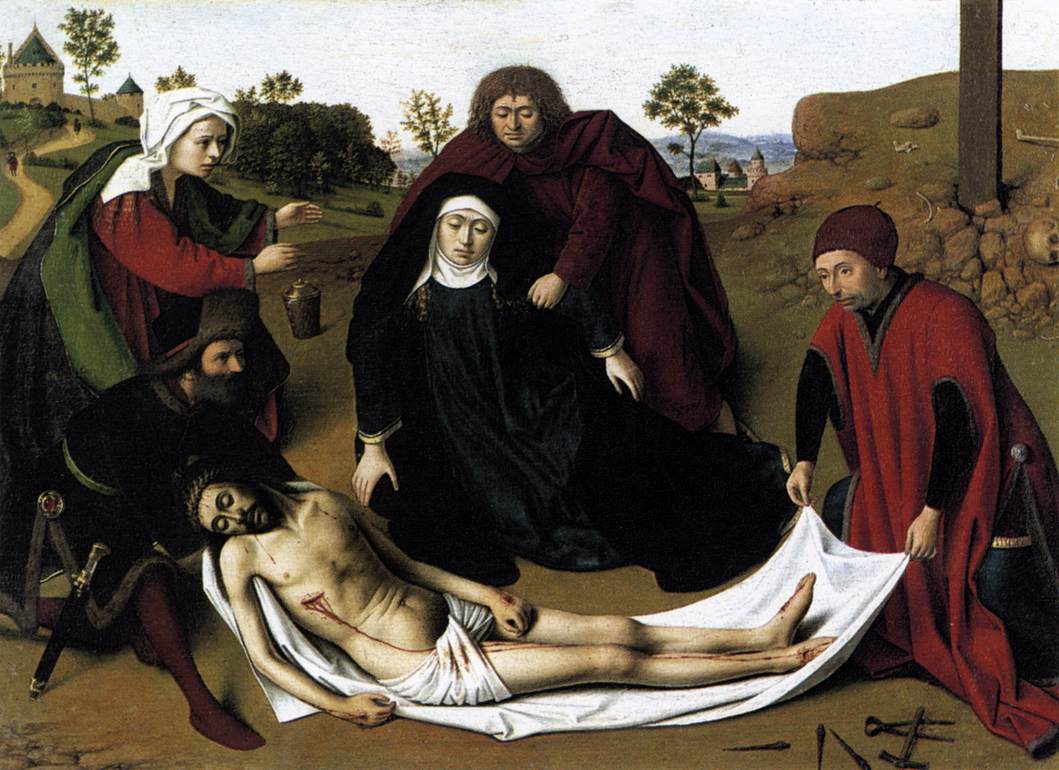
The episode belongs to the Passion of Christ and depicts the moment after the crucifixion, when his followers mourn, support, and prepare his body for burial. The central female figure is associated with the presence of the Virgin Mary, whose proximity to the body expresses the intimate dimension of a mother’s grief. The large white cloth visually links the lamentation to the Deposition and the carrying of Christ, while the gathered figures turn individual grief into a communal ceremony. The fortified landscape extends the sacred narrative beyond the foreground and places the tragedy in an inhabited world crossed by roads and architecture.
The iconography centers on the contrast between the vulnerability of the body and the range of responses from those around it. The nakedness and wounds make the violence of the Passion visible; the hands that support, cover, or clasp together express care, compassion, and contemplation. The white cloth functions both as a reference to the shroud and as a luminous axis running through the composition. The small skull among the rocks introduces a traditional motif associated with Golgotha and Christian meditation on death and redemption. In contrast to the brightness of the body and fabrics, the black, brown, and reddish cloaks deepen the sense of mourning and lend the group emotional weight.
The spatial arrangement guides the gaze from the distant landscape toward the dominant diagonal of the outstretched body. The figures form a sequence of inclinations and gestures that leads the eye from left to right, while the white cloth shapes the foreground as a bright, enveloping surface. The horizon, with its hills, trees, and towers, adds depth without competing with the central drama: its smaller forms establish a broad scale for the scene and make the group seem gathered in a real, open space. The earthy colors of the ground and garments contrast with the intense white of the cloth and the accents of dark red, creating a restrained yet pronounced visual rhythm.
In Petrus Christus’s work, this close attention to figures, objects, and landscape is associated with the sensibility of early Netherlandish painting. The descriptive clarity does not diminish the devotional intensity; on the contrary, it makes every gesture and surface tangible, from the rocks in the foreground to the buildings on the horizon. The strength of The Lamentation lies in this union of detail and structure: Christ’s luminous body concentrates the grief, the cloth connects the mourners, and the landscape turns the intimate scene into an open meditation on the Passion. It is worth observing how each figure adds a distinct variation to the silence of mourning.
Have questions about our oil painting reproductions? See our frequently asked questions.