



Description
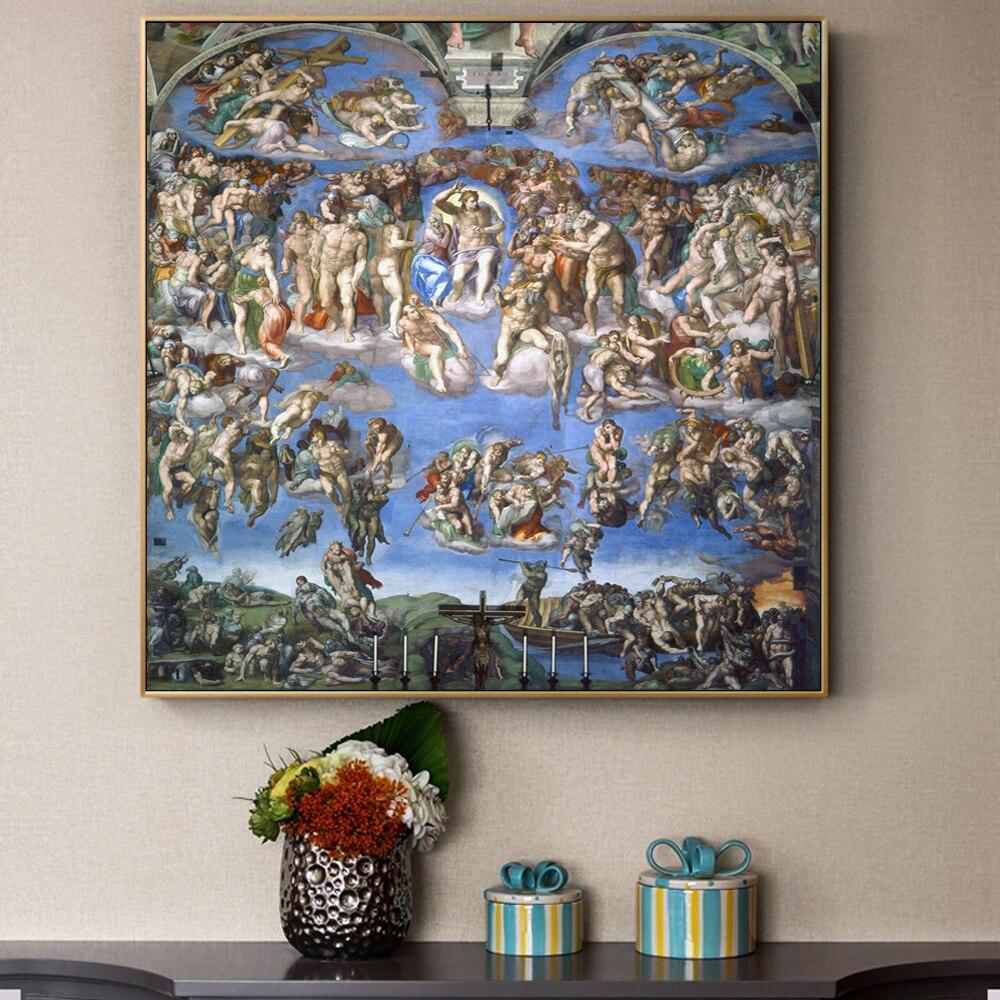
The painting shows The Last Judgment as a monumental, densely populated vision of humanity’s fate. At the center, a haloed figure, seated and dressed in a light-colored tunic and a blue mantle, raises one hand and commands the attention of the entire scene. Naked or partially clothed bodies crowd around him: some rise among the clouds, while others fall, float, or seem to be dragged toward the lower area. Winged angels occupy the upper and side arches, while below, a landscape of dark hills, groups of people, reddish areas, and a large cross bearing a crucified figure unfolds. The architecture of moldings and arches frames this celestial and earthly maelstrom.
The subject belongs to one of the central episodes of Christian tradition: the judgment of humanity at the end of time. Christ appears as the judge of the living and the dead, occupying a dominant position from which the opposing destinies of souls are determined. The righteous ascend toward the celestial realm, accompanied by clouds and winged figures; the damned descend into a darker, more turbulent space. The painting turns this eschatological doctrine into a collective drama, in which every body participates in the same narrative current and the division between salvation and punishment is expressed through movement.
The iconography is structured around the central figure, who serves as an axis of authority and balance amid the turmoil. The halos and angels create a supernatural register, while the cross and crucified figure introduce a visible reference to the Passion and to the redemptive foundation of Christian judgment. The bodies’ opposing directions create an ascending and descending reading: to rise means to draw closer to the celestial realm; to fall means to lose the order of that space. The concentration of figures, clouds, and reddish areas heightens the sense of humanity subject to a universal judgment.
Formally, the composition is organized around a vertical axis, but its diagonals prevent any sense of repose. Arms, legs, drapery and bodies form a network of lines that guides the eye from the cross below to the haloed figure and, from there, toward the winged groups that frame the upper section. The sky blue creates depth and luminosity in the background, while the grays, ochres, dark greens and reds add density to the lower areas. The varying scale of the figures creates a sense of an immeasurable multitude: the nearby bodies gain sculptural force, while the smaller ones extend the scene toward the edges. The contrast between light and darkness turns the space into a setting of continuous tension.
The work is associated with traits widely linked to Michelangelo: anatomical monumentality, sculptural energy, powerful bodies and dynamic groupings in the service of a profoundly intense religious theme. Here, anatomy is not an isolated detail but the primary narrative instrument: every twist, fall or ascent expresses a position within the drama. When contemplating the painting, it is worth first following the axis that connects the cross to the central figure, then tracing the diagonals of the souls, as this route reveals how celestial order and human chaos coexist within a single living architecture.
Have questions about our oil painting reproductions? See our frequently asked questions.