

Description
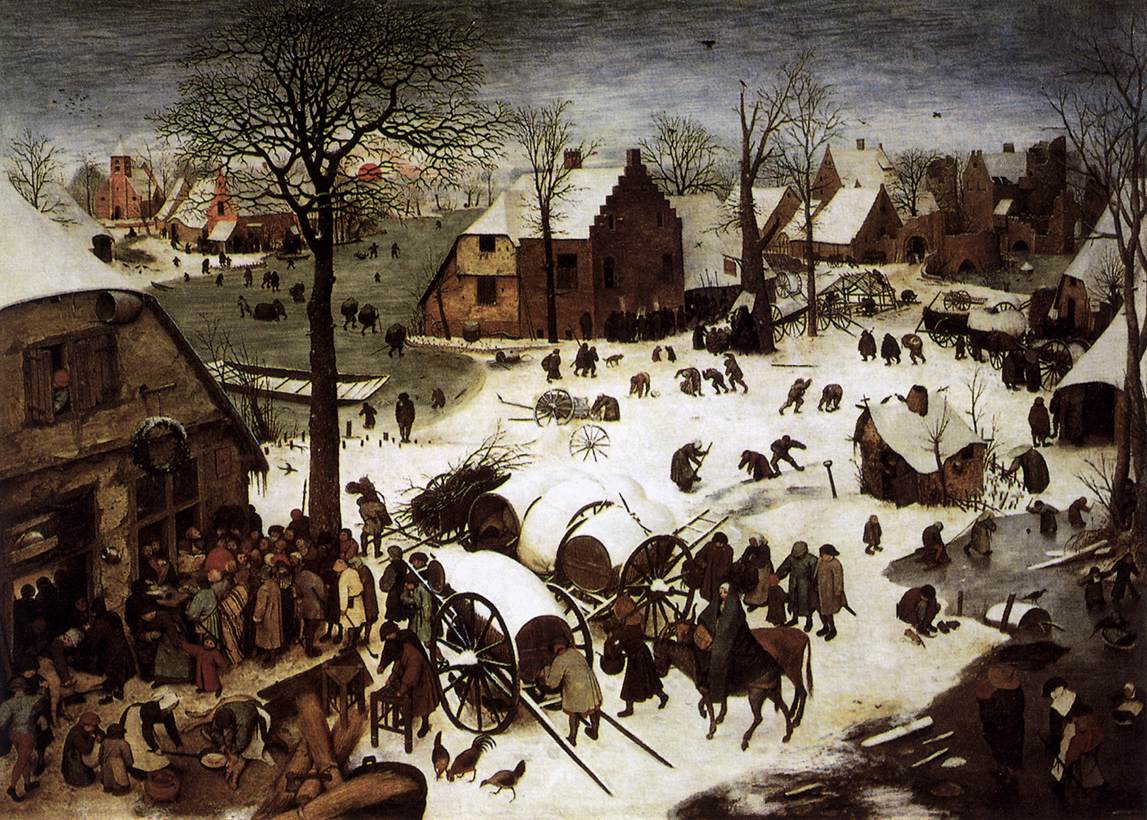
The painting depicts a bustling winter village: snow covers rooftops, roads and fields as villagers move among houses, barns and sheds. Wooden carts, horses, barrels, crates and bundles of branches fill the foreground, alongside groups of figures walking, working or gathering. On the right, several people make their way across an icy surface; in the lower area, domestic fowl and small animals add a touch of everyday life. A religious building rises in the background on the left, set within a settlement of rural architecture. The scene is structured beneath the dominating presence of a large bare tree and a sky filled with cold light.
The subject alludes to the Gospel story in which Joseph travels to Bethlehem with Mary for a census, in the period before the birth of Jesus. Rather than isolating the protagonists in an intimate scene, Pieter Bruegel the Elder turns the episode into a collective event: an entire population seems to be on the move, travelling, working and meeting. Bethlehem thus appears as an inhabited, tangible place, where the religious dimension is intertwined with the material demands of travel, transport and community life.
The crowd and roads visually convey the summoning of a population, while the carts and animals reinforce the idea of a journey to a place of registration. The snow and ice present a physical challenge that makes the journey more tangible and slows every movement. The religious building in the background adds a Christian resonance to a landscape dominated by homes, barns and ordinary tasks. This coexistence of the sacred and the everyday is one of the work’s defining features: the biblical episode is not presented as separate from the world, but as part of the rhythm of a rural community.
The panoramic composition guides the eye across a series of receding planes. The tree on the left near the center serves as a vertical axis, while the row of buildings structures the middle ground and the roads, wheels, and tracks lead into the distance. Contrasts between the white snow, the bluish grays of the ice, and the browns, blacks, and ochres of the figures and buildings create a network of accents that keeps the entire surface alive. The small scale of the figures in relation to the landscape allows numerous actions to be observed at once: no group dominates entirely, and the sense of movement is built through the repetition of bodies, wheels, animals, and paths.
The work is connected to an essential feature of Pieter Bruegel the Elder’s art: the creation of expansive, densely narrative compositions in which seasonal landscapes accommodate countless gestures of everyday life. Here, the census is perceived less as an isolated scene than as the very pulse of a community in motion. It is worth pausing to consider the relationship between the small size of the figures and the vastness of their surroundings: each villager takes part in a larger event while retaining a recognizable activity. The painting’s strength lies in this tension between biblical narrative, winter landscape, and meticulous observation.
Have questions about our oil painting reproductions? See our frequently asked questions.