

Description
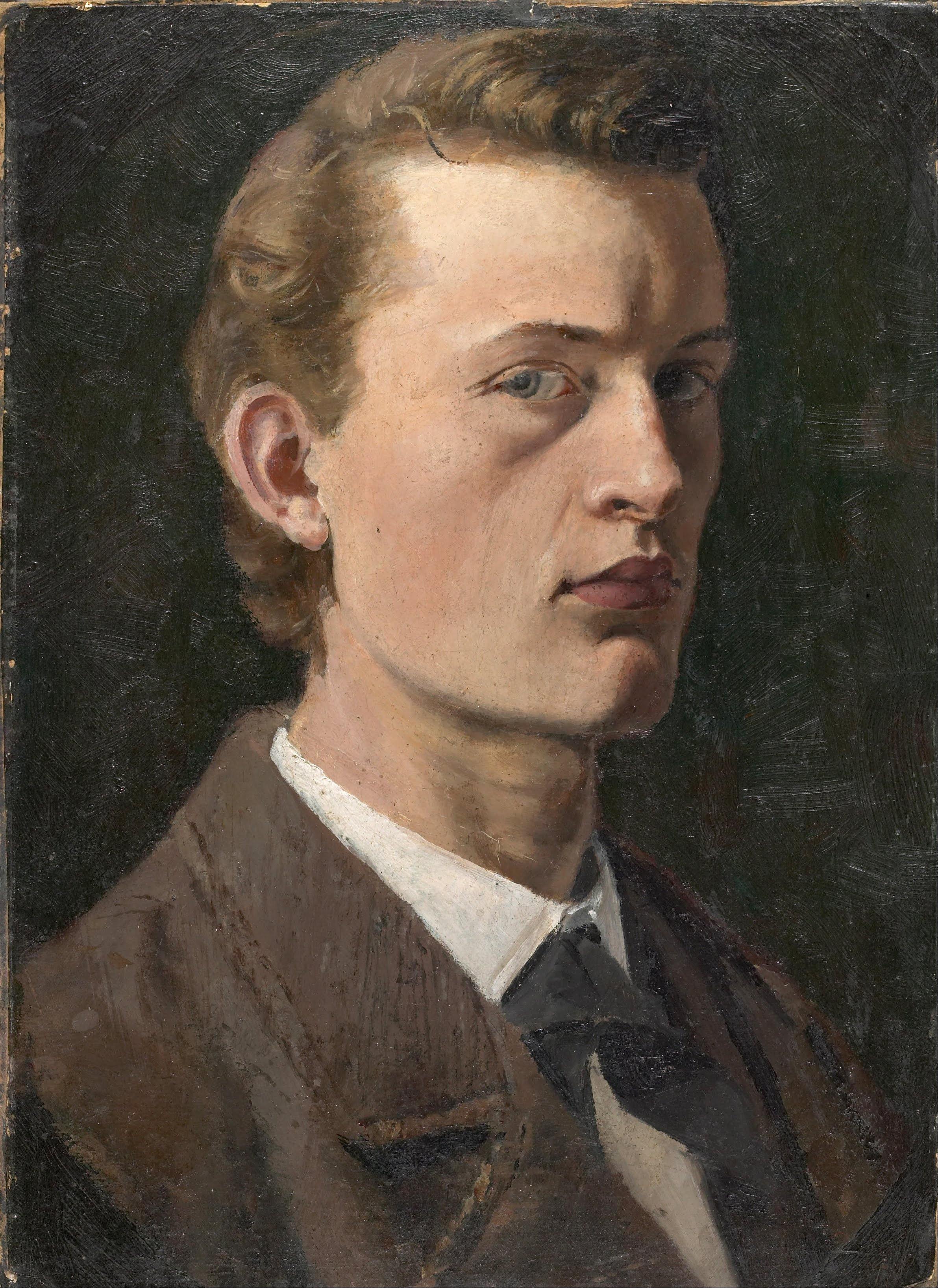
The work presents a Self-Portrait by Edvard Munch in a tightly composed vertical format, conceived as a bust portrait. An adult figure occupies almost the entire pictorial field: the face turns slightly to the right, while the eyes hold a direct, frontal gaze. Short, swept-back hair frames the features; below, a white shirt and a narrow dark garment stand out against a deep brown jacket. There is no landscape, architecture, or secondary object to distract the viewer. The black background, crossed by visible brushstrokes, surrounds the figure and makes their presence the scene’s sole event.
The self-portrait belongs to an artistic tradition devoted not only to depicting appearance, but also to constructing identity. Rather than placing the sitter in a recognizable setting, Munch presents them in isolation, almost suspended before the viewer. This choice shifts the focus from external circumstances to the intensity of individual presence. In the context of Edvard Munch’s work, this concentration is especially significant: his art is widely recognized for exploring the psychological dimension and the expression of inner states. The portrait can therefore be read as a restrained image of the person and, at the same time, as a quiet examination of the human condition.
The direct gaze establishes a tense relationship with the viewer. This is not an expansive pose, but a restrained confrontation: the eyes seem to hold the encounter while the rest of the body remains motionless and reserved. The black background acts as a field of isolation, eliminating the outside world and focusing attention on the face. The contrast between the light shirt, illuminated skin, and dark clothing also creates a precise visual hierarchy. The solemnity of the attire reinforces the seriousness of the expression, while the reddish lips introduce a subtle touch of color that keeps the figure from dissolving completely into the darkness.
Formally, the composition leads the eye from the face down to the torso, then draws it upward again along the head’s vertical axis. The figure occupies the central area on a dominant scale, but the three-quarter turn introduces a slight directional tension: the body remains frontal, the head turns to one side, and the eyes return to the viewer. Light is concentrated on the features and shirt, leaving the jacket and edges in deeper tones. The curved and diagonal brushstrokes in the background do not depict a place; they lend the surface a vibrancy that contrasts with the sitter’s stillness. In this way, the painting balances physical restraint with expressive movement.
The painting’s language can be broadly linked to Edvard Munch’s expressive approach: visible brushwork, a psychologically focused composition, and an intense relationship between color contrast, isolation, and inner state. The overall restraint does not diminish its force; instead, it concentrates it in the face, where every formal element converges. When viewing it, consider how the gaze, dark background, and contrast between light and clothing transform an apparently simple portrait into a scene of self-examination. The figure needs no sweeping gestures: its frontal presence alone is enough to turn the painting’s silence into an experience of intense proximity.
Have questions about our oil painting reproductions? See our frequently asked questions.