

Description
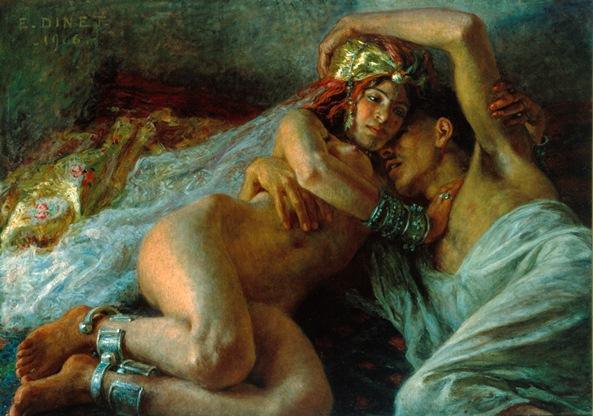
The painting The Seducer, by Alphonse-Étienne Dinet, depicts two human figures reclining in a close embrace, arranged in a diagonal composition that focuses all attention on their intimacy. The foreground figure occupies the front of the scene, with a bare torso, bent legs and a face turned toward the viewer, while the second figure approaches from behind and raises an arm in an arc framing their heads. An ornate headdress, dark bracelets and metal anklets catch the light against the skin. White, blue and patterned fabrics spread around the bodies, set against a deep background of greens, ochres and reddish tones.
The title places the scene in the realm of seduction: not as a literal anecdote involving identified characters, but as a depiction of closeness, desire and romantic persuasion. The figures’ close faces and physical contact make their encounter the narrative focus of the work. The scene also has a theatrical quality, created through the combination of jewelry, headdress, fabrics and carefully intertwined poses. In keeping with Dinet’s general association with Orientalist scenes of North Africa, the composition gives prominence to ornamentation, textiles and warm lighting, although its main strength lies in the physical relationship that organizes the entire space.
The adornments do not function as mere accessories: they heighten the sensuality and make the theatrical nature of the encounter visible. The headdress draws the eye to the head of the foreground figure, while the bracelets and ankle ornaments extend the ornamental rhythm across the body. The patterned fabrics and floral motifs provide a decorative covering that contrasts with the bare torso and heightens the tension between intimacy and spectacle. The light falling on the figures sets them apart from the dark background, as if desire were concentrated in a space of its own, removed from the outside world. The sense of seduction thus emerges from the combination of gestures, touch, gleam, and texture.
Formally, the painting is built around intertwined bodies and diagonal lines. The foreground figure leads the eye from the adorned ankles up to the torso and face, while the raised arm of the figure behind describes a curve that closes the composition at the top. This upward movement balances the horizontal spread of the fabrics and keeps the scene from becoming static. The contrast between the light surfaces of the skin and white fabrics and the greenish, ochre, and reddish background establishes an immediate visual hierarchy. Warm colors and golden reflections model the bodies, while the dark areas around them act as a frame that intensifies the contact.
The work is consistent with Alphonse-Etienne Dinet’s interest in figures, ornamental fabrics, and lighting with a strong sensory appeal within his Orientalist imagery. Without needing to divide the scene into isolated symbols, the artist creates a visual unity in which the body, jewelry, and fabric all contribute to the same language of seduction. It is worth noting how each ornamental detail draws the eye back to the center: the bracelets echo the curve of the arms, the ankle ornaments extend the diagonal, and the headdress crowns the point of greatest intimacy. The result transforms an embrace into an enveloping, sensual, theatrical representation, sustained both by the figures’ closeness and by the chromatic architecture surrounding them.
Have questions about our oil painting reproductions? See our frequently asked questions.