

Description
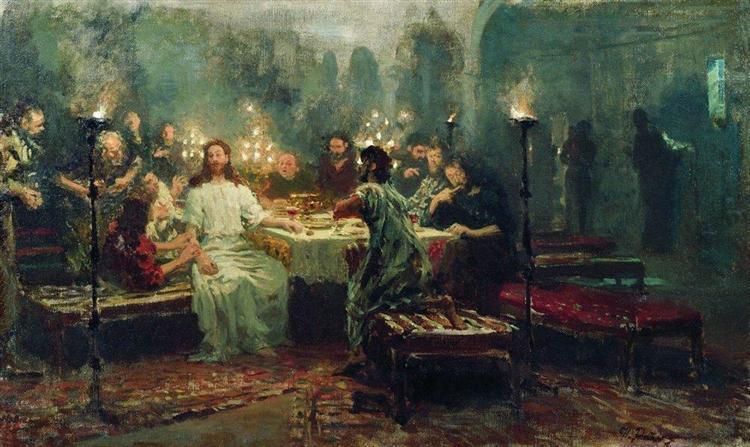
The painting depicts the Last Supper as a solemn, densely composed nighttime gathering arranged around a long table covered with a light-colored cloth. Christ occupies the central-left foreground, wearing a luminous robe and with long hair, while a figure dressed in green leans toward him in an attitude of intense closeness. Around them, numerous diners sit or stand, grouped at varying depths. Plates, serving dishes and vessels organize the surface of the table, while wooden benches, an upholstered seat and an ornate rug extend the scene toward the viewer. In the background, dark walls and a barely lit architectural opening heighten the sense of an enclosed interior.
The Last Supper depicts Christ’s final meal with his disciples before the Passion. In Christian tradition, the episode brings together the intimacy of a shared meal and the awareness of an impending separation marked by suffering and betrayal. The table laid for the meal thus takes on a narrative significance that goes beyond the depiction of a banquet: it is the center of a community gathered at a decisive moment. The scene is also associated with the institution of the Eucharist, so the food and vessels contribute to its religious setting while retaining a tangible, domestic and human presence.
The light-robed figure serves as the visual and spiritual axis of the composition, standing out against the surroundings of deep greens, browns, and blacks. The group around the table recalls the gathered disciples, but the work avoids turning them into a uniform row: each body, inclination, and direction of gaze introduces a distinct response within the group. The figure in green has a particularly intense gestural connection with Christ, which can be read as reverence, dialogue, or agitation. The candles and torches, arranged on the table and raised on either side, transform light into a symbolic and dramatic device: they illuminate the gathered community while leaving the background shrouded in uncertainty.
Formally, the work is built around a crowded horizontal composition, with the table as its physical center and the light-robed figure as its narrative center. The line of the tablecloth leads the eye from one end to the other, while the succession of plates, flames, and faces creates a fragmented rhythm, like a visual conversation. The warm chiaroscuro of the candles contrasts with the greenish shadows of the interior, drawing attention to the faces, hands, and folds of the garments. In the lower area, the red-and-ochre carpet and benches establish a weighty base that brings the scene closer to the viewer’s space; toward the background, the silhouettes gradually merge with the gloom.
In the context of Ilya Repin’s work, this painting can be associated with a realist sensibility attuned to the expressiveness of figures and the psychological tension of narrative scenes. Here, the theatrical lighting does not diminish the human dimension of the episode; it reinforces it through partially illuminated faces, bodies drawing closer or recoiling, and a crowd that seems to react all at once. The result is a Last Supper of great dramatic intensity, in which the feast becomes a scene of spiritual anticipation. It is worth pausing to consider how the light brings the diners together while also setting Christ apart from the background: the visual meaning of the work lies in this dual effect.
Have questions about our oil painting reproductions? See our frequently asked questions.