

Description
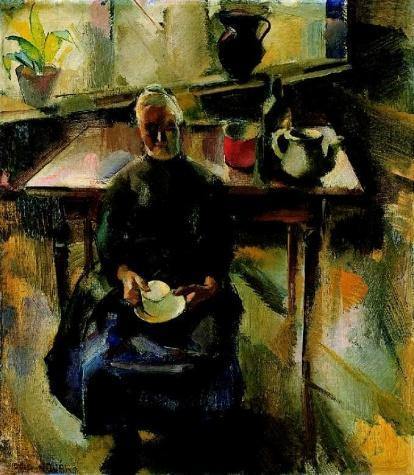
The painting depicts a kitchen scene centered around a wooden table. A seated figure occupies the lower center of the composition, holding a light-colored vessel between their hands, while their dark clothing stands out against the brighter areas of the interior. A light-colored pitcher or teapot, a reddish vessel and other dark everyday objects are gathered on the tabletop. In the background, a black, narrow-necked pitcher creates a vertical accent, while a plant with green leaves on the left introduces a lively counterpoint amid the gloom. The scene unfolds in a room defined by vertical surfaces and bright areas that suggest openings or windows.
The subject belongs to the realm of domestic scenes: it depicts not an exceptional event, but a still moment in everyday life. The figure remains beside the table in an attitude of pause or concentration, surrounded by the objects that identify the space as a kitchen. This narrative simplicity shifts attention to the experience of inhabiting an interior: the proximity of things, the quiet of an interrupted activity, and the relationship between the person in the room and the utensils that organize it. In this way, Vilmos Aba-Novák’s work turns a familiar situation into a pictorial subject of powerful presence.
The table serves as the practical and symbolic center of the scene. Its vessels and pitchers reinforce the functional character of the space, while also creating a sequence of shapes, weights and colors that accompanies the figure. The light-colored object held between the figure’s hands focuses the painting’s human dimension: rather than depicting a precise action, it introduces an intimate pause within the composition. The plant in the background adds an organic green accent against the predominance of wood, ceramic and dark surfaces. Together, these elements give everyday life a contemplative quality, as if the kitchen were also a place of isolation and attention.
The visual composition is built around two very clear axes. The table runs horizontally across the middle of the scene and stabilizes the image, while the central figure establishes a vertical axis that draws the eye to the vessel and then to the head. The objects create small points of light around this center: the cream-white pitcher, the muted red vessel, and the green plant interrupt the continuity of ochres, browns, and blacks. The dense, gestural brushwork keeps the surfaces from appearing completely smooth; each plane retains a material vibrancy that brings the figure, furnishings, and background together. The warm, diffuse light does not come from a single dominant source but is spread throughout the room, keeping the dim atmosphere visible.
In the Kitchen, Vilmos Aba-Novák presents the domestic interior as a structure of relationships: the figure provides scale and a sense of intimacy, the table organizes the space, and the vessels set the rhythm of the viewer’s gaze. The earthy palette and moderate contrasts make the scene seem quiet without making it static; the plant and light accents sustain a subtle tension within the darkness. Notice how the gesture of holding an object connects the body to the table, and how, behind this simple action, the luminous planes make the room feel larger. The result is an everyday scene transformed by the density of the paint and by sustained attention to simple things.
Have questions about our oil painting reproductions? See our frequently asked questions.