

Description
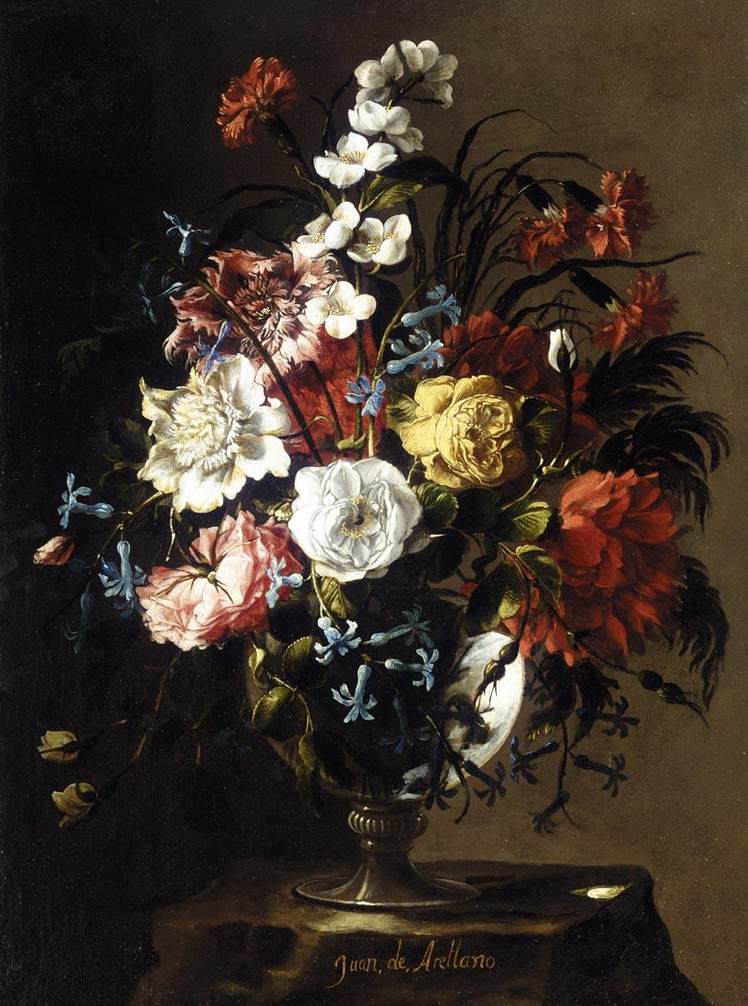
The painting shows an exuberant bouquet arranged in a metal vase on a dark pedestal. The arrangement rises vertically from the base and fills the space with white, red, orange, yellow, and pink flowers, intertwined with dense leaves and long stems that curve toward the edges. The handwritten inscription “Juan de Arellano” appears on the front of the plinth, integrated into the presentation of the work. Several small blue forms resembling dragonflies are scattered among the flowers and foliage, introducing delicate accents of movement into an essentially still scene.
As a floral still life, the work does not develop a specific historical or religious narrative. Its subject is the contemplation of an abundant bouquet, arranged like a luminous apparition against an almost black background. This choice belongs to a pictorial tradition that makes flowers autonomous protagonists: they are not merely decorative elements, but a celebration of the variety, abundance, and visual richness of the natural world. The vase and pedestal present the bouquet with an almost theatrical dignity, as if it were an offering or a spectacle carefully arranged for the viewer.
The floral abundance brings together beauty and fragility. The diversity of forms and colors suggests nature’s changing richness, while the small winged insects remind us that even this image of abundance is suffused with life and movement. Their tiny scale creates an expressive contrast with the large, open flowers and leads viewers to explore the composition in search of details. The pedestal, in turn, separates the bouquet from its surroundings and transforms it into an object of contemplation. The dark background intensifies this impression: the flowers seem to retain their brilliance for a moment before symbolically returning to the shadows.
The composition is organized around a strong central axis, marked by the vase’s neck and by several stems rising toward the top. The white flowers draw much of the light, while the reds and oranges balance the sides and add chromatic depth. The yellows and pinks introduce gentler transitions, and the blues of the winged forms serve as small cool interruptions within a palette dominated by warm, dark tones. The black background on the left and olive-brown background on the right do not depict a recognizable place; instead, they act as a contrasting surface that sets off the silhouettes, focuses attention on the bouquet, and heightens its theatrical effect.
The work is associated with Juan de Arellano’s style, widely recognized for its Baroque floral still lifes, sumptuous bouquets, ornamental density, and contrast between illuminated flowers and dark backgrounds. Here, that tradition is distilled into a highly intense vertical structure: the vase provides stability, the stems create a flexible rhythm, and the flowers open up successive focal points of color. Notice how abundance does not dissolve the sense of order; each petal, leaf, and insect helps guide the eye from the metallic base to the upper part of the bouquet. The result is a visual meditation on living, fleeting beauty, created through color, contrast, and carefully orchestrated theatricality.
Have questions about our oil painting reproductions? See our frequently asked questions.