

Description
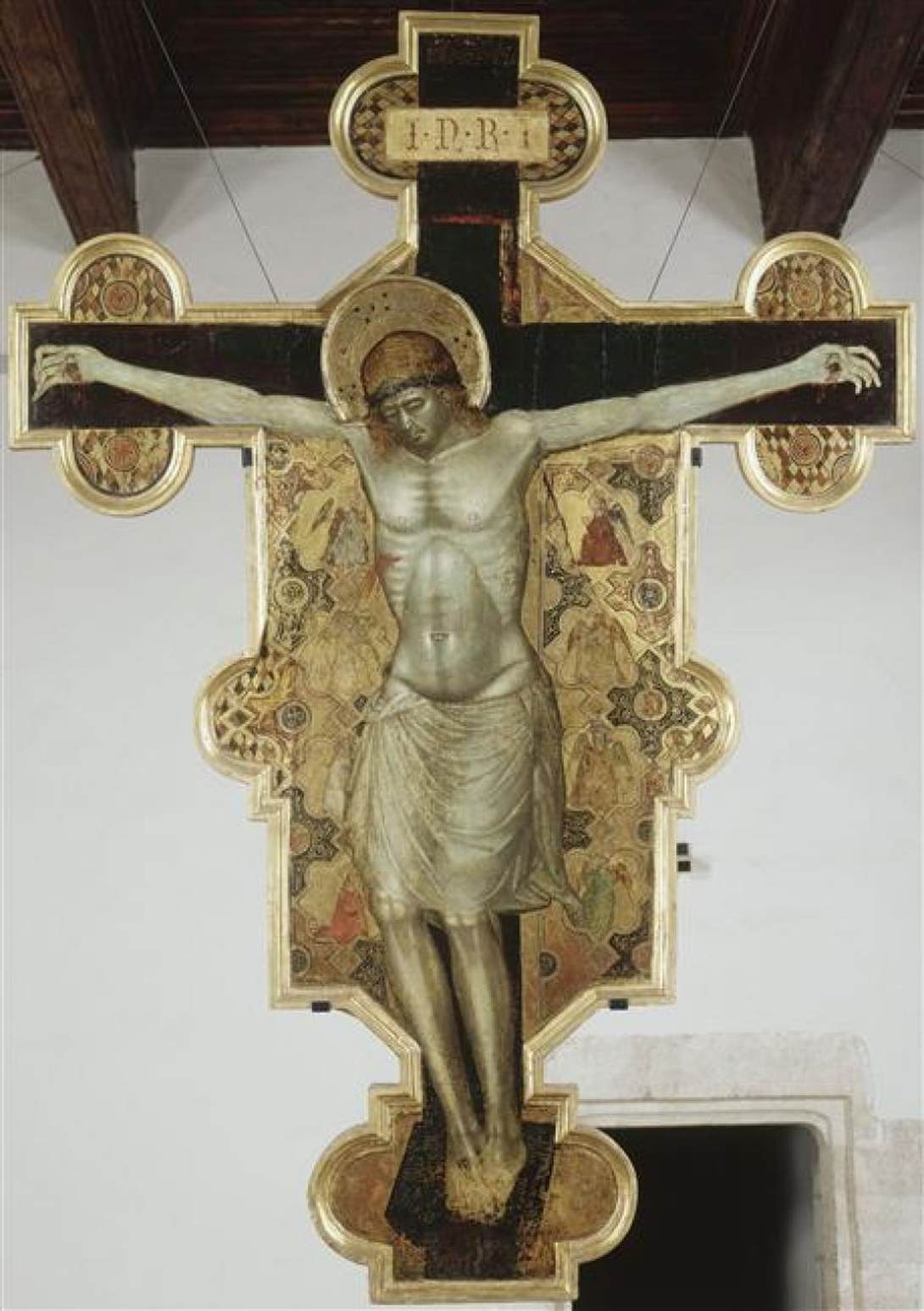
The work depicts Christ crucified at the center of a monumental cross, shown frontally and carefully ornamented. His figure descends along the vertical axis, with arms outstretched, hands open, and head bowed, while a light-colored loincloth is gathered around his waist and legs. Behind his face, a circular golden halo stands out against the dark surface of the cross. The horizontal arms, topped with lobed forms and gold edges, are covered with geometric panels, medallions, and small figurative motifs. At the top, the plaque bearing the inscription I.N.R.I. establishes the sacred identity of the scene.
The crucifix depicts the Crucifixion, a central episode in the Christian Passion and the redemption brought about by Jesus Christ’s death on the cross. The image focuses the story on a single figure, isolated from any crowd scene, directing the viewer’s gaze toward Christ’s sacrifice and its devotional significance. The inscription I.N.R.I. traditionally refers to “Jesus of Nazareth, King of the Jews,” a title associated with the Gospel account of the Passion. Thus, every visible element contributes to a recognizable religious narrative, conceived for sustained contemplation rather than dramatic action.
The iconography is conveyed through simple yet powerful attributes. The golden halo denotes Christ’s holiness, while his outstretched arms and bowed head reinforce the ideas of suffering and surrender. The light-colored loincloth contrasts with the dark background and draws attention to the body, presented as the human and spiritual center of the work. The gold that runs along the cross and its medallions introduces a liturgical dimension: the ornamental surface functions not merely as a frame, but as a sacred structure that envelops the scene and transforms the instrument of death into an object of veneration.
The composition is rigorously axial. The cross occupies almost the entire width of the visual field and organizes the other elements around a vertical axis running from the inscription to the base. The frontal view reduces depth and gives the figure a direct presence, almost suspended before the viewer. Against the dark background, the ivory-colored body, the halo, and the gilded edges form a luminous sequence that guides the eye from top to bottom. The repeated patterns, circles, and lateral finials introduce rhythm and balance, while the wooden beams and the architectural opening in the background place the work in an interior space without competing with its devotional intensity.
In relation to Lorenzo Di Bicci, this crucifix is associated with Florentine religious painting from the transition between the Late Gothic and the early Renaissance, in which clear compositions and golden ornamentation support images with a profound devotional purpose. The work combines this structural clarity with a solemn, monumental presence: Christ’s body is immediately legible, but the gaze lingers on the gilded details that frame it. It is worth observing how the light figure, the shadowy cross, and the gold form a single visual unity; the contemplative power of the whole lies in this tension between bodily suffering and sacred splendor.
Have questions about our oil painting reproductions? See our frequently asked questions.