

Description
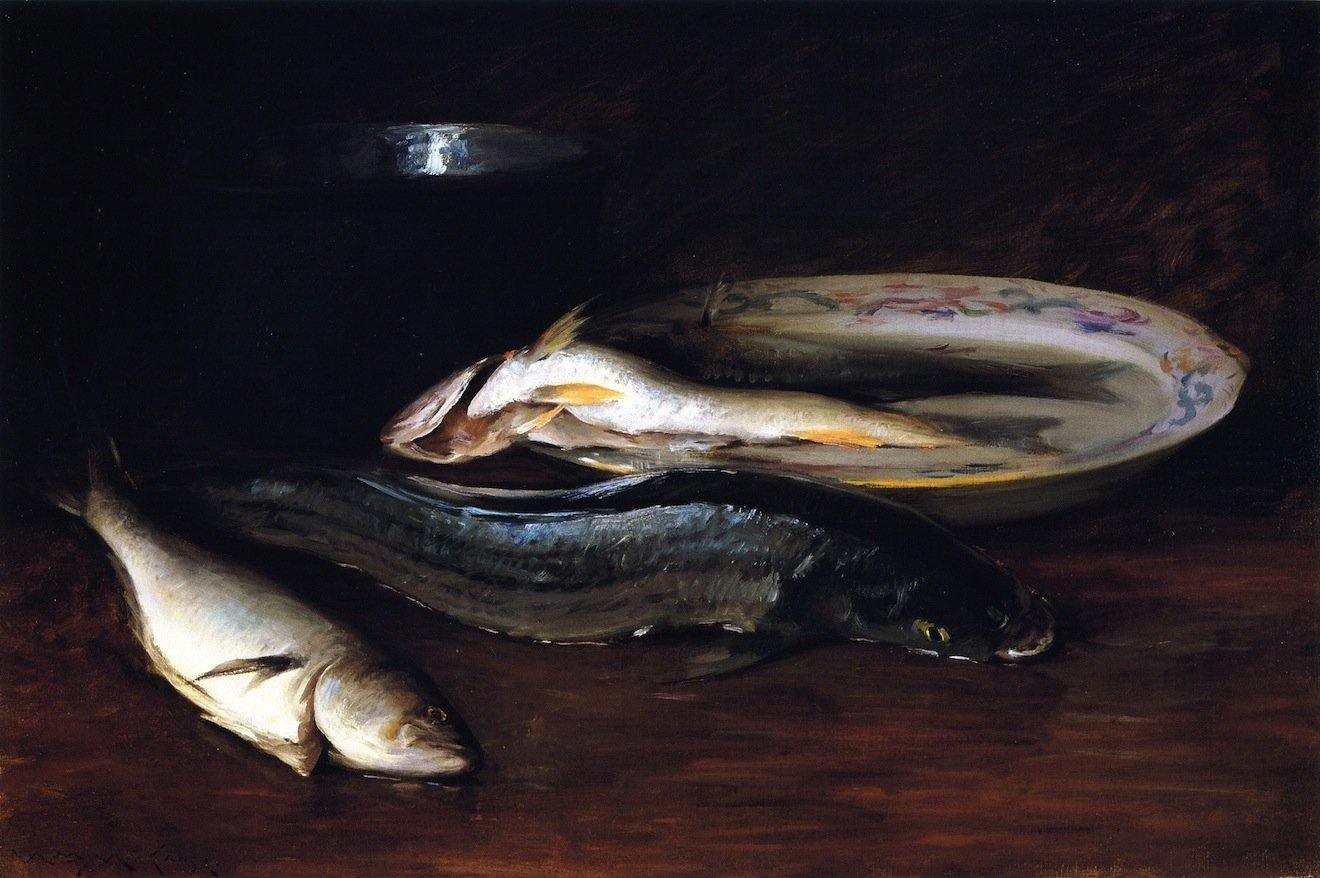
The painting shows a still life of fish arranged on a very dark brown surface. Four motionless bodies are grouped in a compact horizontal composition: a large, silvery, gleaming fish occupies the upper-right area, facing left; beneath it, a dark fish stretches across the center; in the foreground, two pale fish overlap in the lower-left area. The scene dispenses with any external narrative elements and focuses the viewer’s gaze on the bodies, their weight, and their reflections. The almost black background envelops the group, lending an intense presence to each illuminated scale.
As a genre, still life centers on the observation of inanimate objects, including food and dead animals. Its interest does not depend on an action or historical episode, but on the relationship between forms and the space that supports them. In this work, the fish become a subject for pictorial study: their volumes, surfaces, and tonal differences make it possible to examine how light transforms humble material into a complex visual presence. The arrangement’s restraint keeps attention on the direct experience of looking at the objects.
The fish’s stillness reinforces the contemplative character of the composition. Gathered at different levels, they do not form an anecdotal scene, but rather an accumulation of forms that gives shape to a meditation on materiality, weight, and the fragility of bodies. The dark background isolates each figure and creates an atmosphere of silence, while the white, silvery, and yellowish reflections introduce a tension between the scales’ wet appearance and the animals’ immobility. The painting thus finds meaning in the opposition between brightness and darkness, surface and depth, suggested life and absolute stillness.
The composition guides the viewer’s gaze through a stepped structure. The upper fish serves as the first focal point because of its size and luminosity; the dark body in the center acts as a transitional band, while the two lower fish lead the eye toward the left edge and the lower center of the painting. The visible, horizontal and diagonal brushstrokes lend a certain vibrancy to the background and surface, although the overall composition retains a pronounced stability. The palette, dominated by blacks, browns, and bluish grays, is punctuated by bright highlights that shape the curves of the bodies. Tonal contrast takes the place of extensive spatial depth, making the fish seem to emerge directly from the gloom.
In relation to William Merritt Chase, the work can be associated with a sensibility close to American Impressionism, particularly in its attention to light, color, and the changing effects of surfaces. Here, these interests are concentrated on a limited subject: the gleaming skin, the scales, the contours, and the way the background absorbs light. It is worth observing how the painting turns four fish into an architecture of reflections: the silvery fish above draws the eye, the dark fish gives the center density, and the lighter bodies below balance the composition. The strength of the still life lies precisely in this transformation of the everyday into a focused study of light and matter.
Have questions about our oil painting reproductions? See our frequently asked questions.