

Description
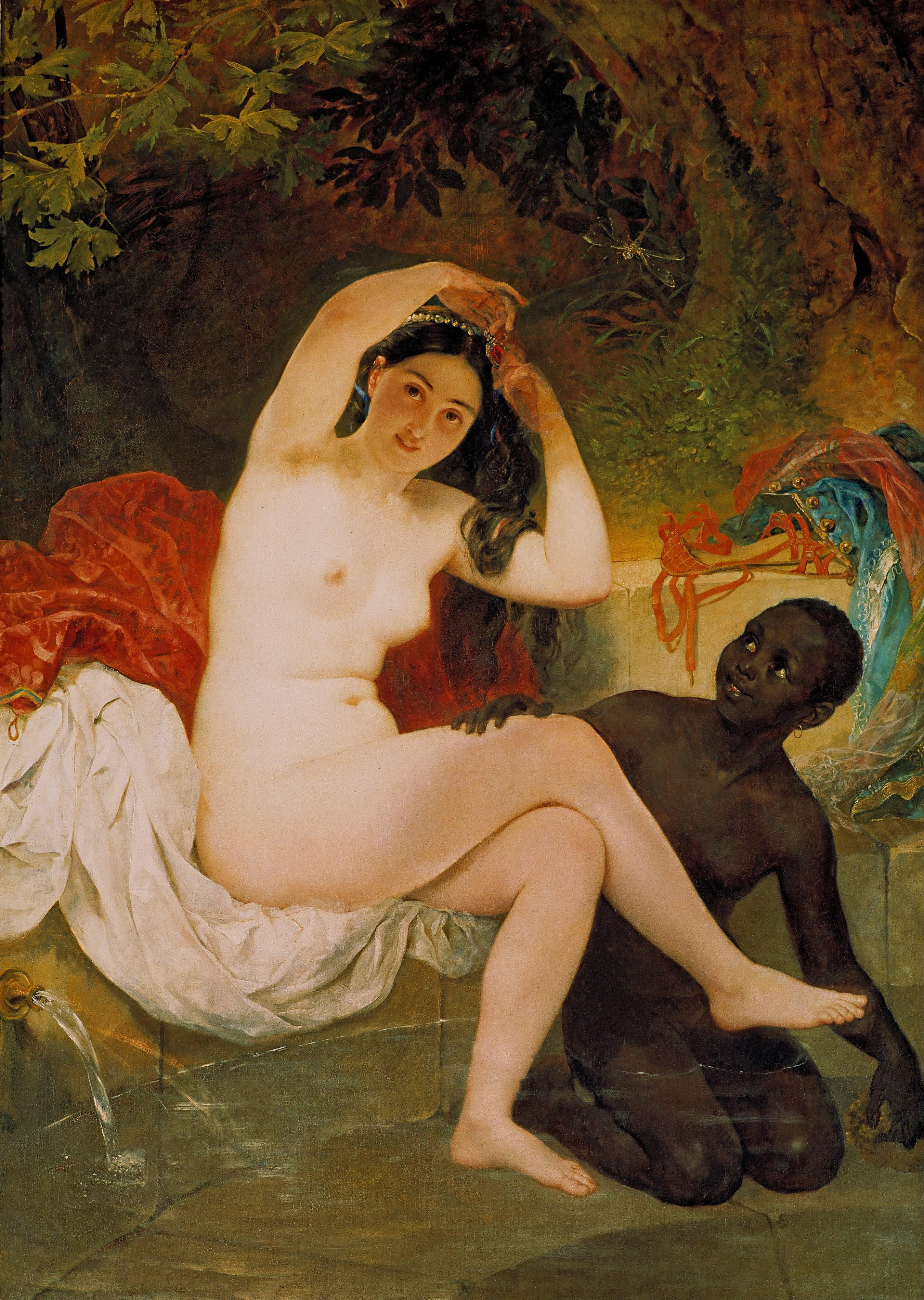
The painting depicts Bathsheba bathing in an intimate, lush scene arranged around a fountain or pool. The nude woman occupies the center of the composition: seated on a broad white cloth, she raises her arms to her hair, her figure silhouetted against the dark vegetation. Beside her, a dark-skinned figure kneels, attending to the central figure and helping with her bath. Red, blue and green fabrics, ornaments, ribbons and cords are piled on either side. Water gushes from the lower-left corner, while a rough tree trunk, dense leaves and a small winged insect complete the natural frame.
The subject comes from the biblical story of Bathsheba, a figure in the Old Testament associated with King David. According to the account, David saw her bathing and later took her as his wife; before that, Bathsheba was Uriah’s wife. The work focuses on the moment of bathing and omits any visible presence of the male onlooker, directing attention instead to the woman, her attendant and the sumptuous surroundings. The religious episode is thus transformed into a depiction of intimacy, idealized beauty and restrained narrative tension.
The water, ornamental fabrics and adornment around Bathsheba’s hair create an iconography of luxury and ceremonial preparation. The kneeling figure may be read as an attendant serving the central figure, reinforcing the private, staged quality of the bath. The lush vegetation acts as a natural enclosure: it conceals, envelops and separates the scene from the outside world. The vividly colored ribbons and fabrics suggest material wealth, while the contrast between Bathsheba’s fair skin and the green shadows around her heightens her visual prominence. The flowing water brings a sense of freshness and movement to a scene otherwise dominated by the stillness of the figures.
The vertical composition guides the eye from the foliage above to the central figure and, finally, to the stream of water in the lower left. Bathsheba’s body forms a supple diagonal, extended by her outstretched leg and the folds of the white fabric; the kneeling attendant balances this axis in the lower-right quadrant. The masses of textiles create color counterpoints on either side, keeping the vegetation from overwhelming the scene. Golden light softly models the figures and brings the reds, blues, and greens to life, while the dark areas of the trunk and foliage add depth. The careful drawing of the figures contrasts with the tactile variety of leaves, fabric, stone, and water.
In keeping with Karl Bryullov’s academic and Romantic idiom, the work brings together theatrical composition, idealized figures, rich color, and a marked attention to light and texture. The biblical episode is presented not as an austere illustration but as a visual spectacle in which sensuality, luxury, and narrative are brought together through color and the arrangement of the figures. Notice how the whiteness of the fabric and skin establishes the focal point, while the richly colored textiles and vegetation create an enveloping setting. In this balance between intimacy and staging, Bathsheba appears both as a figure to be gazed upon and as the active center of the entire pictorial composition.
Have questions about our oil painting reproductions? See our frequently asked questions.