

Description
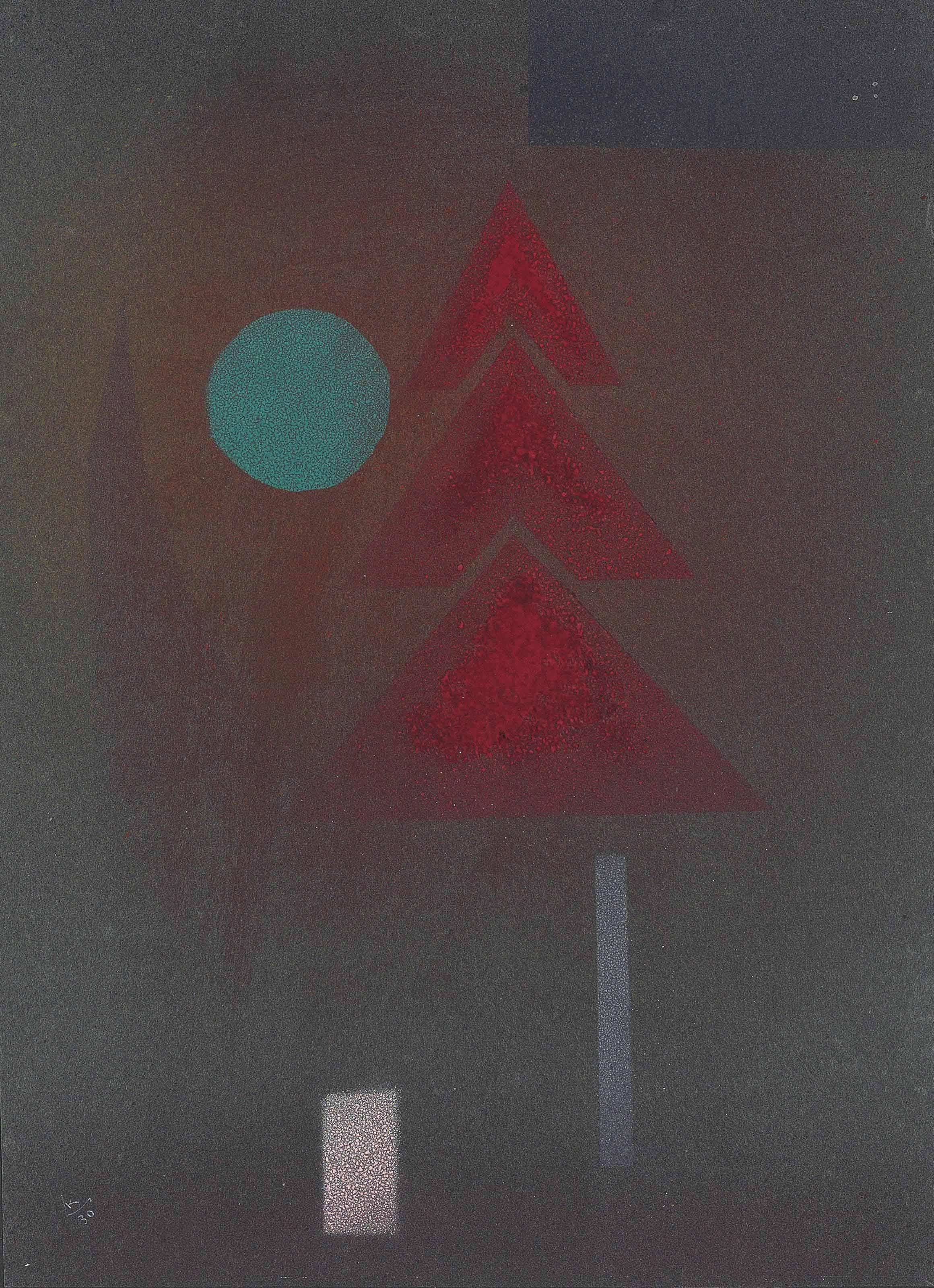
The painting shows a geometric abstract composition dominated by a turquoise disc in the upper-left half. Facing this isolated, luminous circular form is a structure of red triangles, bands, and planes that crosses the center and extends to the right. The background, built up with blacks, dark browns, and muted reds, leaves broad areas of visual emptiness around the main forms. The grainy surface unifies the different fields of color and gives the work a dense, almost tangible presence. The title, Almost Lost, finds a poetic resonance here: the circle seems suspended in an uncertain space, set apart from the angular architecture around it.
As an abstract work, the painting presents neither a narrative scene nor recognizable figures, but rather relationships between forms, colors, tensions, and directions. Its context lies in a modern conception of abstraction, in which geometry can organize visual experience without representing objects from the visible world. Associated with Wassily Kandinsky in the catalogue, the work approaches a visual language based on the interplay of circles, diagonals, and intense planes of color. Rather than recounting a specific episode, it proposes an open-ended visual situation: a rounded, stable presence confronts a fragmented, dynamic, seemingly unstable structure.
The turquoise disc carries much of the work’s symbolic meaning. Its color, brighter and cooler than that of the surrounding planes, makes it a point of separation within the dark field; it may suggest a suspended, distant presence, or one on the verge of disappearing. The red triangular forms introduce a different energy: their points, intersections, and shifts create tension and a sense of contained movement. The contrast between the circle and the angles establishes a relationship between balance and rupture, while the almost-black background intensifies the impression of depth, concealment, and distance. Thus, the title does not serve as a literal explanation, but as an atmospheric key to contemplating the isolation of the turquoise form.
The vertical, asymmetrical composition guides the eye along an upward path. The disc first draws attention through its color contrast and relatively stable outline; then the red diagonals lead the eye toward the center and right side, where the planes overlap and seem to expand. The alternation of narrow triangles, broad shapes, and dark bands creates an irregular rhythm, closer to fragmentation than symmetry. The blacks and browns serve as pauses and areas of depth, while the crimson adds visual weight and drama. The mottled texture keeps the surfaces from appearing completely smooth and gives each color an inner vibration, especially visible in the turquoise.
In this work by Wassily Kandinsky, geometry does not act as a cold formula but as a system of visual forces. The circle offers a center of relative stillness; the triangles and diagonals introduce momentum, displacement, and structural disintegration. This contrast connects the piece with a modern abstract conception in which forms acquire meaning through their position, color, and relationship to one another. As you look at it, follow the path from the turquoise disc to the red expansion on the right: along this route, you can sense how Almost Lost transforms an impression of isolation into a formal experience of tension, distance, and suspended movement.
Have questions about our oil painting reproductions? See our frequently asked questions.