

Description
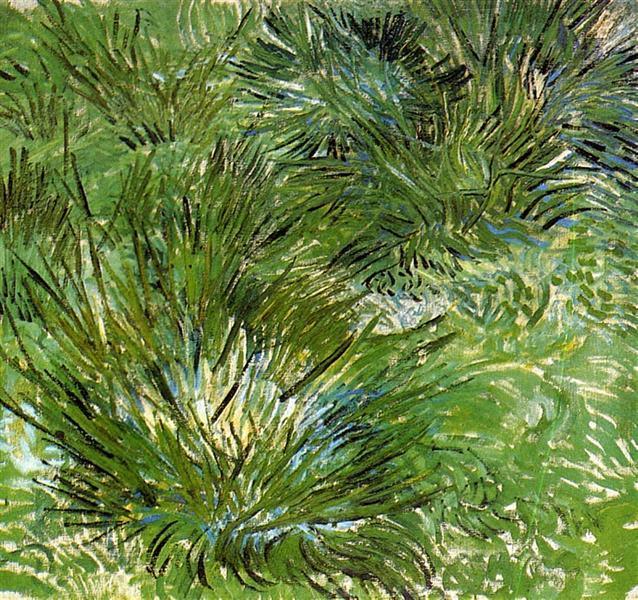
The painting shows several tufts of grass and long leaves fanning out within a very close crop. Vegetation occupies almost the entire surface: some leaves emerge from the lower left, others arch toward the top, while a finer cluster extends to the right. There is no horizon, figures, or architecture to distract from the main subject. The result is a concentrated view of nature, in which the mass of vegetation becomes the true space of the work.
As a botanical landscape, Tufts of Grass does not depend on a narrative scene, but on intense observation of a fragment of the natural world. Vincent van Gogh treats vegetation as an autonomous, expressive subject, capable of sustaining the entire composition on its own. The close crop transforms humble plants into a pictorial subject of great presence. The landscape ceases to function as a background and becomes a direct experience of density, growth, and movement.
The concentration of overlapping leaves directs the eye toward the material, organic force of the vegetation. The curved and diagonal forms suggest continuous growth, as if each cluster responded to the impulse of the others and kept the surface in motion. The contrasts among greens, blues, pale yellows, and dark strokes enrich the way the whole is perceived: the grass does not appear as a uniform mass, but as a living weave of directions, highlights, and shadows. The variety of color heightens the sense of vitality without turning the subject into an anecdotal scene.
Formally, the work is built up through dense layers and curved lines that create an almost radial rhythm. The longer leaves in the foreground form diagonals that lead the eye from the bottom toward the center and upper area. Among them, light blue brushstrokes break up the green background and create a shallow, compressed sense of depth, characteristic of a detail observed from very close up. The black and dark strokes act as visual pauses: they separate the leaves, emphasize their outlines, and heighten the shifts in direction. The visible brushwork makes the surface seem to vibrate, so the eye travels across the painting rather than settling on a single point.
The treatment of nature is consistent with a characteristic feature of Vincent van Gogh’s work: energetic brushwork, expressive color, and intense attention to the texture and rhythm of plant forms. Here, this sensibility transforms a grouping of grass into an almost abstract composition, held together by diagonals, curves, and luminous contrasts. It is worth noting how the title derives its strength not from describing a specific species, but from the multiplication of clusters that fill the field of vision. The work makes the energy of the landscape visible through the very substance of the paint.
Have questions about our oil painting reproductions? See our frequently asked questions.