

Description
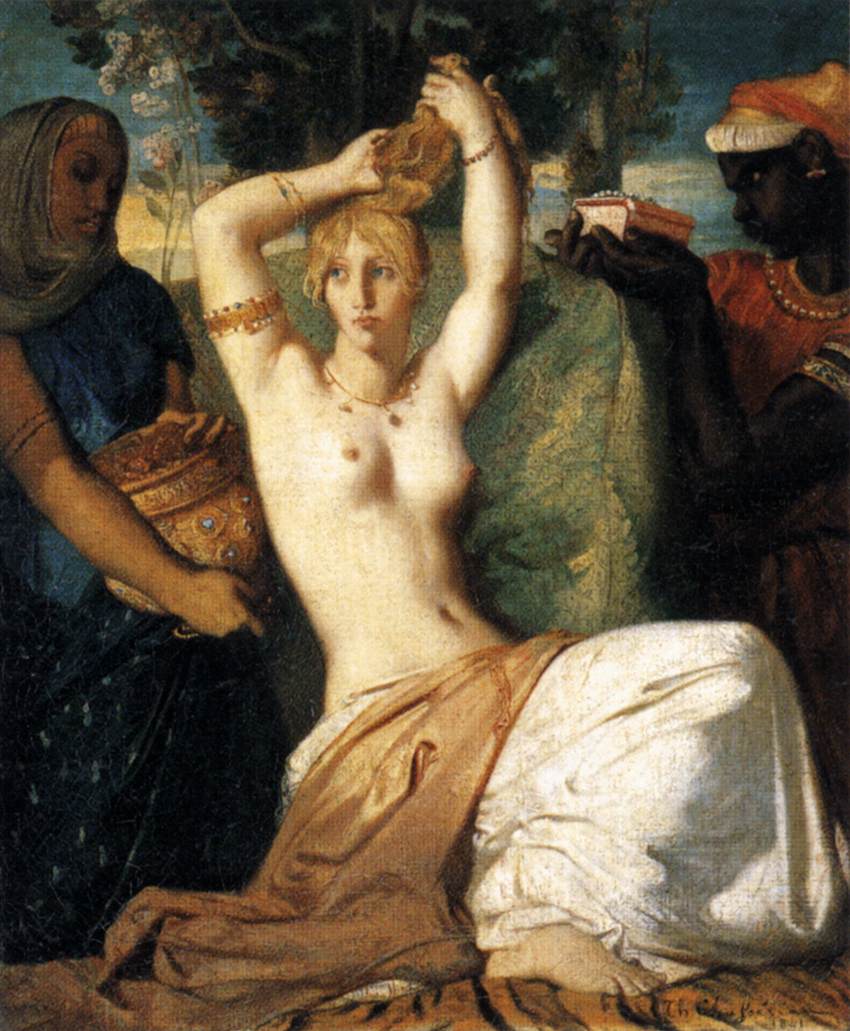
The painting shows Esther during a bath or while preparing herself, attended by two servants in an outdoor setting with a palatial appearance. The protagonist occupies the center of the composition: the light falls most intensely on her bare torso, while a light-colored fabric wraps around her lower body. Seated or reclining, she raises her arms and brings her hands together above her head in a gesture associated with arranging her hair and the ritual of the toilette. On either side, two figures whose skin is darkened by shadow wear loose garments and ornate headdresses. One stands beside a rectangular object decorated in shades of brown and gold; the other holds a light-colored item with a red edge. Trees, foliage and glimpses of blue sky complete the setting.
The subject refers to Esther, the Jewish woman who would become queen of Persia. Her story has a central place in the biblical narrative because, from her position at court, she intercedes with the king to protect her people from Haman’s conspiracy. Here, the painting focuses on an intimate moment that precedes the political action: the future queen appears attending to her body, surrounded by attendants and sumptuous objects. The biblical narrative is thus translated into a scene of preparation, where the vulnerability of the body coexists with the dignity and power associated with a courtly figure.
Esther’s pose draws attention to the body, the gesture, and the ritual of grooming. Her raised arms form an arch that visually organizes the center of the work, while the figures at the sides serve as a dark frame for the protagonist’s brightness. The headdresses, luxurious fabrics, and ornate objects suggest a world of palatial wealth and ritual care. The foliage and open sky introduce a sensual, theatrical dimension: the intimacy of the toilette unfolds not in an enclosed space, but before lush nature, which broadens the scene and turns it into a spectacle.
The formal structure depends on a striking contrast between light and shadow. The ivory white and beige of the fabric, together with Esther’s illuminated skin, establish the main focal point against the deep greens, browns, and blacks surrounding the figure. Red and gold accents on the headdresses and objects punctuate the darkness with carefully distributed glimmers. The vertical, centered composition is balanced by the two figures at the sides, while the central figure’s diagonal posture adds movement and sensuality. The leafy background creates depth without competing with the foreground: its branches and masses of foliage form an irregular screen that lets the blue sky show through and reinforces the theatricality of the whole.
In Théodore Chassériau’s work, this combination of sinuous drawing, restrained sensuality, contrasting color, and theatrical composition is associated with Romantic and Orientalist language. The human figure retains a sculptural presence, while the setting, fabrics, and headdresses introduce a decorative richness that heightens the courtly atmosphere. The light makes Esther the focal point of the scene without completely isolating her: the attendants, objects, and vegetation guide the eye toward her while also creating the world of power and ceremony that surrounds her. The bath thus emerges as a threshold between the intimacy of the body and the public identity of a queen.
Have questions about our oil painting reproductions? See our frequently asked questions.