

Description
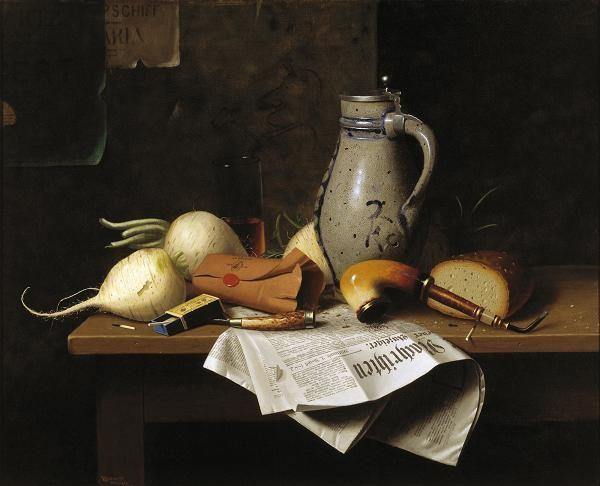
The painting depicts an interior still life composed of humble, everyday objects: two white roots with short leaves rest on the left side of the table, beside a small box in shades of blue and yellow and a barely visible dark vessel. In the center-right stands a tall, pale, speckled ceramic jug whose upright silhouette organizes the scene. Around it are a piece of cut bread, a knife, and other utensils, while an open newspaper fills the foreground and drapes over the edge of the table. The background, clad in dark wood, envelops the gathering of objects in dense shadow. In Munich Still Life, William Harnett turns a domestic surface into a space for close observation, where each element gains weight, texture, and presence.
As a still life, the work does not depend on a historical, religious, or mythological narrative. Its interest lies in the contemplation of a quiet domestic scene: food, ceramics, paper, and everyday utensils are brought together in a carefully balanced arrangement. The title provides a geographical designation, but the visible subject stands on its own as a study of objects and materials. Everyday life is presented here without human figures, although the table retains indirect traces of activity: the bread has been cut, the newspaper opened, and the utensils seem to have been left momentarily at rest.
The bread and vegetables can be read as simple signs of food, sustenance, and domestic life, without needing to turn them into fixed emblems. The newspaper introduces another dimension: its printed columns evoke current events and the circulation of information, but also function as a visual surface of folds, shadows, and contrasts. Set against the organic matter of the food and the solidity of the ceramics, the paper adds fragility and movement. The jug, for its part, acts as a stable, vertical presence, almost architectural, that visually anchors the composition. The grouping of humble objects invites an intimate reading of everyday life: what usually goes unnoticed becomes worthy of sustained attention.
The horizontal composition groups the elements in a dense band across the table, while the jug establishes a vertical axis just right of center. The roots balance its weight from the left and lead the eye toward the bread, knife, and newspaper. The latter introduces a descending diagonal that extends the scene into the foreground and reinforces the sense of physical proximity. Soft side lighting defines the forms against the almost black background and gradually brings out the surfaces: the bread’s uneven crust, the ceramics’ muted sheen, the softness of the roots, and the folds of the paper. The range of browns, blacks, creams, muted greens, and ochres maintains chromatic unity, while small light accents keep the darkness from completely absorbing the objects.
The work is associated with William Harnett’s visual language, widely recognized for his illusionistic still lifes and meticulous attention to textures, materials, and effects of light. Here, that precision does more than describe: it transforms the table into a setting of intense tangible presence. The dark background focuses the gaze, the compact arrangement creates a quiet tension, and the contrast between matte, shiny, rough, and folded surfaces keeps the eye moving. Notice how the newspaper, far from being a mere accessory, opens the composition toward the viewer, while the jug anchors it from the back. Between them, the bread, vegetables, and utensils turn the scene into a sober meditation on the materiality of everyday life.
Have questions about our oil painting reproductions? See our frequently asked questions.