

Description
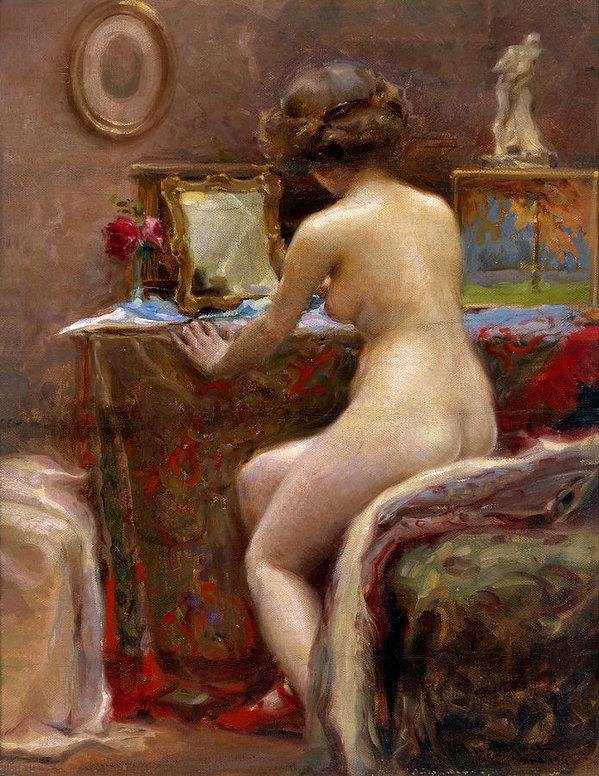
The painting shows a nude woman beside a dressing table, seen from behind as she leans toward the mirror and arranges her hair. Her figure occupies the center of the composition and becomes the focal point of a carefully arranged domestic interior. In front of her stands a rectangular mirror with a gilt frame; gathered around it are a bouquet of red and pink flowers, patterned fabrics, a small ornamental sculpture and a framed picture. The reddish-brown wall envelops the scene, while the upholstered seat and floral cloths extend the decorative richness to the lower part of the painting. The body, hair and furniture create an intimate relationship between the human presence and the objects surrounding it.
The title Before the Mirror places the scene at a private moment of personal grooming and attention to appearance. It is not a public action or a complex narrative episode, but an everyday pause focused on caring for the body and gazing into the mirror. Within the Western visual tradition, this object also introduces a dimension of self-observation: it connects the visible body with the image formed in front of it. The work thus turns a domestic activity into a particularly intimate pictorial subject, in which the private space takes on the importance of a stage.
The mirror gives the scene its visual structure. Although the figure is shown mainly from behind, her proximity to the glass draws attention to the relationship between the body, appearance, and the gaze. The curve of her back and the tilt of her torso convey concentration, while her hair, swept up, accentuates the figure’s verticality. The flowers and patterned fabrics add a sensory, ornamental dimension; their colors and patterns make the act of grooming seem part of a world of textures, adornments, and personal care. The small sculpture and the painting in the background add depth to the interior and reinforce an atmosphere shaped around contemplation and self-presentation.
Formally, the composition is organized around a vertical structure dominated by the body, balanced by the horizontal lines of the dressing table, frames, and furniture. The back forms a diagonal curve that leads the eye from the shoulders toward the legs, while the objects in the background create successive planes and slow the viewer’s reading of the scene. Reddish browns and golden ochres establish a warm foundation, punctuated by the reds of the flowers, dark greens, muted blues, and the cream tones of the skin. The mirror concentrates an area of light and acts as a counterpoint to the dense surfaces of the fabrics. This alternation between decorated areas and more open expanses of the body allows the figure to remain the focal point without being isolated from her surroundings.
In the context of Vlaho Bukovac’s work, the painting can be appreciated for the richness of its figurative and ornamental scene, while staying close to what its visual composition directly offers. Its appeal lies in the way a simple gesture—dressing before the mirror—takes on a sense of presence through the enveloping arrangement of the furniture, fabrics, and objects. The painting does not separate the figure from the interior; it integrates her into a network of reflections, colours, and surfaces that turns intimacy into a silent spectacle. It is especially worth following the path from the hair to the mirror, from the mirror to the flowers, and from the flowers to the fabrics; in this circuit, the figure and her surroundings form a single visual meditation on appearance, self-care, and self-image.
Have questions about our oil painting reproductions? See our frequently asked questions.