
Description
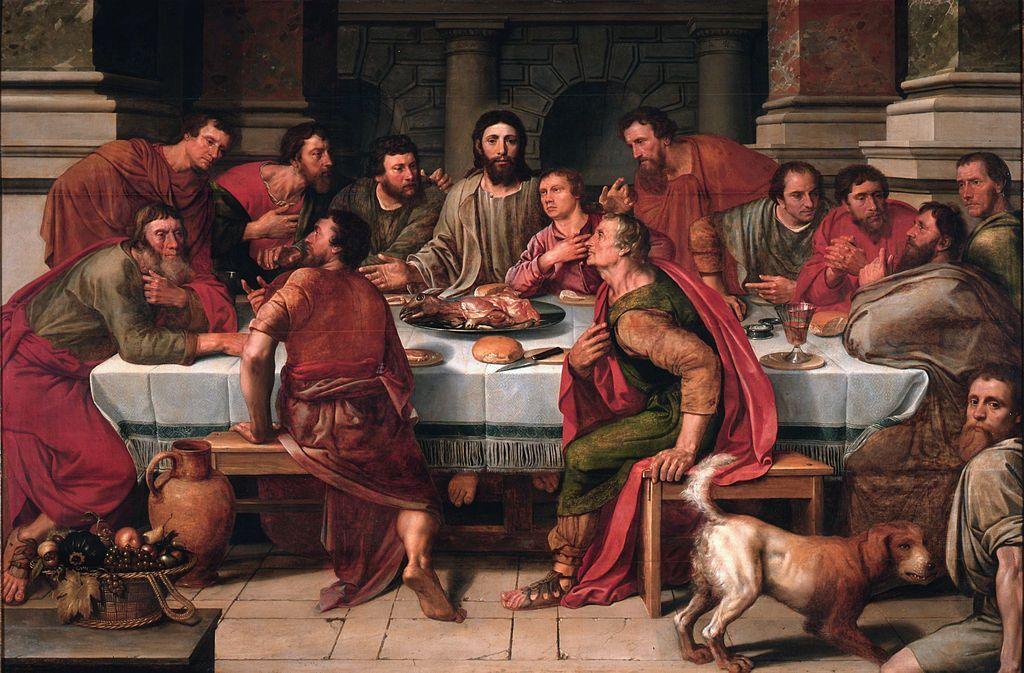
The scene shows a spacious interior where numerous figures gather around a long table draped with a white cloth and set with plates, loaves, food and vessels. The central figure, dark-haired and bearded, draws much of the visual attention. He is surrounded by people who talk, turn their bodies or raise their hands in various gestures, creating a web of glances and movements that crosses the entire composition. The horizontal breadth allows us to see both the core of the gathering and the lateral groups, where each person seems to take part in a conversation or react to what is happening at the center.
The space is defined by columns, stone surfaces and a floor made of large pale slabs. These architectural elements add depth and place the gathering in a solemn interior. The table functions as a structural axis: its line guides the eye from one end to the other, while the light cloth provides contrast with the darker tones of the garments and the shadows. The food and vessels break the uniformity of the white surface and add small points of interest in the central area and the foreground.
The palette is built from dark reds, browns, ochres, muted greens, creamy whites and stone grays. Light concentrates especially on the central area and on some faces, leaving parts of the setting in a warm penumbra. This contrast organizes how the image is read without completely isolating any group: the figures at the extremes remain visible, though with a presence more subordinate to the central core. The result has a restrained, dramatic character, based more on the interaction of the figures than on a single gesture or a clearly defined action.
In the foreground several details balance the abundance of human figures. In the lower left a basket with fruit and vegetables and a pitcher can be distinguished; on the right, a dog stands beside the gathering. These elements introduce variety of shapes, scales and textures. The basket gathers rounded volumes and earthy colors, while the animal provides a simpler, more dynamic silhouette on the pale floor. They are secondary details, but they help extend the visual attention beyond the table.
The arrangement of the figures avoids a static reading. Some sit, others lean toward their companions and several stand, forming staggered groups that give rhythm to the pictorial surface. The folds of the garments, the profiles and the gestures help to differentiate the figures without breaking the unity of the whole. In this painting by Willem Adriaensz Key, the eye constantly shifts between the illuminated center, the lateral faces, the objects on the table and the small details in the foreground. The scene can be seen first as a collective gathering and then as a succession of individual relationships.
The central figure appears to establish a point of stability, while the groups around him introduce conversation, expectation and a certain contained tension. The light cloth separates visually those around the table, but it also unites them within a single structure. The dog, the basket and the pitcher visually remind us that the event takes place in an inhabited space, not an abstract stage. Without asserting a specific meaning for each element, the composition invites reflection on the relationship between the ceremonial and the everyday, between the focused attention at the center and the activity that continues at the margins. Each look or gesture seems to open a small scene within the larger scene.
Pay particular attention to how the central light is reflected on the faces, the cloth and some objects on the table before traveling to the lateral groups and returning to the dog in the foreground.
Do you have questions about our oil-painting reproductions? See our frequently asked questions.