

Description
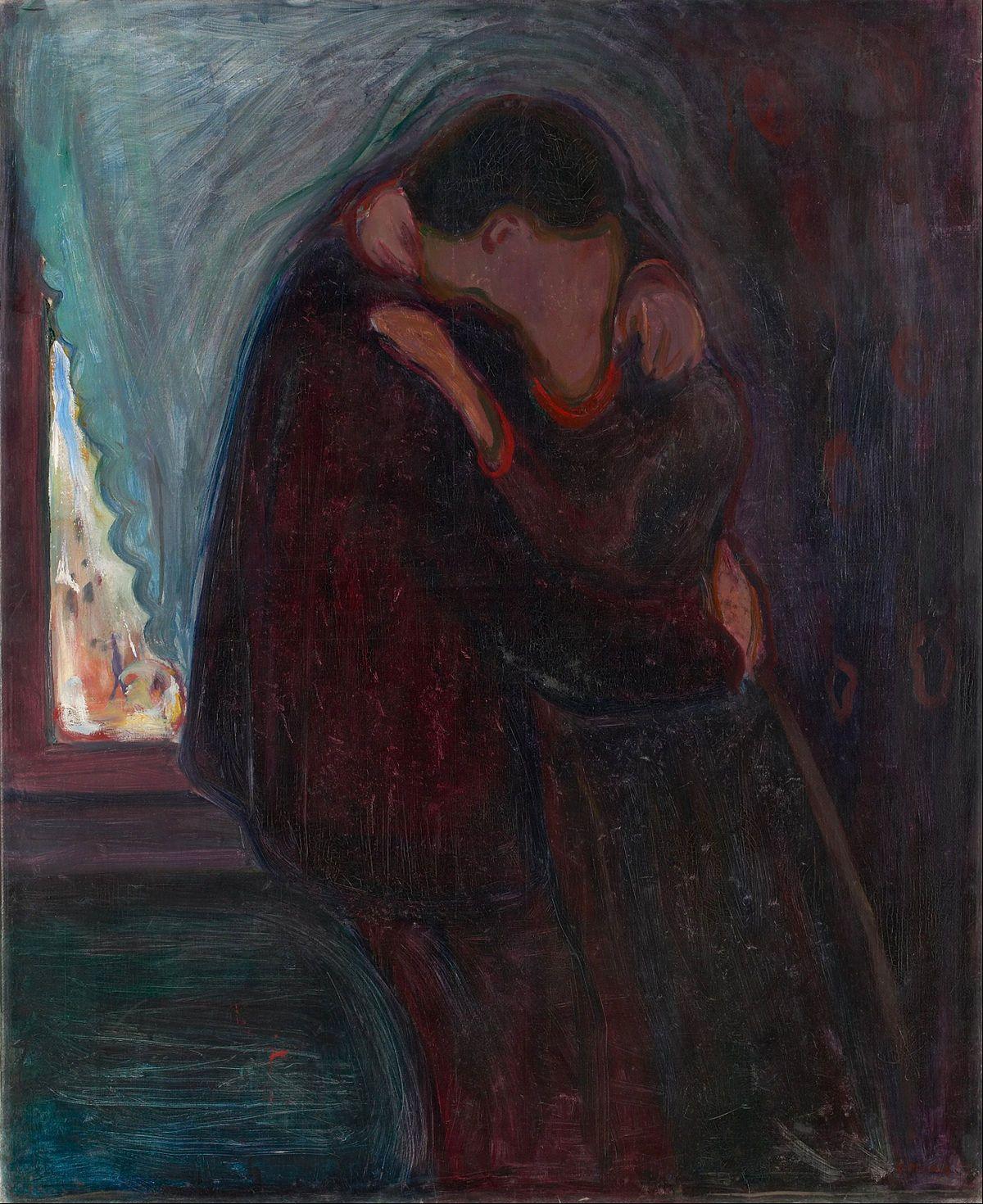
The painting depicts an embracing couple in a dark interior, focused on the closeness of their bodies and faces. One figure occupies the upper central area, with part of the face visible, while the other is seen from behind, with dark hair and a silhouette extending across the center and foreground. An arm encircles the upper part of the couple, making their embrace the scene’s focal point. On the left, a narrow opening lets in a strip of pale blue light, just enough to distinguish the interior from the outside. The rest of the setting is formed by vertical surfaces, shadowy planes, and a low band suggesting the floor or baseboard.
The Kiss turns an intimate gesture into the work’s central subject. The couple is not part of a social scene or an anecdotal narrative; they are isolated within an enclosed space, as if all attention has been concentrated on this moment of union. The kiss is a motif widely associated with intimacy, desire, and the bond between two people. In Edvard Munch’s artistic world, human relationships often take on a psychological intensity that goes beyond literal storytelling. Here, the embrace becomes a condensed emotional experience, marked by closeness and the partial disappearance of individual features.
The merging of the two bodies is the composition’s most powerful symbolic device. Their contours draw so close that it becomes difficult to distinguish one figure completely from the other, and this ambiguity creates an image of physical and emotional union. The dark interior reinforces a sense of isolation and inwardness, while the luminous opening introduces a tension between intimate refuge and the outside world. Light does not dominate the scene; it serves as a lateral counterpoint that makes the dark masses feel denser and directs the eye toward the face and the shared gesture. The curves and diagonals of the brushstrokes envelop the couple and lend a perceptible vibration to the stillness of the embrace.
Formally, the work is organized as a closed, vertical composition, dominated by a large diagonal mass descending from the central head toward the lower area. The visible face acts as a focal point through its position and contrast with the black, brown, and burgundy tones surrounding it. The figure seen from behind occupies much of the space, placing the viewer close to the encounter, almost at bodily proximity. The muted colors—blue-green, gray, dark red, and ochre—create subdued lighting, without clearly separating all the planes. This reduction of detail encourages an overall perception: first, the embrace is recognized, and then it becomes apparent how the bodies, architecture, and brushwork form a single emotional field.
The scene is consistent with traits widely associated with Edvard Munch: psychological intensity, expressive simplification of figures, a somber palette, and enveloping forms capable of conveying emotion. Rather than depicting a domestic interior precisely, the space functions as an extension of the couple’s emotional state. The power of The Kiss lies precisely in this transformation: a familiar gesture becomes an image of merging, silence, and emotional concentration. Far from opening up the scene completely, the small entrance of light heightens the sense of confinement; around it, the dark bodies seem to erase their boundaries, making the embrace the painting’s true space.
Have questions about our oil painting reproductions? See our frequently asked questions.