

Description
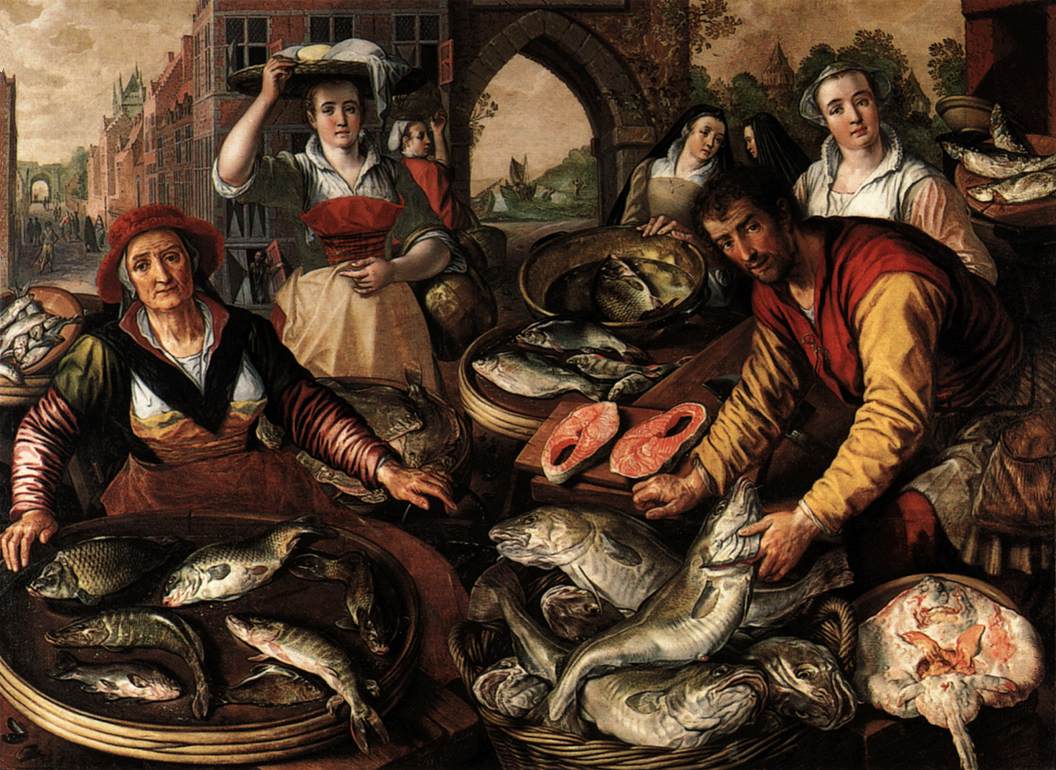
The painting depicts a busy fish market embodying the element of Water within the allegorical cycle of The Four Elements. In the foreground, a woman wearing a red headdress reaches out beside a large basket brimming with fish, while another vendor carries a load on her head. On the right, a man in a yellow shirt handles a large fish; trays, slanted boards, baskets and pieces of cut fish are piled around him. Several women complete the market activity beneath a stone arch, on an urban street that opens out towards the water and a distant boat.
The work transforms an everyday scene of trade into a thematic representation of aquatic abundance. The tradition of the four elements regards earth, water, air and fire as the fundamental principles of nature, and Water is usually identified through sea creatures, coastal produce, ships and riverside landscapes. Here, these attributes are woven into everyday life: the element is not presented as an isolated figure, but as a tangible abundance that passes from the waters to the market and from there into the experience of vendors and buyers. The scene thus retains a dual identity, both as a genre scene and as an accessible allegory.
The whole fish, fillets, trays and shellfish gathered in the containers serve as signs of natural diversity and prosperity. Their tangible presence brings the allegory closer to the senses: one can imagine the weight of the catch, the texture of the scales, the products’ implied dampness and the work involved in offering them for sale. The arch marks a meaningful transition between the two worlds. Through its opening, the water, shore and small boat extend the market back towards its maritime or riverside source. The bustle of human activity is thus connected to a broader horizon, where commerce forms part of a natural cycle.
The horizontal composition is densely populated, with the visual weight concentrated in the lower section. The baskets and fish project toward the viewer, creating a succession of round, elongated, and angular forms that organizes the foreground as a still life integrated into the scene. The figures are arranged in a middle band, their gestures and postures guiding the eye from left to right toward the man holding the fish. Behind them, the arch functions as an architectural window: its stone mass frames the landscape and adds depth. Browns, ochres, reds, and creams create warm lighting, while muted green and bluish-gray tones give the background a more open, distant feel.
This combination of material detail, human activity, and narrative landscape connects the work with a widely recognized feature of Joachim Beuckelaer’s art: his scenes of markets, kitchens, and food commerce, in which the products take center stage while remaining rooted in everyday spaces. In The Four Elements: Water, the accumulation in the foreground is not merely descriptive; it creates a visual experience of abundance, set against the openness of the arch. Notice how each fish and each vessel draws the eye individually, while the composition as a whole ultimately leads toward the water: the domestic, the commercial, and the natural are united in a single image.
Have questions about our oil painting reproductions? See our frequently asked questions.