

Description
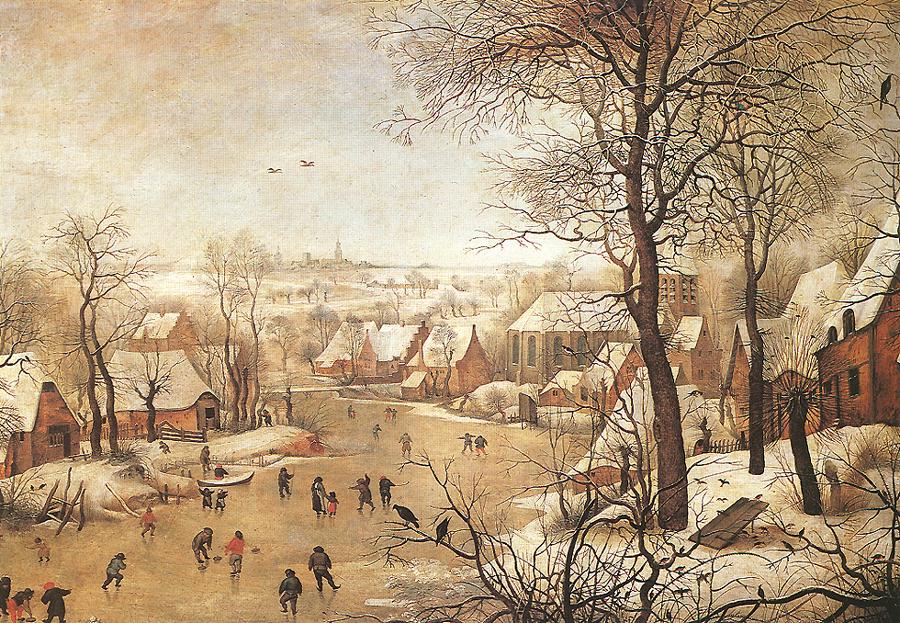
The painting depicts a Flemish winter landscape in which a snow-covered village stretches into the distance while numerous figures gather on a broad expanse of ice. Some people skate, others walk or lean forward as they make their way, and several red, blue, and dark garments add small touches of color to the foreground. Houses with sloping roofs cluster along the valley, accompanied by taller buildings and a pointed structure silhouetted against the horizon. Large bare trees frame the scene from the right and along the lower edges, while birds cross the sky or perch among the branches. The title introduces the motif of a bird trap into this lively community scene, linking human activity with the natural life of the surroundings.
In Winter Landscape with a Bird Trap, Pieter Brueghel the Younger turns a winter’s day into a sweeping visual account of rural customs. The village is more than a simple architectural backdrop: it is the setting for a community whose inhabitants share the ice as a place to travel, gather, and enjoy themselves. The scene belongs to a Flemish painting tradition attentive to everyday gestures and to the relationship between human settlements and the landscape. The reference to the bird trap introduces a modest action within this collective panorama and connects village social life with the observation of the countryside.
The figures on the ice evoke the sociability and everyday activities of a community during the cold season. Their small size does not make them insignificant; on the contrary, the multitude of gestures and movements turns the landscape into an inhabited, ever-changing scene. The birds provide a light, vertical counterpoint to the horizontal expanse of ice and engage with the titular motif of capture. The bare trees, snow, and clustered architecture reinforce a sense of winter as something lived through, not merely observed: nature imposes its conditions, but also provides a setting for communal life. The distance between the small figures and the expansive surroundings balances human activity with the vastness of the landscape.
The composition is arranged through a deep succession of planes. The ice fills the foreground and draws the eye toward the village, while the larger trees act as side wings framing the central space. The contrast between the dark branches and the light snow lends rhythm to the edges of the painting; at the center, the numerous figures form a network of points, diagonals, and gestures that keeps the visual field lively. The ochres, beiges, and browns of the ground and buildings blend with the blue-gray tones of the ice and air, punctuated by flashes of red and blue in the clothing. The diffused light unifies the distances without imposing a single dramatic focal point.
The work is associated with the tradition of Pieter Brueghel the Younger, evident here in the meticulous attention to everyday life, the abundance of small figures, and the creation of a panoramic winter landscape through villages, trees, and communal activities. Its appeal lies not only in the picturesque motif of ice skating, but also in the way each scale contributes to a unified composition: people bring the ice to life, the village extends the communal life, and the birds connect sky and ground. It is worth following the painting from the gestures in the foreground to the distant houses, then returning to the branches that frame it; in this movement, the bird trap becomes part of a broader vision of community, nature, and the season.
Have questions about our oil painting reproductions? See our frequently asked questions.