

Description
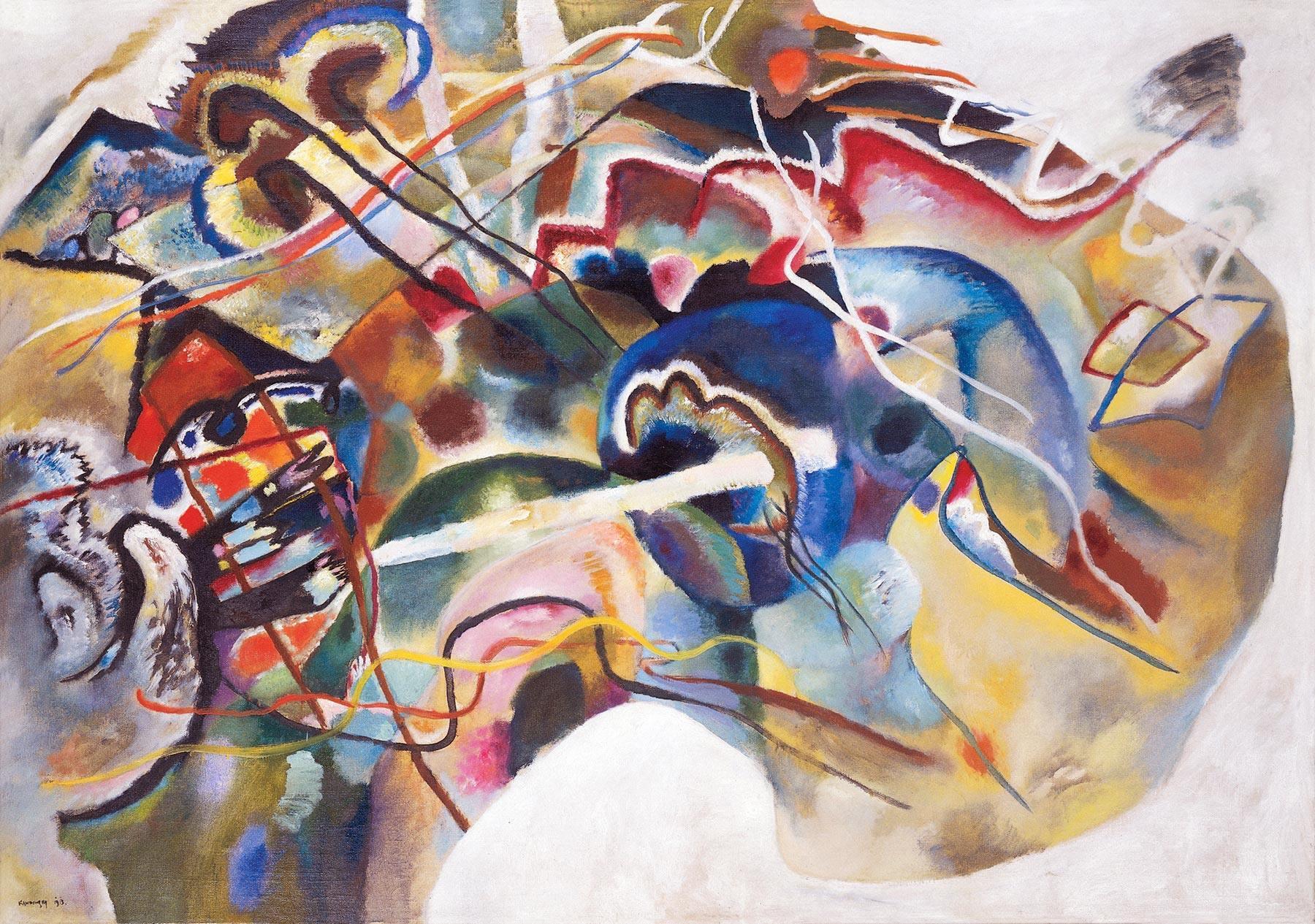
The painting presents an abstract composition of great chromatic intensity, arranged against a light background that functions as a border and a space of separation. Large blue fields occupy the center and center-right, intertwined with masses of green, ochre and grayish green. Reds, oranges and yellows gather on the left and in the lower area, while black, white, blue and red lines cross the surface in curves, diagonals and undulating paths. Arched forms, angular structures, gestural marks and a blue, white and yellow oval stand out against the central blue mass. The composition does not depict figures, objects or a recognizable landscape: its scene is built through relationships of color, line, rhythm and open space.
As an abstract work, Painting with White Border shifts interest away from figurative storytelling and toward the visual autonomy of its elements. There is no historical or religious episode to decipher, but rather a dynamic arrangement in which each form participates in a field of tensions. The title focuses attention on the white and cream areas that surround and separate the groups of colors. This border does not serve merely as a passive margin; it sustains the composition’s breathing space and allows the areas of color to appear as active units within a shared space. In this context, the work can be broadly related to Wassily Kandinsky’s explorations of the independent expressiveness of color, line and abstract forms.
The chromatic contrasts create a sense of energy and expansion. The blues and greens at the center form a broad, enveloping visual mass, while the reds, oranges, and yellows introduce warmer pulses on the left and along the bottom. Curving lines connect distant areas, and the black diagonals add structural tension that keeps the patches from appearing static. The interplay of biomorphic forms and angular geometry creates a balance between spontaneity and order: some surfaces suggest growth, fluidity, or movement, while others interrupt that flow with edges, intersections, and precise directions.
The visual structure is built on layering. The fields of color overlap, so the eye does not settle on a single center but moves among layers and pathways. The red line rising diagonally creates a particularly dynamic route, reinforced by the blue line that crosses several fields and the white strokes that meander over the masses of color. The result is a dense but open surface: the light background reappears between the forms and in the lower area, creating pauses that intensify the contrast. The visible brushstrokes and irregular edges retain a gestural quality, while the straight segments and ring-shaped forms introduce measures and repetitions.
In relation to Wassily Kandinsky’s abstract language, the work presents color as a compositional force capable of establishing rhythms without relying on recognizable objects. Its interest lies in how a network of lines, blocks, and patches transforms the white border into an active space, from which the painting continually expands and reorganizes itself. It is worth observing the transition between the central blue and the warm colors on the left: much of the visual tension is concentrated there, while the overlapping lines guide the eye toward the edges and back to the center. The experience of the work arises precisely from this movement between structure and gesture, density and pause, intense color and open background.
Have questions about our oil painting reproductions? See our frequently asked questions.