

Description
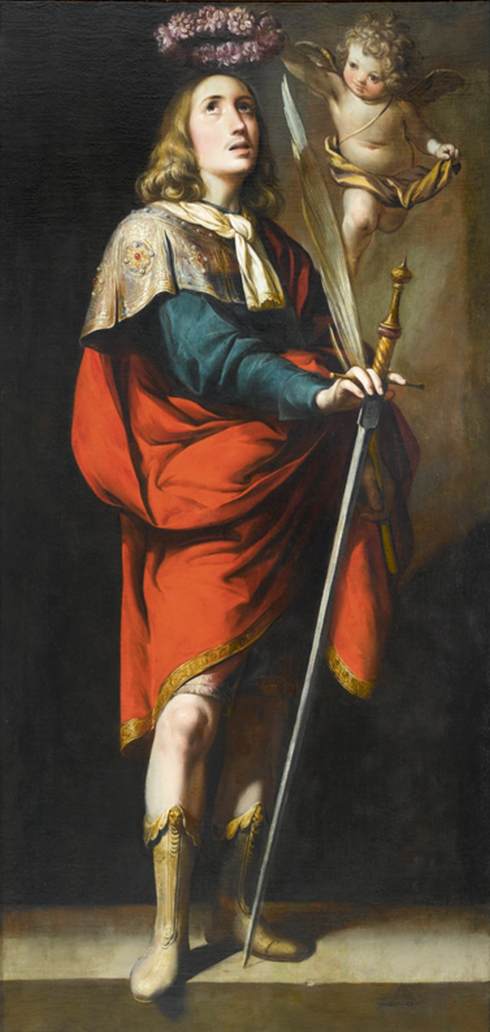
The painting presents Saint Acisclus as a monumental, armed figure standing upright at the center of the composition. The saint is shown full-length, his gaze raised, a long sword angled toward the ground, and ornate armor projecting over his left shoulder. A greenish-blue tunic is partly covered by ample red drapery, whose gold-edged folds extend to either side and visually enhance his presence. A floral garland rests on his head, while in the upper-right area, a winged childlike figure hovers behind him, introducing a celestial dimension to the scene. The plain, dark background opens only onto a narrow strip of light-colored ground, where the figures cast their shadows.
Saint Acisclus belongs to the Christian devotional tradition associated with Córdoba, where he is venerated as a martyr. The work presents him in a heroic, triumphant mode, closer to a sacred apparition than to an everyday narrative scene. The composition does not need to depict a complex action: it focuses attention on the martyr’s dignity and his symbolic elevation toward a spiritual reward. Isolated against the dark background, the central figure thus takes on a solemn, almost theatrical presence.
The attributes shape this reading with notable clarity. The sword, set on a diagonal, offers a tangible reference to combat and sacrifice; the armor reinforces the image of a saint prepared to face his trial. The floral garland evokes a crown of glory or martyrdom, placed on his head as a sign of spiritual recognition. Above, the winged figure establishes a link between the saint and the celestial realm, making visible a dimension of accompaniment and glorification. The intense red of the drapery adds an echo of passion and devotion, contrasting with the cool tones of the tunic to visually distinguish the body’s dramatic energy.
The vertical structure concentrates all the weight in the central figure, which serves as a stable axis against the diagonal movement of the sword and the upward counterpoint of the winged figure. The red drapery breaks up the rigidity of the armor with broad, undulating folds, creating a rhythm that broadens the lower area. The dark background removes unnecessary spatial references and gives the outlines, metallic gleams, and golden accents an almost theatrical intensity. The lighting is concentrated on the figures and the main objects: the upturned face, the sword, the armor, and the light-colored folds stand out in turn, guiding the gaze from earthly matter toward the apparition above.
The work is associated with the Spanish and Cordoban Baroque painting of Antonio Del Castillo, particularly in its interest in religious imagery, firm draughtsmanship, monumental figures, and contrasts of light that heighten its dramatic solemnity. In Saint Acisclus, these elements turn devotion into an immediate visual experience: the saint occupies the space like a sacred hero, but the garland, the color red, and the winged presence shift his power toward an idea of glory. It is worth observing how the sword leads the gaze toward the ground while the childlike figure directs it back upward; between these two directions, the painting’s essential meaning takes shape, uniting martyrdom, spiritual triumph, and exaltation.
Have questions about our oil painting reproductions? See our frequently asked questions.