

Description
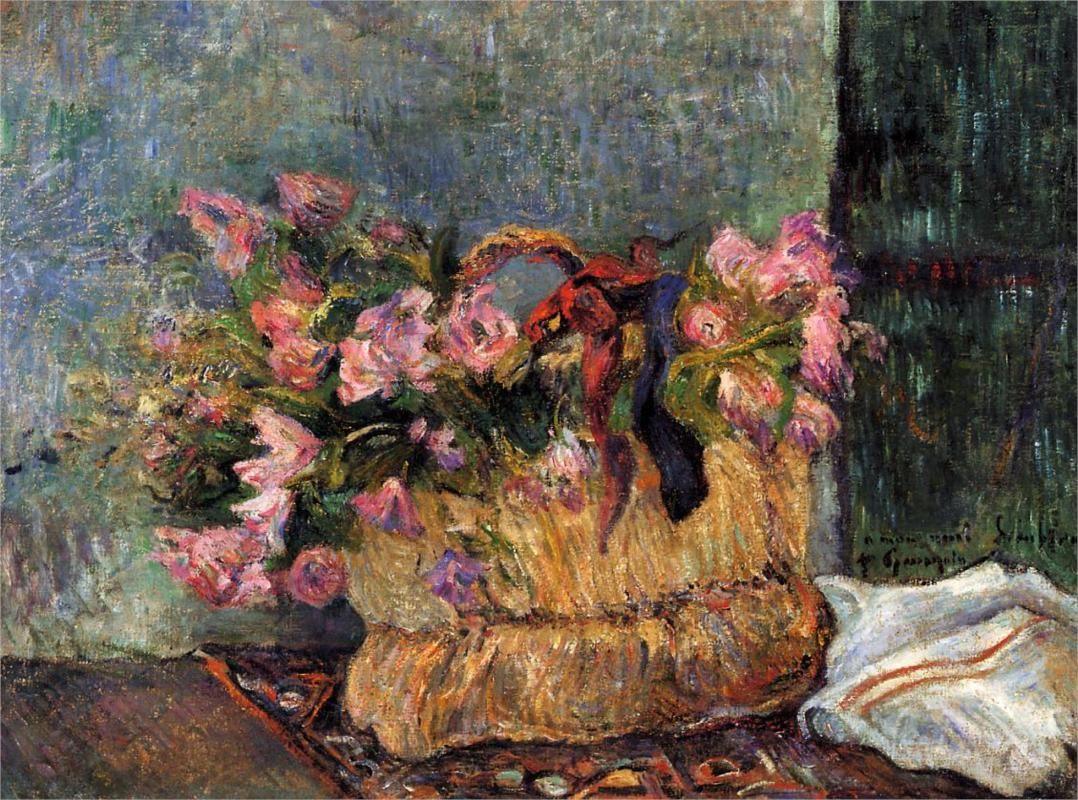
The painting depicts an interior floral still life in which an abundant bouquet rises from a woven basket in ochre and brown tones. The open and partially closed flowers form a compact mass of pinks, reds, mauves, corals, and oranges, supported by dark green foliage that spreads across the composition. The basket rests on an almost black horizontal surface, while a crumpled white and grayish cloth marked with warm brushstrokes fills the lower-right corner. Behind the arrangement, the blue-green background and a dark vertical strip create a quiet interior setting and make the bouquet’s vivid colors stand out.
As a genre, the work belongs to the floral still life: a domestic scene without a figurative narrative, built around everyday objects and their arrangement on a surface. The choice of a basket, a cloth, and a simple background directs attention to the physical presence of the flowers and to the relationships between color, texture, and volume. In this reading, Basket of Flowers does not depend on an external story; its interest lies in the transformation of a familiar subject into a rich pictorial structure, in which the domestic takes on an almost monumental force through the density of the arrangement and the concentration of the viewer’s gaze.
The bouquet may conventionally evoke beauty, vitality, and transience, though here it functions above all as a chromatic and formal core. The basket introduces a material, domestic reference that contrasts the visual roughness of the weave with the delicacy of the petals. Beside it, the light-colored cloth adds a tactile note and a luminous pause, as though the scene could also be perceived through its surfaces. The blue-green background heightens the separation between the bouquet and the space behind it, while the dark area at the side reinforces its silhouette. The symbolic reading thus emerges from the relationship between floral exuberance, a humble support, and interior stillness.
The horizontal composition keeps the visual weight concentrated in the lower center, where the basket acts as a stable base for the bouquet’s diagonal expansion. The flowers rise and spread out on both sides, creating an irregular rhythm of petals, leaves, and stems that avoids rigid symmetry. The pink and red tones catch the eye first; it then moves across the dark greens of the foliage, descends toward the ochres of the fabric, and finally encounters the white contrast of the cloth. The visible brushstrokes and patches of color in the background preserve an active surface, so the space is not rendered with illusionistic precision but through layers of color and texture. The darkness of the table and the right side further concentrates the light on the flowers.
In general, the work can be associated with Paul Gauguin’s sensibility through its expressive use of color, intense chromatic relationships, and an approach that favors decorative force and formal synthesis over meticulous naturalistic description. The subject remains recognizable, but its impact depends on how each element contributes to a compact visual unity: the basket anchors the composition, the cloth introduces contrast, and the background gives the bouquet an almost theatrical presence. When viewing it, it is worth observing how the abundance of flowers does not scatter the eye, but instead draws it to a vibrant center where material, color, and domestic quiet sustain one another.
Have questions about our oil painting reproductions? See our frequently asked questions.