

Description
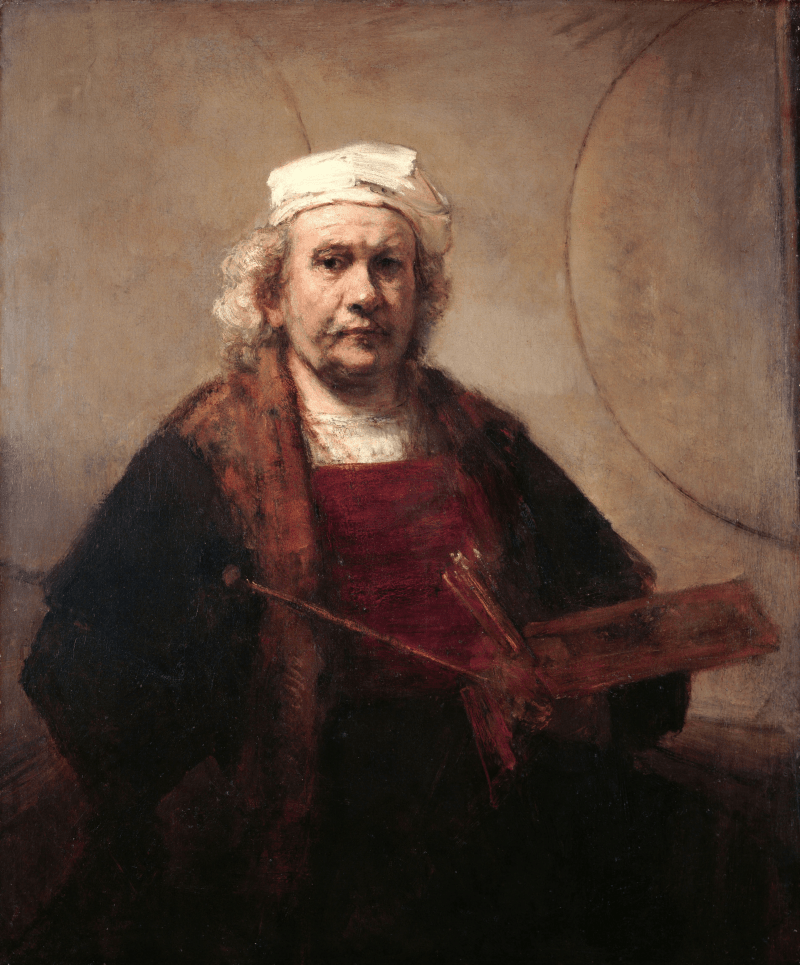
The painting shows Rembrandt seated and facing the viewer in a vertical composition that focuses attention on his presence. He wears a white cap or cloth wrapped around his head, while his light, wavy hair frames a serious, brightly illuminated face. A dark outer garment envelops his shoulders and falls toward the lower edge, contrasting with the deep red of the clothing at the front. A palette and several brushes appear before his torso, linking the figure to his profession. Two faint circles or arches are visible against the brown background, a distinctive motif that gives the work its name.
As a self-portrait, the scene belongs to a tradition in which artists record their own features and visually assert their professional identity. Rembrandt, the Dutch painter celebrated for his extensive body of self-portraits, presents himself here as a reflective and focused figure. The palette and brushes turn this personal depiction into a statement of artistic identity: the face belongs to the individual, while the tools also speak of the painter. The simplicity of the setting removes all narrative distractions and centers the viewer’s contemplation on the relationship between appearance, profession, and psychological presence.
The painting tools support the reading of the figure as a creator, not merely a model. The dark red of the palette and the clothing at the front introduces a warm, material note into a palette dominated by browns, blacks, and ochres. Set against the sitter’s physical presence, the two circles in the background provide a quiet geometric counterpoint. Their curved lines organize the space without competing with the face, visually extending the figure beyond its outline. The composition brings together personal identity, profession, and a meditation on the image of the artist.
The composition is balanced around a central axis. The face occupies the upper focal point, while the arms, palette, and brushes create diagonals that draw the eye toward the lower part of the painting. Light is concentrated on the face and upper torso, bringing these forms out of an earthy, dark background. The contrast between the lightness of the cap and the depth of the garments reinforces the vertical structure. The visible brushwork lends the surface density and humanity, while the expanse of the background allows the circles to function as a steady, geometric secondary rhythm.
The work brings together features widely associated with Rembrandt: concentrated illumination on the face, an earthy palette, a striking contrast between light and shadow, and sustained attention to the sitter’s psychological presence. Without relying on an elaborate setting, it builds its power through the figure’s closeness, the gravity of the expression, and the appearance of the tools of the trade. The eye can follow the path from the illuminated face to the hands, and from the hands to the palette; there, the painting’s central idea takes shape. The man portrayed and the painter asserting himself through his tools come together in a sober, introspective, and tactile image.
Have questions about our oil painting reproductions? See our frequently asked questions.