

Description
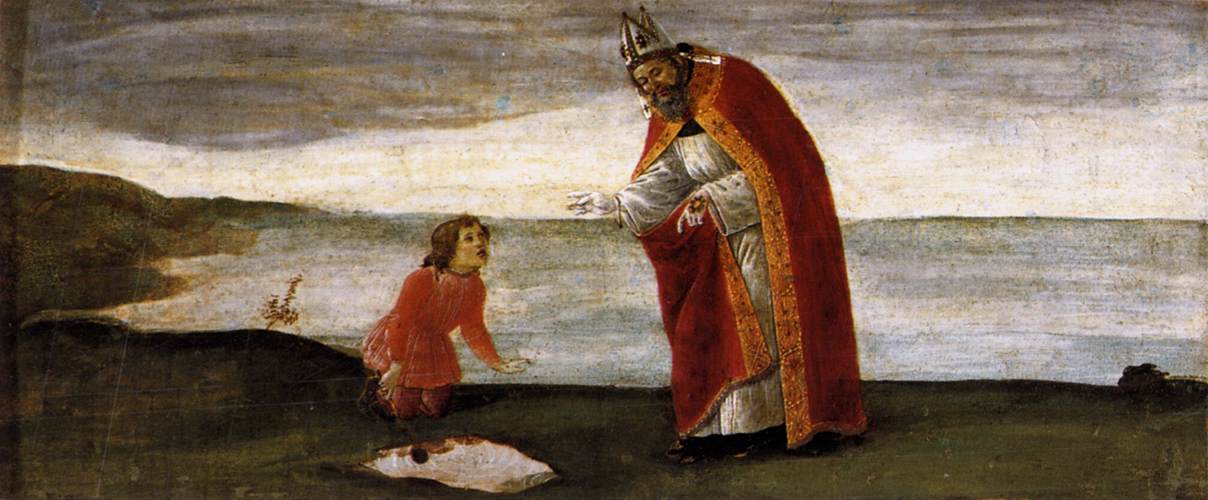
The painting shows Saint Augustine experiencing a vision, with the narrative tension focused entirely on the encounter between two figures. Standing on the right side of the center, the saint wears a red mantle with trim over a gray tunic and a pointed headdress of a ceremonial nature. He reaches out toward the kneeling child in the center-left, also dressed in red and facing him with arms outstretched. Both figures stand out against an open landscape of low hills, bands of dark terrain, and a broad sky, while an elongated, light-colored form lies in the foreground.
The scene alludes to the legend of Saint Augustine’s vision by the sea. According to the traditional account, while meditating on the mystery of the Trinity, the saint saw a child attempting to collect or carry away the water of the sea. This impossible task becomes a lesson about the limits of understanding: just as the ocean cannot be contained in a small vessel, the infinite mystery cannot be fully grasped through reason. The adult figure thus represents the theologian confronted with a revelation, while the child introduces a simple, concrete image to express a profound spiritual idea.
Saint Augustine’s outstretched gesture establishes a silent dialogue with the child’s posture and directs the viewer’s attention to this exchange between knowledge and wonder. The red garments lend the scene an air of authority and presence, while also visually connecting the two figures, as if they were both part of the same visionary episode. The open horizon broadens the scope of the lesson: the landscape is not merely a backdrop, but a space for contemplation in which humanity confronts the immeasurable. The light-colored elements in the foreground reinforce the maritime allusion without drawing attention away from the central encounter.
The horizontal composition is organized into a series of bands: the dark ground in the foreground, the hills in the middle distance, and the layered sky that occupies much of the surface. Against this linear stillness, the two figures rise, their bodies introducing a vertical axis and a diagonal of contact. The dominant scale of Saint Augustine contrasts with the child’s humble position, yet the distance between them is narrowed by the direction of their hands and gazes. Brown, dark green, and gray tones create an austere setting, interrupted by the red of the garments and the cream-colored light of certain details. The serene rhythm of the bands gives the gesture a particular intensity.
This work by Sandro Botticelli displays features consistent with his devotional sensibility: elegant drawing, stylized figures, expressive gestures, and restrained storytelling. The characters’ refined linearity coexists with a sober landscape, so the scene depends not on spectacular action but on the reflective pause that precedes understanding. It is worth observing how Saint Augustine’s hand, the child’s kneeling body, and the expanse of the horizon form a visual chain: the gesture leads to the episode, the episode leads to the mystery, and the landscape turns that idea into an experience of infinite space.
Have questions about our oil painting reproductions? See our frequently asked questions.