

Description
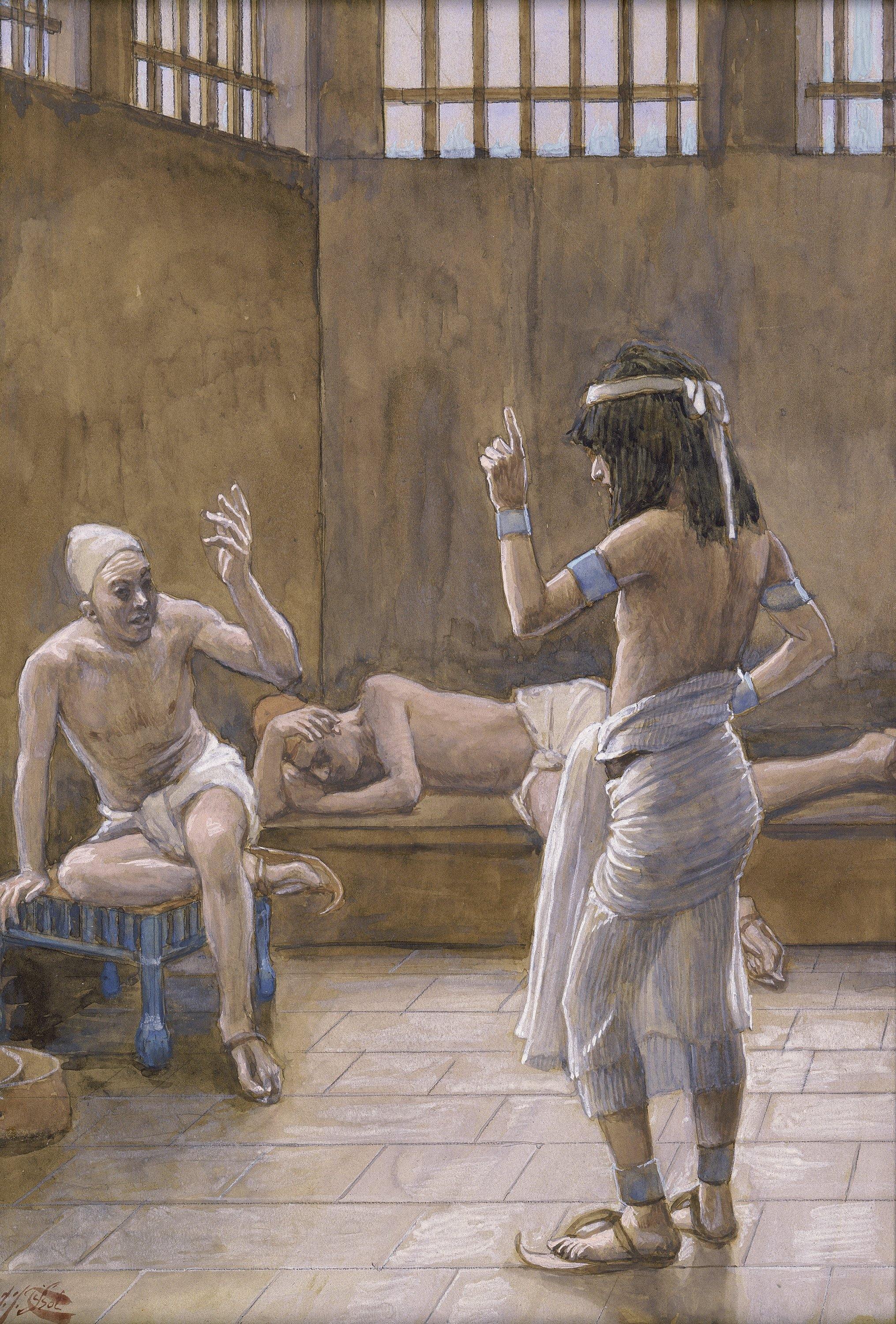
The painting depicts Joseph Interprets the Dreams of the Butler and the Baker in a spacious, austere interior dominated by three figures. On the right, Joseph occupies the foreground, seen mostly from behind and in profile, with one hand raised and his index finger extended in an explanatory gesture. Facing him, a seated figure on the left also raises a hand, while another lies horizontally on a central bench, with his head resting on one arm. White drapery, gray-blue bands and bare bodies distinguish the figures within the sober architecture, defined by ochre walls, wooden benches, a floor of rectangular stone slabs and tall windows that admit a pale light.
The scene refers to the episode in Genesis in which Joseph, imprisoned in Egypt, interprets the dreams of Pharaoh’s cupbearer and baker. Before attaining a position of authority, Joseph demonstrates a decisive ability to understand and explain what remains obscure to others. The arrangement of the figures clearly conveys this narrative situation: the two figures grouped in the left and central areas form a group seeking counsel, while Joseph occupies the position from which the conversation is led and the exchange is ordered. The prison is not merely an architectural backdrop, but the setting for a crucial moment in the protagonist’s journey.
Joseph’s upright gesture concentrates interpretive authority, making his body an axis between those listening and the space that confines them. His raised hand signals intellectual and verbal activity, contrasting with the physical vulnerability of the other figures: one remains seated, with an open hand, while the other stretches out on the bench in a posture of waiting. The high windows, divided by a geometric lattice, admit light without truly opening up the space; they thus reinforce the tension between knowledge and confinement. The white clothing lends luminosity to the figures, while the blue bands introduce rhythmic accents and visual differentiation within the stylized biblical setting.
The vertical composition is organized around the contrast between the dominant figure in the right foreground and the horizontal group formed by the benches and the reclining figure. The floor lines lead the eye toward the back, and the platforms create a succession of planes that gives depth to the interior. The palette of browns, ochres, beige, and muted grays absorbs the light and keeps the scene subdued; the white garments stand out without disrupting this austerity. The window lattice introduces a regular rhythm across the upper part of the composition, contrasting with the irregularity of the bodies and gestures. The architecture remains motionless as the narrative focuses on Joseph’s upright posture and raised hand.
The work reflects James Tissot’s turn toward the narrative depiction of biblical episodes, with close attention to space, clothing, and the clarity of the figures’ gestures. The tension does not arise from a dramatic action, but from a moment of listening and explanation sustained by the austerity of the setting. Joseph’s gesture connects the three figures, while the light from above turns the windows into a visual boundary rather than an exit. Among benches, stone slabs, and white cloths, the episode takes shape as a scene of quiet authority: interpreting a dream also means opening up a possibility within confinement.
Have questions about our oil painting reproductions? See our frequently asked questions.