

Description
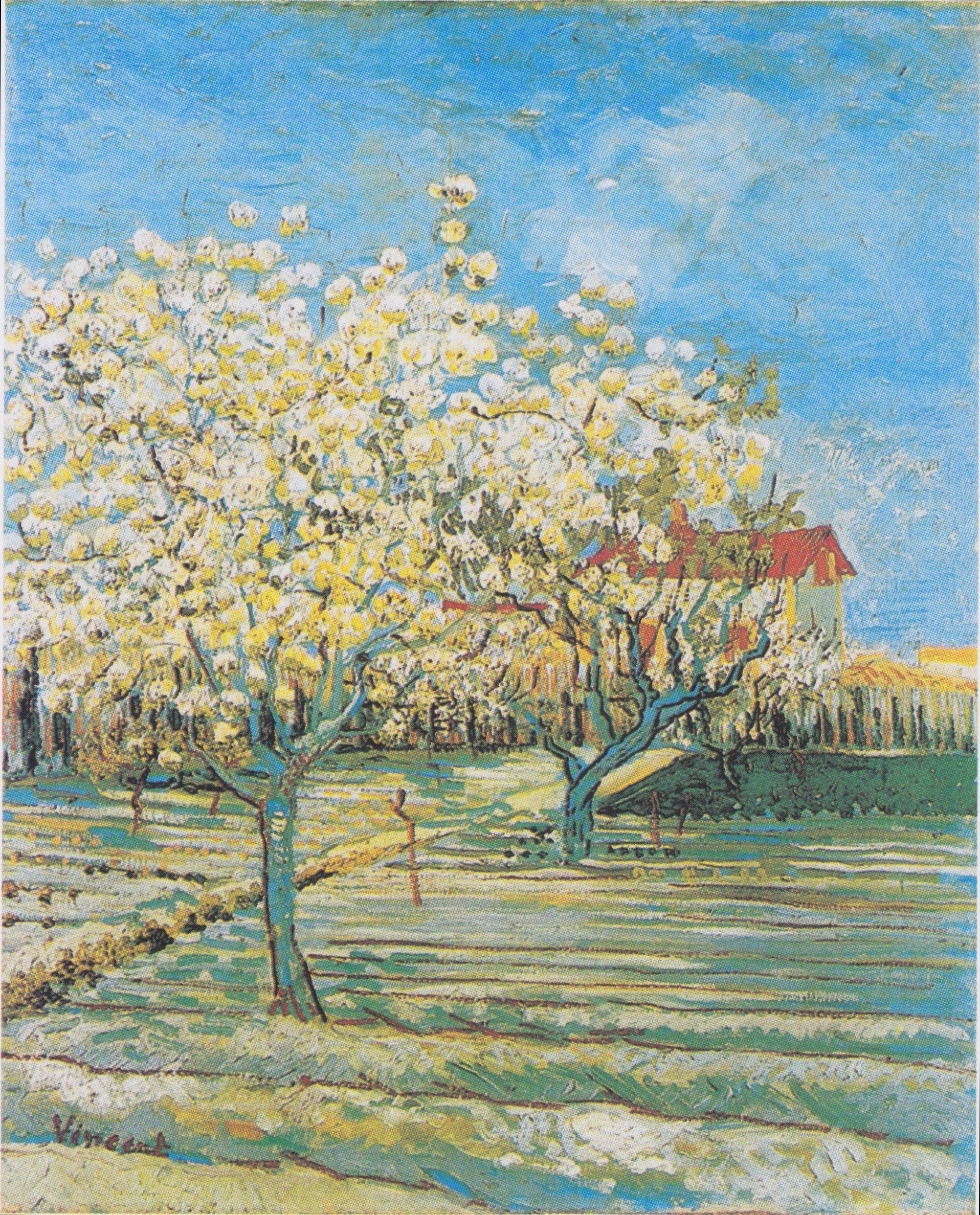
The painting shows an orchard in blossom stretching alongside open agricultural fields beneath a vast blue sky. Several trees with dark trunks and twisting branches raise their white and yellowish crowns from the foreground to the middle of the composition. On the right, a house with light-colored walls and a red roof brings a domestic presence to the landscape. Hedges, shrubs, and low vegetation surround the building, while cultivated plots extend in bands toward the horizon. The scene feels bright, springlike, and serene, though the intensity of the brushstrokes gives this calm a palpable energy.
As a rural landscape, the work focuses on a moment of natural renewal: the flowering trees herald spring, and the plowed fields connect this transformation with working the land. No historical or religious narrative structures the scene; its interest lies in the relationship between cultivated nature, domestic architecture, and open space. The house serves as a point of reference for scale and rootedness, situated between the orchard and the agricultural expanses. In this way, an everyday subject becomes a visual celebration of the seasonal cycle and the vitality running through the rural surroundings.
The white blossoms draw the eye and can be read as an image of renewal, lightness, and vitality. In contrast, the dark trunks and sinuously drawn branches retain a structural strength that keeps the landscape from becoming merely delicate. The bands of cultivated land emphasize the relationship between nature and human labor: they are ordered forms that contrast with the irregular growth of the trees. The red roof adds a warm, domestic accent, a small assertion of human presence amid the countryside. The composition balances the wild, the cultivated, and the habitable.
Formally, the composition is structured through a succession of planes that guides the eye from the bands in the foreground to the low horizon line. The green, ochre, blue, and pale bands create a horizontal and diagonal rhythm, while the trunks and branches introduce vertical and curved lines that disrupt this order. The visual weight is concentrated in the left and central areas, where the flowering crowns form a vibrant mass; the red house balances this volume on the right. Above it all, the open sky heightens the sense of spaciousness. The visible brushstrokes and chromatic contrasts make the surface seem to move with the light.
In relation to Vincent van Gogh, the work displays widely recognizable features of his artistic language: intense color, expressive brushwork, and a construction of the landscape based on linear rhythms and contrasts in texture. The orchard is not viewed as an immobile scene, but as a dynamic experience in which every band of field, every branch, and every cloud participates in the same vibration. It is worth observing how the flowers first draw the eye, and how the furrows then lead it back toward the house and the horizon. Along this visual journey, the springtime subject and the pictorial structure merge, transforming a peaceful landscape into an image of renewing energy.
Have questions about our oil painting reproductions? See our frequently asked questions.