

Description
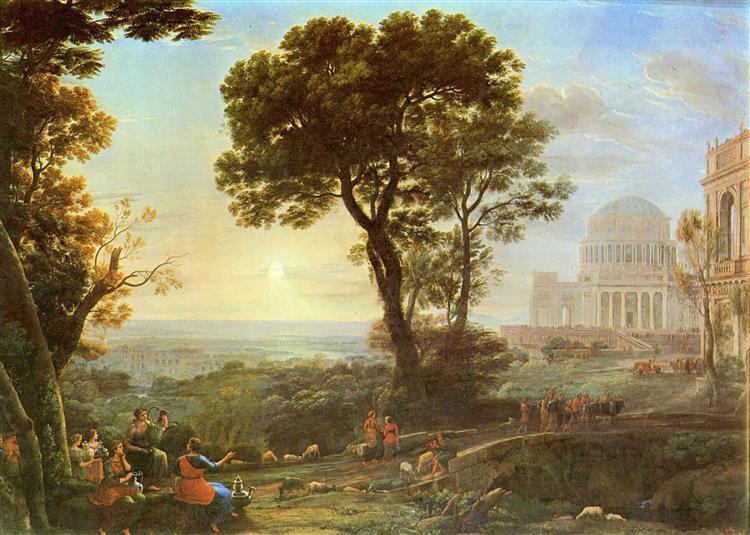
The painting presents an idealized vision of Delphi at the moment when a sacrificial procession moves through an open, luminous landscape. In the foreground, several figures sit, bend down or make their way along an ochre-colored path that extends toward the architecture in the background. The reddish, green and light colors of their garments stand out amid the vegetation. Small animals and a vessel appear nearby, while other, more prominent animals gather beside the monumental building. Large trees with leafy canopies dominate the center and edges of the composition; on the right, a classical structure with a dome, a windowed drum and a columned portico serves as the visual destination of the journey.
The episode is set within the religious imagination of ancient Greece. Delphi was one of its great sanctuaries, dedicated especially to Apollo, and its ceremonies incorporated processions, offerings and sacrifices. Here, the procession is not presented as a dramatic scene, but as part of a serene landscape order: people move among trees and hills, with a blue expanse opening up the view toward the horizon. The sacred architecture gives the scene its structure and turns the path into a passage between the natural world and the ceremonial space.
The animals near the figures reinforce the ritual interpretation of the scene, while the small vessel in the foreground introduces a tangible detail of preparation and offering. The path visually connects the scattered groups and leads them toward the sanctuary, so that the procession also becomes a structure through which to read the scene. The warm light softens the religious character of the episode and incorporates it into a contemplative vision of antiquity. The dome, columns and classical façades lend a sense of permanence, in contrast with the figures’ smaller scale and unhurried movement.
The composition is built around a balance between vertical masses and horizontal depth. The large central tree serves as an axis and a natural screen, its raised branches standing out against the sky and guiding the eye toward the middle ground. The leafy trees on the left frame the landscape, while the architecture concentrates visual weight on the right. Between these two extremes, the terrain, the water or blue-tinted plain, and the hills form successive planes that extend the space. The palette of dark greens, golden ochres, soft blues, and orange-reds creates a gradual transition from the warm foreground to the luminous horizon.
The work is associated with a widely recognized hallmark of Claude Lorrain: the creation of idealized landscapes with classical subjects, using golden light, atmospheric depth, monumental trees, ancient architecture, and small figures that animate the space. In this painting, the ritual subject is subordinated to a broader visual experience, in which human passage, nature, and the sanctuary all share the same rhythm. Observe how the path leads the eye from the vessel and the groups in the foreground to the dome, and how the light transforms this route into a serene image of Antiquity.
Have questions about our oil painting reproductions? See our frequently asked questions.