

Description
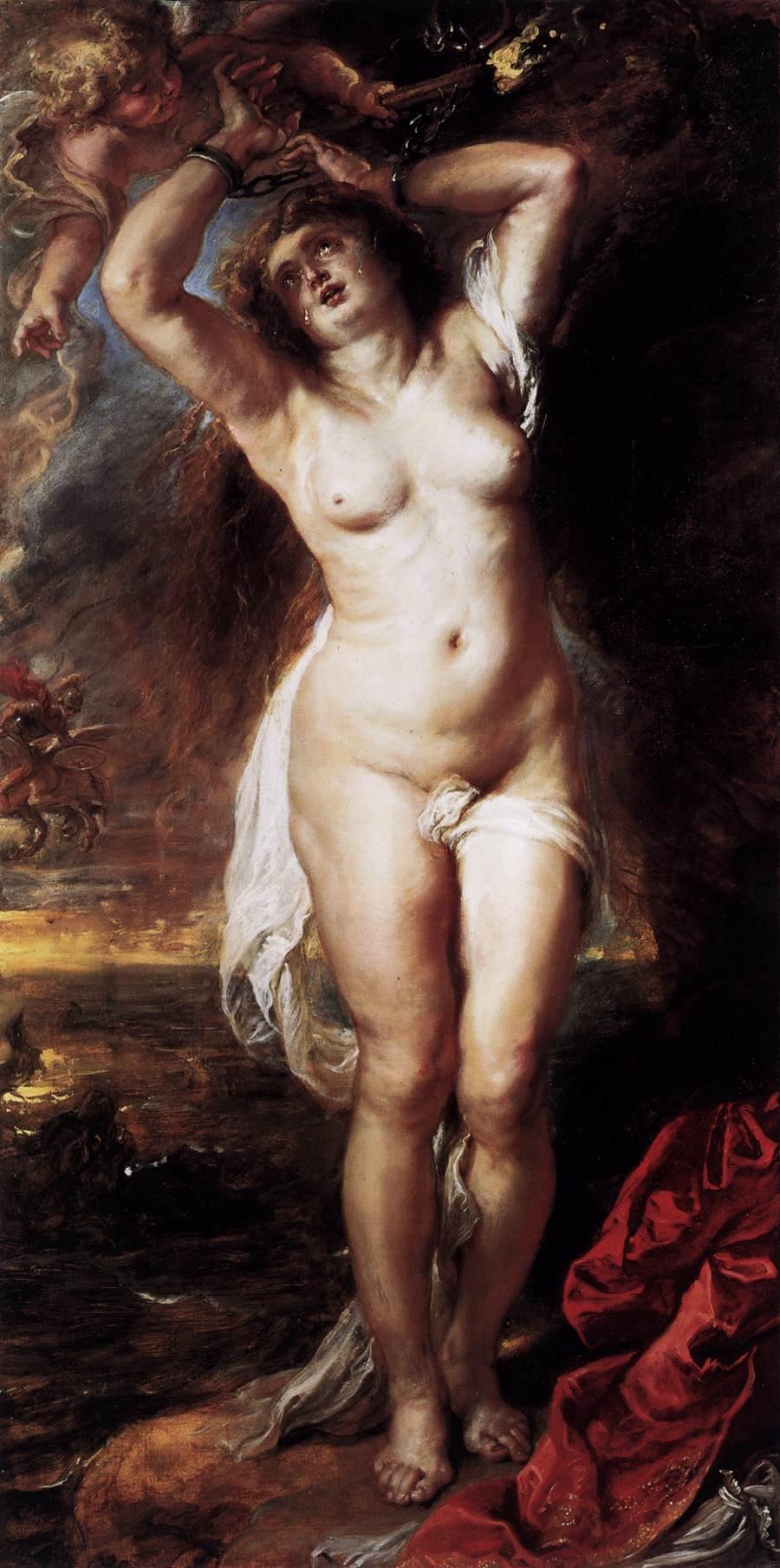
The painting shows Andromeda at the moment of her captivity, standing upright at the center of a shadowy, rugged landscape. The nude figure, intensely illuminated, raises her arms above her head, where the dark bonds holding her in place are gathered. A white cloth partly covers her hips and falls beside her leg, while another piece of fabric follows the movement of her body. In the lower right corner, a large red cloth spreads across the ground as a dramatic accent. A secondary human figure appears in the upper left, among shadows and rocks, heightening the narrative tension of the scene.
In Greco-Roman mythology, Andromeda was the daughter of Cepheus and Cassiopeia. Her mother's arrogance provoked divine wrath and exposed the kingdom to the threat of a sea monster; as a sacrifice, the young woman was chained to a rock. Perseus found her in this situation and rescued her, turning the episode into a tale of extreme danger, heroic intervention, and liberation. The scene focuses on the moment of greatest vulnerability, before her salvation, making the princess's body the emotional center of the composition.
The raised bonds encapsulate the idea of captivity and sacrifice while also organizing the entire scene visually: from her wrists, the lines rise into the darkness, prolonging the figure's helplessness. The rock and enclosed landscape intensify her isolation, while the shadows evoke the nearness of a threat that remains outside the illuminated center. The secondary figure introduces the tension of a rescue at the upper edge without taking attention away from Andromeda. The white cloth emphasizes the vulnerability of her flesh, while the heavy, theatrical red fabric adds a note of danger, passion, and restrained violence.
The vertical structure draws the eye to the central figure, whose elongated pose establishes a pronounced upward direction. Her arms form a diagonal leading toward the upper-left corner, while the crimson fabric creates a visual counterweight in the lower-right. The contrast between the warm skin, ivory whites, and black, brown, and blue-gray background shapes the figure with almost theatrical lighting. The dark masses of the ground and rock frame the body like a natural stage, while the rumpled surfaces of the fabrics add tactile rhythm against the protagonist’s taut stillness.
This work by Peter Paul Rubens displays features widely associated with the Baroque: dynamic composition, powerful anatomy, warm coloring, and theatrical lighting that makes the figure vibrate against the dark background. The drama depends not only on the mythological narrative, but also on the way light, diagonals, fabrics, and shadows turn captivity into an immediate visual experience. As you look at it, follow the path from the chained hands to the red fabric in the foreground: this journey brings vulnerability, threat, and the promise of heroic rescue together in a single scene of great intensity.
Have questions about our oil painting reproductions? See our frequently asked questions.