

Description
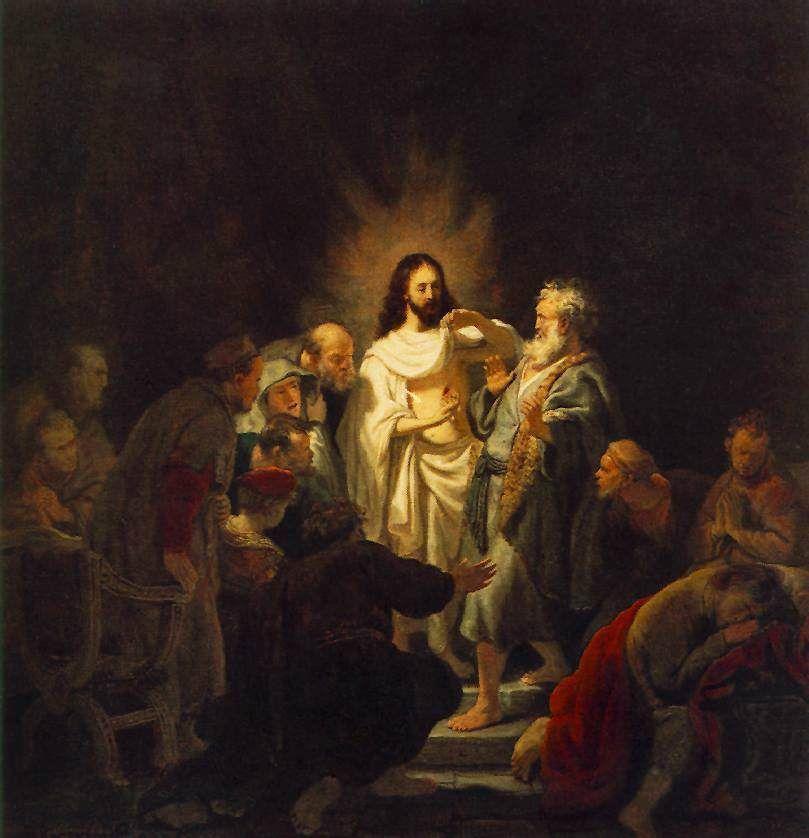
The Incredulity of Thomas presents a revelation scene concentrated in a dark interior. Christ stands at the center of the composition on the steps, wearing a light robe, with a circular glow setting his head apart against the gloom. A large group of figures gathers around him: some watch from the sides, others lean forward or approach, and a figure in the foreground extends both arms toward the center. At the lower right edge, another figure recoils among reddish fabrics. The stone architecture and the ascending arrangement of the steps organize the encounter as a physical and spiritual approach toward Christ.
The episode belongs to the Gospel account following the Resurrection. Thomas, one of Jesus’s disciples, doubts the testimony of the others and expresses the need to see and touch Christ’s wounds in order to believe fully. When Christ appears before his disciples and shows them those wounds, doubt turns into recognition. The painting condenses this transition into a silent, expectant gathering: Thomas’s experience becomes one shared by the entire community assembled around the sacred figure.
The halo and the illumination surrounding Christ establish a clear visual hierarchy: the light identifies the sacred center and draws the group’s attention. The inclination of the bodies and the outstretched arms form a chain of gestures leading toward him, while the contrast between illuminated heads and faces submerged in shadow suggests differing degrees of closeness and understanding. The steps take on symbolic significance within the composition, transforming the space into a progression toward revelation. The red fabric in the foreground introduces an intense, earthly note into a scene dominated by browns, blacks, and ochres.
Formally, the work is structured through deep, selective chiaroscuro. The almost-black background draws attention to the areas where the light touches the bodies, bringing faces, hands, robes, and drapery partially into view. The vertical, pyramidal composition guides the eye from the recumbent figure in the foreground up to Christ’s face, while the figures at the sides form an irregular semicircle that encloses the scene. The steps add diagonal lines and depth, and the grouping of the figures creates a dense rhythm of heads, arms, and fabrics.
In this work associated with Rembrandt, intense chiaroscuro, a warm, dark palette, and selective lighting turn a biblical subject into a dramatic experience of presence. Its expressiveness arises from the concentration of the figures around a single light source: the central figure remains serene, while the group is arranged through inclining bodies, gazes, and hands reaching to draw closer. This contrast between stillness and movement transforms Thomas’s doubt into an image of spiritual recognition. The light does more than illuminate Christ; it also guides the reading of each figure and makes the half-light an active part of the revelation.
Have questions about our oil painting reproductions? See our frequently asked questions.