

Description
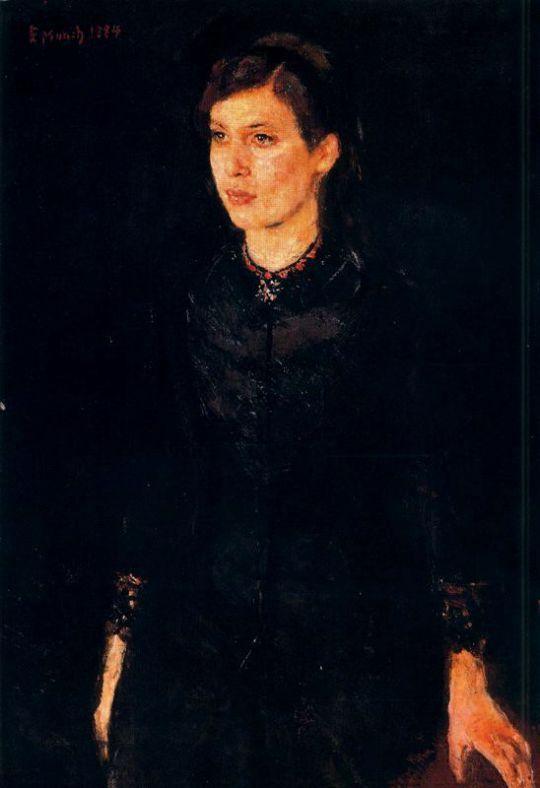
The painting shows Inger Munch in a vertical, frontal, carefully centered portrait. The figure occupies almost the entire composition: her slightly turned face emerges above a high-necked black garment, while her hands hang down at either side of her body. Her dark hair, brushed back, creates visual continuity between her head, clothing, and the background. A small reddish mark at the neck adds a restrained accent, accompanied by a reddish inscription in the upper left. Everything is reduced to the essentials: a woman, her physical presence, and an enveloping space of darkness.
The work presents a portrait of Inger Munch, Edvard Munch’s sister. Rather than constructing a narrative scene or placing the sitter in a recognizable setting, the painting focuses attention on the individual and her psychological presence. Inger’s demeanor is calm and restrained; there is no theatrical gesture or anecdotal detail to distract the viewer. This visual economy transforms a family portrait into a meditation on identity, inner distance, and the silent intensity that an immobile figure can convey.
The darkness surrounding Inger functions as more than a mere backdrop. By almost completely absorbing her clothing and lower contours, it creates a sense of isolation and gives her face and hands particular expressive weight. Her slightly turned face avoids the rigidity of an entirely frontal pose and suggests a reserved inner life, as if the sitter’s presence asserted itself without being fully revealed to the viewer. Her hands, visible at either side, provide balance and a tangible physical dimension: they anchor the figure within the dark field and prevent her from becoming a mere mask.
Formally, the composition is organized around a stable vertical structure. The central axis guides the eye from the hair to the face, continues down the neck and across the broad black expanse of the clothing, and comes to rest on the hands, two warm accents that balance the concentration above. The skin tones and ochre or orange hues stand out boldly against the blacks, very dark blues, and browns of the overall palette. The light is not distributed evenly: it is concentrated in specific areas, modeling the head and hands while the rest remains in a dense half-light. In this way, color contrast takes the place of meticulous description, making each pool of light seem charged with presence.
In this work, Edvard Munch takes portraiture to a psychological intensity characteristic of his artistic sensibility, grounded in expressive simplification and somber chromatic atmospheres. The isolated figure, restrained gestures, and close relationship between face, hands, and background transform an apparently austere image into an experience of emotional concentration. Notice how Inger is not separated from the background by a sharp outline, but gradually emerges from it: first the face appears, then the hands, and finally the body dressed in black comes into view. The portrait’s quiet force lies in this passage between presence and shadow.
Have questions about our oil painting reproductions? See our frequently asked questions.