

Description
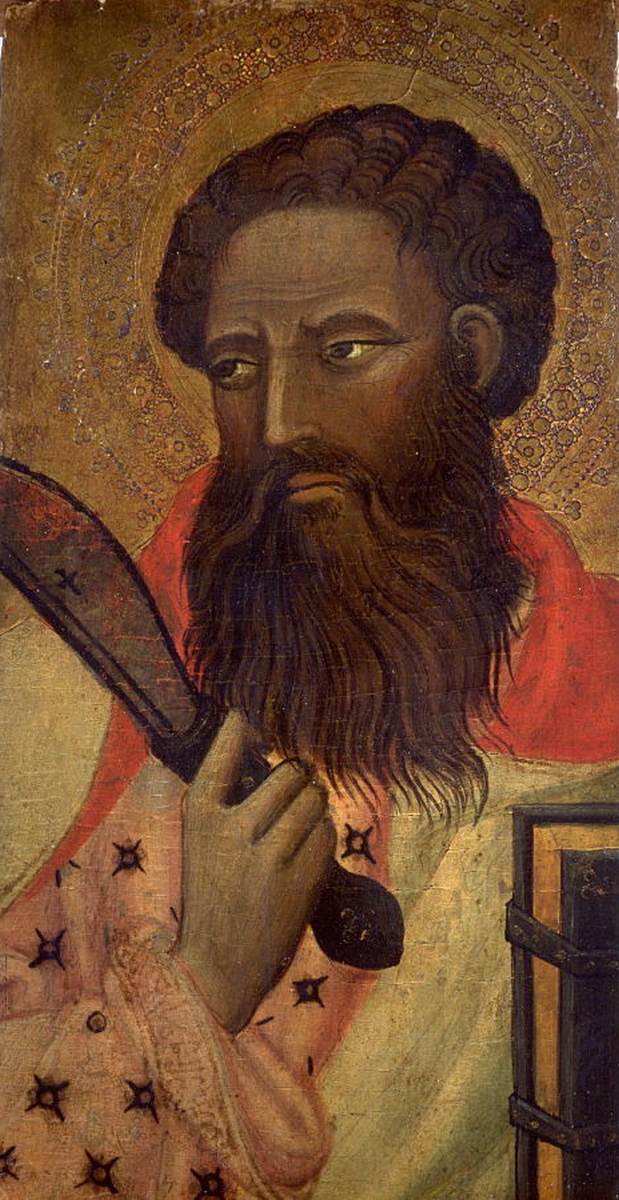
The painting depicts Saint Bartholomew in a devotional half-length portrait, positioned almost frontally, though his face turns slightly to the left. His curly hair, mustache, and long dark beard give him a grave, contemplative presence. A circular golden halo appears behind his head, composed of concentric bands and repeating ornamentation that turns the immediate background into a visible sign of holiness. The saint wears a red cloak over a light-colored garment covered in small dark motifs, while one raised hand comes close to his torso and to a rounded object in a deep hue. Other cropped elements appear at the edges of the composition, including an elongated diagonal form and a rectangular structure, heightening the impression of an image constructed from attributes and symbolic fragments.
Saint Bartholomew holds a traditional place among the Twelve Apostles of Jesus Christ and is venerated in Christian tradition as a martyr. Depictions of the saint often combine his apostolic dignity with a reference to the violence of his martyrdom by flaying. In this context, the figure is not presented as a narrative character caught in the midst of action, but as a sacred presence intended for contemplation: the body is presented in a composed pose, the face maintains a restrained expression, and the halo clearly separates the figure from the surrounding space. The image thus concentrates the saint’s identity in his appearance, gesture, and the objects accompanying him.
The golden halo serves as the work’s iconographic centre and organizes the composition around the head, where holiness, authority and spiritual stillness converge. The reddish mantle adds a note of intensity that can be visually associated with dignity and sacrifice, in contrast to the lighter garment, which is more orderly and meticulously decorated. The elongated element at the left edge can be read as a reference to Saint Bartholomew’s traditional knife and, by extension, to his martyrdom. The raised hand introduces a gestural pause within the composition: it does not disrupt the solemnity, but instead guides the eye towards the attributes positioned in front of the torso. The repetition of motifs in the clothing and halo reinforces the image’s ceremonial character.
The narrow, vertical structure concentrates the visual weight in a single figure, whose head occupies the upper area, while the beard, hand and objects extend the axis downwards. The halo’s circle provides stable geometry against the irregular contours of the hair, beard and cropped elements at the sides. The palette of golds, ochres, reds, browns and blacks creates an aged warmth, while the contrasts between the face, halo and background draw attention to the saint’s identity. The ornamentation does not act as a mere frame: it establishes a rhythm of bands and motifs that makes the surface seem to advance towards the viewer, reducing depth and encouraging a frontal, hieratic and ceremonial reading.
Editorially associated with Giovanni Bonsi, the work is understood above all through the force of its visible devotional composition: a monumental figure, a carefully ornamented halo, and a selection of attributes that distill the story of Saint Bartholomew. The painting needs no expansive setting to suggest a biography; it organizes the apostle’s memory around his face, beard, mantle, and the possible allusion to a knife. It is worth noting how the red interrupts the golden continuity and how the hand links the serene expression with the objects at the torso. In this union of frontality, ornamental detail, and a sign of martyrdom, the saint appears as a silent presence whose authority stems both from his religious identity and from the precision with which the composition guides the eye.
Have questions about our oil painting reproductions? See our frequently asked questions.