

Description
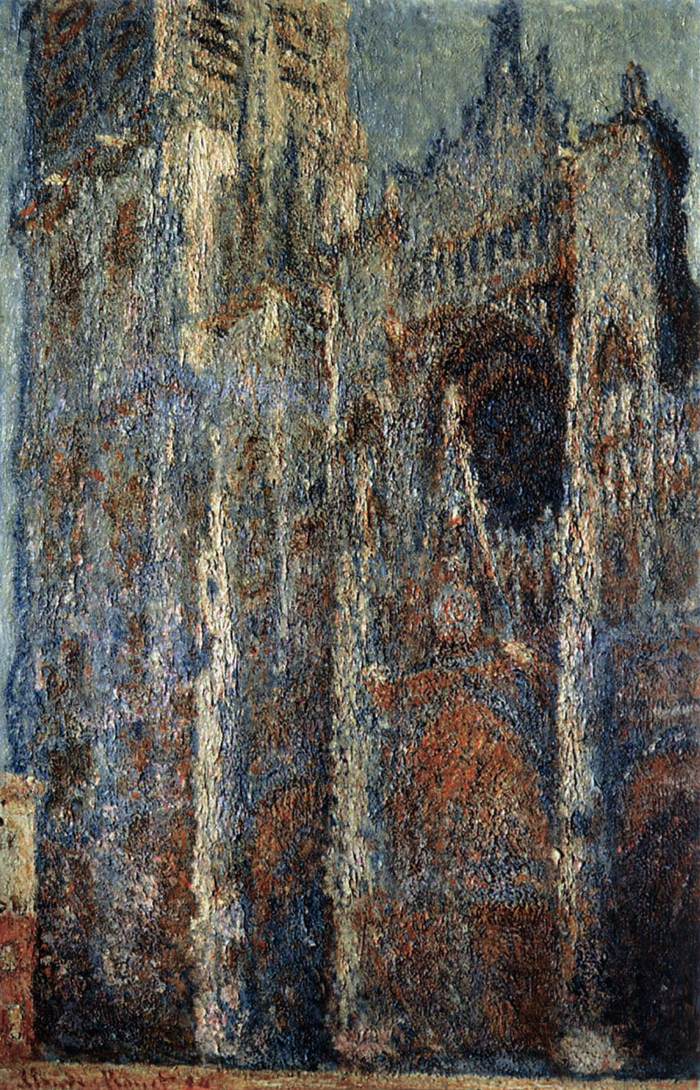
The painting shows the western façade of Rouen Cathedral close up, so close that its towers and portals extend beyond the edges of the canvas. A massive tower rises on the left; in the center, the great rose window is glimpsed as a dark patch above the main portal, while Gothic spires and pinnacles stand out against a grayish-blue sky. The stone seems to vibrate beneath a surface of dense brushstrokes in blues, pinks, ochres and whites. Rouen Cathedral turns architecture into a study of light.
Notre-Dame de Rouen Cathedral, in Normandy, is one of France’s great Gothic buildings. In the early 1890s, Claude Monet painted more than thirty views of its façade from an almost identical vantage point, recording how its appearance changed with the time of day, the weather and the season. The series has become one of the most ambitious expressions of Impressionism.
More than the building itself, the true subject is light and the passage of time. The cathedral, a symbol of permanence and faith, becomes a changing, almost immaterial surface that exists only as it is perceived by the eye in a particular moment. Solid stone dissolves into color and atmosphere.
The tight vertical composition excludes the square and its surroundings, compelling the viewer to look straight at the façade. The vertical lines of the tower and buttresses structure the composition, while the portal arches and rose window introduce curved forms. The palette alternates bluish and violet shadows with warm touches of pink and ochre, without sharp outlines: each form emerges from the accumulation of color.
Monet applied the paint in thick, rough layers that imitate the texture of stone and capture light in its relief. This hand-painted oil reproduction on canvas recreates that impasto and chromatic vibrancy, allowing the façade to retain the luminous, changing presence of the original painting.
Have questions about our oil painting reproductions? See our frequently asked questions.