

Description
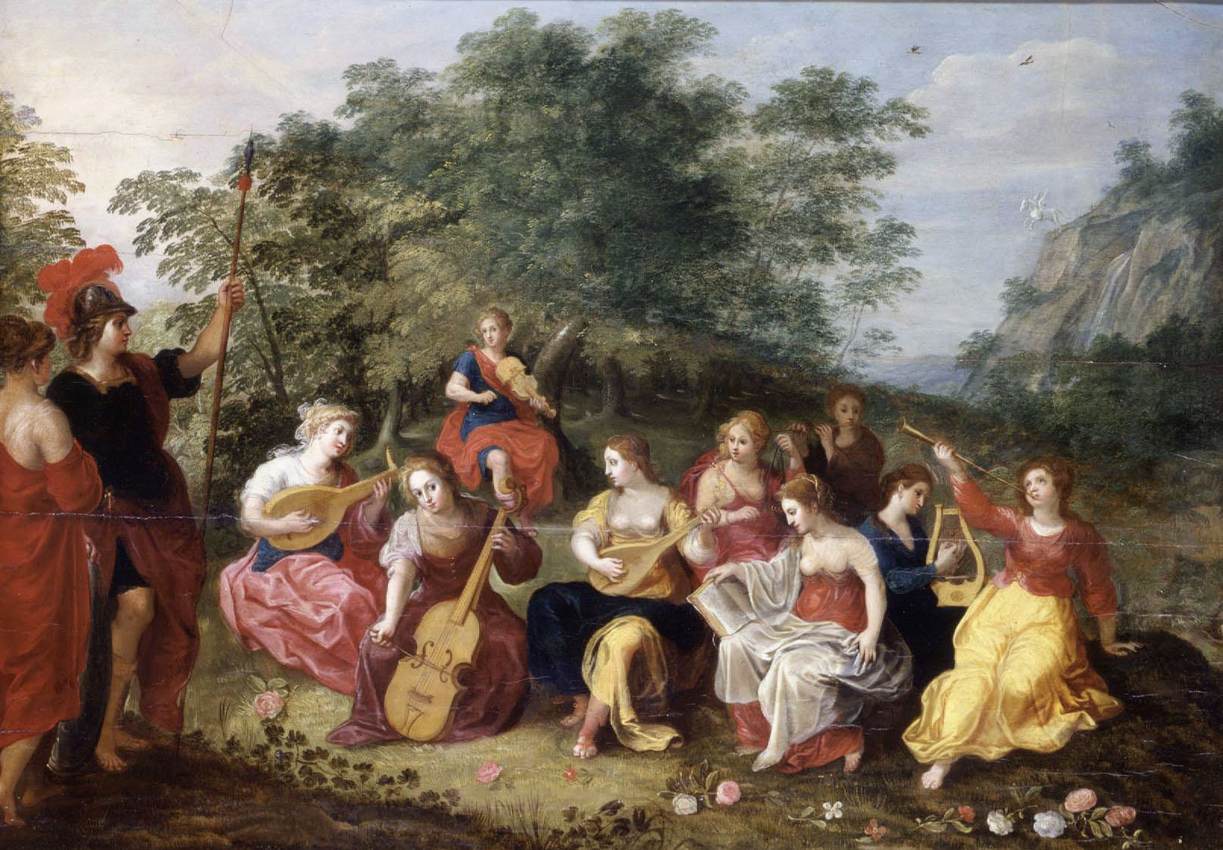
The painting depicts Minerva and the nine Muses gathered in a woodland clearing beside a landscape of valleys, crags and a waterfall. On the left, an upright female figure wearing a plumed headdress and armed with a spear lends the scene an air of authority. In front of her and around her, the group is arranged at different levels on the grass: several women play stringed instruments, another leans over an open book, and the rest take part in a tranquil, musical gathering. Their red, pink, blue, yellow and white dresses stand out against the dark vegetation. The water, trees, flowers in the foreground and small birds in the sky complete an idealized natural setting.
The scene brings together two complementary realms of classical culture. Minerva is the Roman goddess associated with wisdom, the arts and strategy, while the nine Muses represent poetic inspiration, music, dance, history and various forms of knowledge and creativity. According to mythological tradition, they are the daughters of Zeus and Mnemosyne, the personification of memory. Their presence together turns the gathering into an allegory of cultivated intellect: the authority of the armed goddess does not oppose musical activity, but presides over it and gives it order. The open book broadens the meaning of the gathering, connecting musical practice with reading, memory and the transmission of knowledge.
The iconography is articulated through specific, easily legible attributes. Minerva’s spear and headdress serve as signs of power, wisdom, and her warrior aspect, setting up a counterpoint to the relaxed poses of the seated figures. The lutes and other stringed instruments introduce a visual rhythm that brings the Muses’ artistic dimension into view; their curved forms echo the performers’ gestures and soften the weapon’s verticality. The book, open toward the viewer, offers an intellectual pause amid the musical activity. The forest, valley, and waterfall create a locus amoenus: a natural refuge where contemplation, memory, and inspiration form a single experience.
The composition takes the form of a balanced horizontal frieze. The group of figures occupies mainly the lower half, while the background opens into the distance, leading the eye to the waterfall set among the rocks. The two upright figures on the left anchor the scene and contrast with the succession of leaning bodies, arms, instruments, and fabrics extending to the right. The alternation of reds, pinks, yellows, and blues creates a warm chromatic rhythm against a foundation of deep greens and bluish grays. Soft light separates the figures from the foliage without disrupting the continuity of the landscape, while depth is built up in layers: flowers and grass in the foreground, the musical gathering at the center, and an open horizon in the background.
In Hendrick van Balen’s work, this combination of mythology, elegant figures, rich color, and idealized landscape is rooted in the tradition of Baroque Flemish painting. The work turns a classical subject into a visually accessible scene of conviviality, in which each attribute contributes to a shared reading. The spear establishes the axis of authority, while the instruments, book, and water extend that axis into the realms of the arts, memory, and imagination. Rather than separating Minerva from the group, the composition integrates her into a community of knowledge: wisdom appears as the principle that brings together and gives meaning to music, poetry, and contemplation of the natural world. The gaze ultimately moves from the armed figure toward the waterfall in the background, following the visual passage from authority to inspiration.
Have questions about our oil painting reproductions? See our frequently asked questions.