




Description
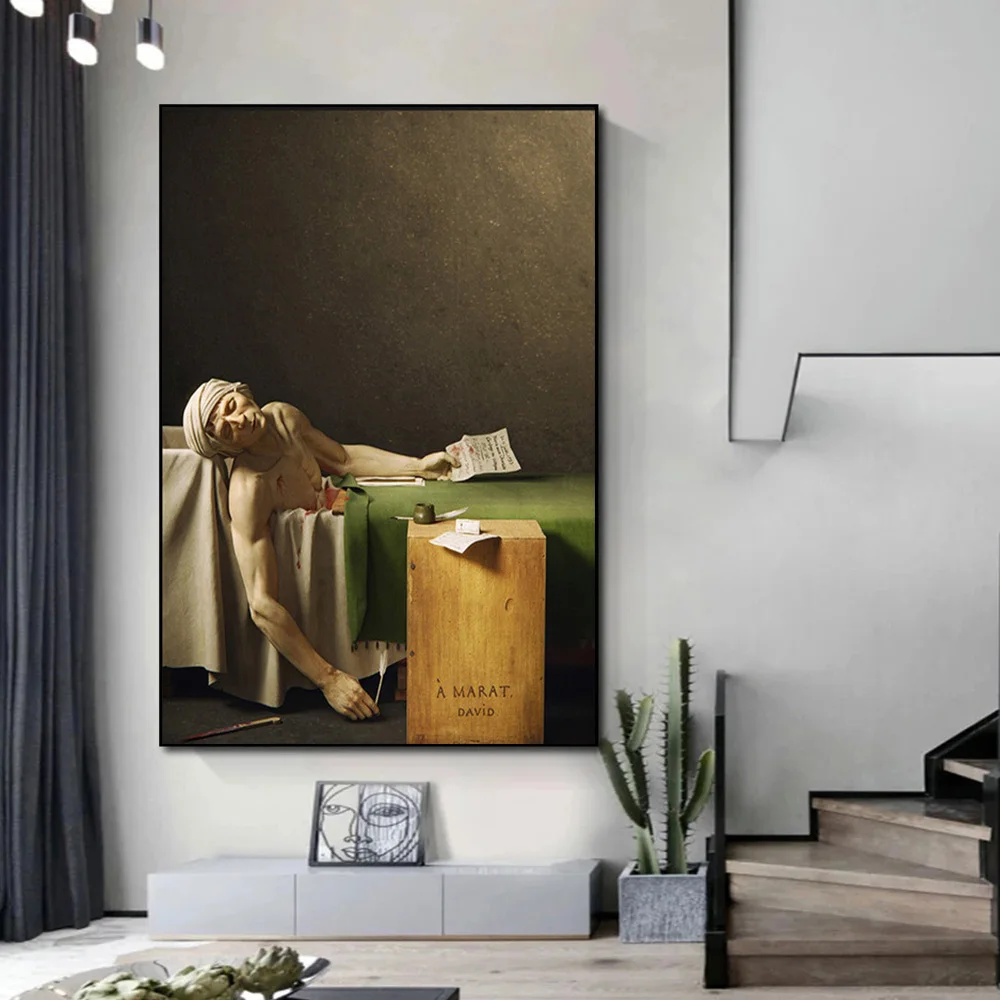
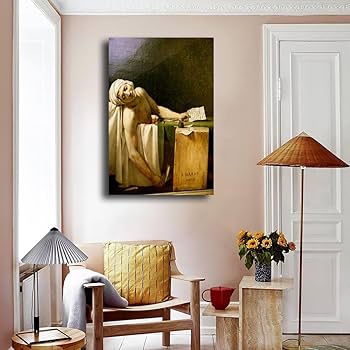
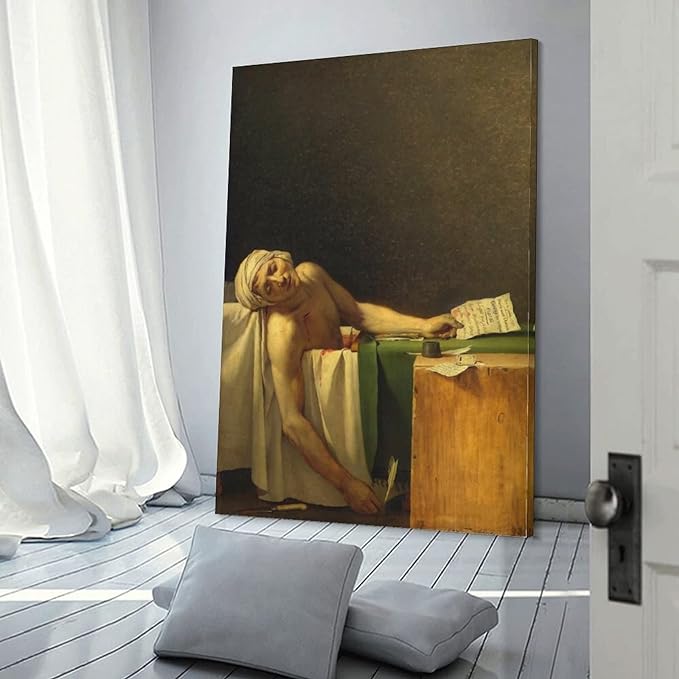
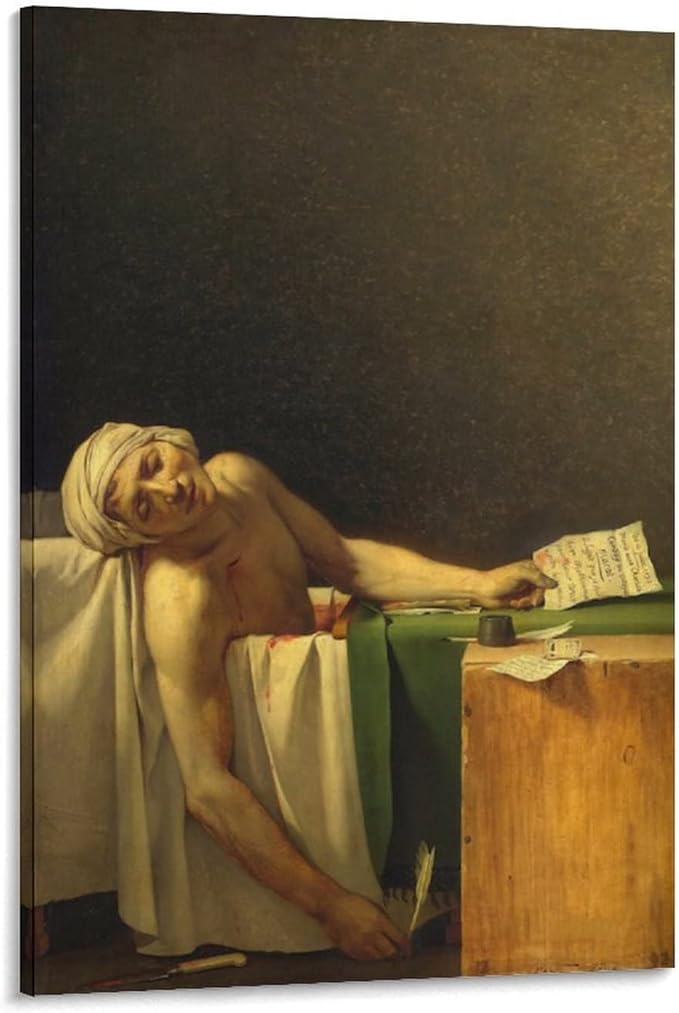
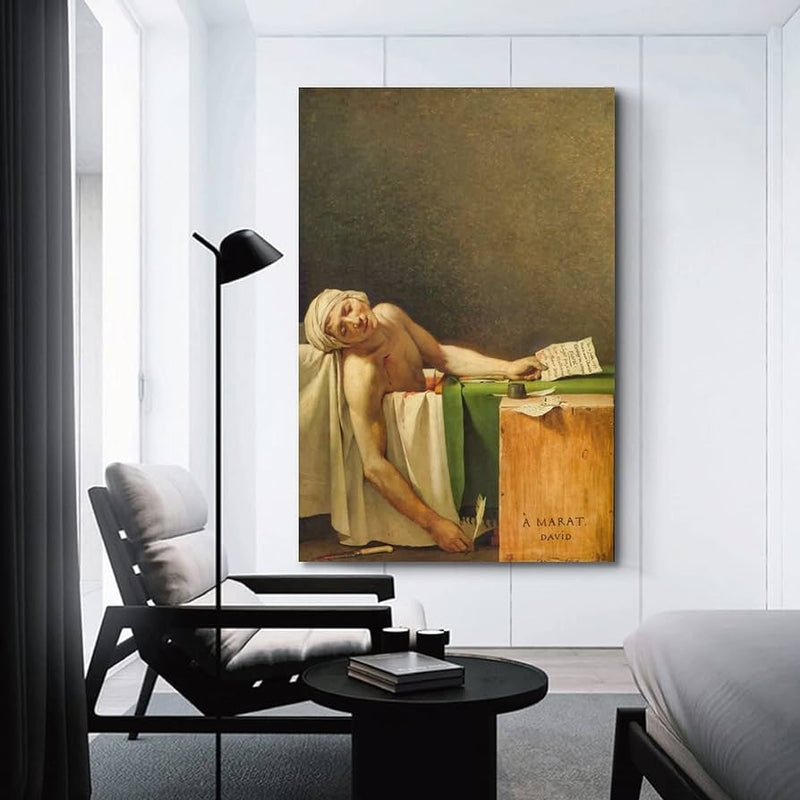
The painting depicts Jean-Paul Marat dead in the bath, reclining on a horizontal surface covered with fabric. His bare torso fills the lower-left and central areas; his head, tilted and wrapped in a light-colored cloth, rests to one side, while one arm stretches across the green fabric, holding a written sheet. His other arm hangs heavily toward the floor. Around him are handwritten papers, a small inkwell, and a quill, objects that extend the presence of writing even beyond death. In the foreground, a large wooden box introduces a warm, solid block, marked with the inscription «À MARAT. DAVID.»
The scene depicts Jean-Paul Marat, a political figure and journalist associated with the French Revolution, after he was assassinated in 1793 by Charlotte Corday while he was in the bath. The letter and writing implements connect the body with his public and political activities, transforming a private, violent episode into an image with collective resonance. The composition does not show the assassination explicitly: it shows its consequences, the silence that follows, and the vulnerability of the figure. In this way, the historical event becomes a scene of mourning and remembrance, in which the fallen figure takes on the gravity of a monument.
Everyday objects carry much of the work’s meaning. The papers, inkwell, and quill present Marat as a man of writing and public action, still bound to his work in his final moments. The sheet held in his hand connects the body to the political world beyond the scene. The inscription on the box serves at once as a dedication, an identification, and the artist’s presence in response to the event. The exposed torso and the stillness of the body make political death intimate, while the white cloths lend a note of vulnerability and visual clarity against the surrounding darkness.
The formal power stems from the contrast between the concentrated illumination on the figure and the light-colored objects, and the almost black background that fills a large area above. This emptiness intensifies the silence and lets the eye descend toward the body, the hand, and the sheet before coming to rest on the orange-toned drawer in the foreground. The horizontal lines of the bathtub, the fabrics, and the papers organize the scene with severe stability, while the diagonal of one arm and the fall of the other introduce a restrained bodily tension. Muted greens, ochres, creamy whites, and deep browns create a sober palette in which every accent of light seems carefully reserved.
In The Death of Marat, Jacques-Louis David articulates the Neoclassical idiom through controlled drawing, a clear and austere composition, and lighting that focuses attention on what is essential. The domestic scene is presented with an almost geometric simplicity, but its elements—the illuminated body, the letter, the quill, and the inscription—extend its significance, turning it into a recognizable image of revolutionary memory. It is worth observing how the drawer takes the place of a monumental base and how the writing implements balance the character’s physical fragility: between these two poles, the painting transforms mourning into a visual affirmation of Marat’s public life.
Have questions about our oil painting reproductions? See our frequently asked questions.