

Description
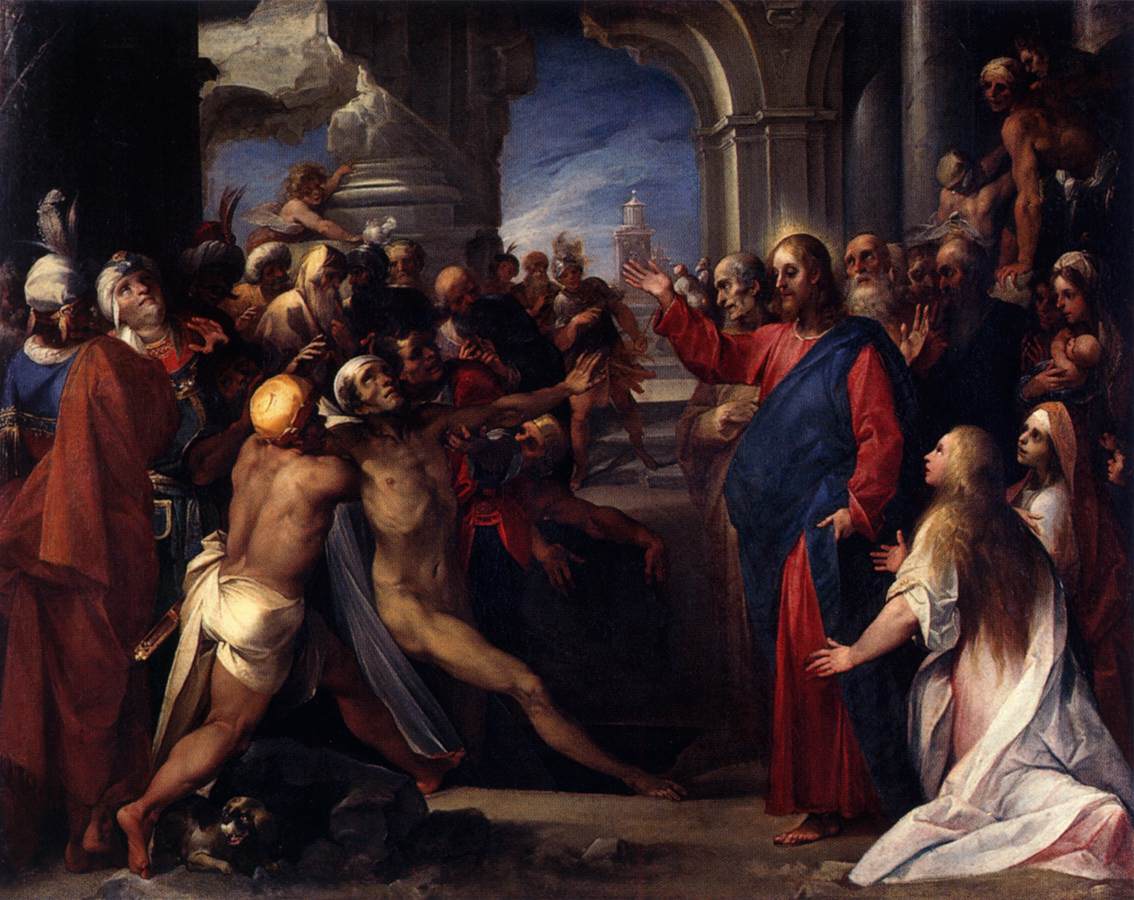
The painting depicts The Raising of Lazarus as a crowded, dramatic scene. Christ dominates the center, bearded and dressed in a red tunic and blue cloak, raising his hand as he directs the action toward the gathered figures. In front of him, two seminude men occupy the foreground; one stretches out his arms, while the other rises or kneels with his face turned upward. On the right, several women dressed in light colors sit or kneel, surrounded by men in tunics and headwear, making emphatic gestures. A dark dog rests at the lower left edge. Sturdy columns, arches, stairways and partially ruined stone walls frame the scene, while a distant tower and open landscape appear beneath the blue sky.
The work depicts the Gospel episode in which Christ calls Lazarus, who has died and been buried, and brings him back to life in the presence of his sisters and the others gathered there. The central figure embodies the authority of the miracle, while the crowd conveys its immediate effects: astonishment, agitation and recognition. The women gathered on the right are associated with Martha and Mary, figures closely connected with the story. The scene is not presented as an intimate moment, but as a public manifestation in which faith and wonder unfold before numerous witnesses.
The iconography is built around gestures and the opposition between death and life. Christ’s raised hand serves as the composition’s axis and a sign of authority, while the figure rising up embodies the physical tension of the miracle. The outstretched arms and faces turned toward the center form a collective response that amplifies the event’s energy. The dog lying on the ground introduces an everyday note into the religious solemnity. The architecture is also significant: its ruins and shadows evoke an ancient, broken world, in contrast with the luminous opening in the background, which reinforces the visual transition to revelation and life.
The horizontal composition is densely populated, yet clearly organized around the figure of Christ. The two bodies in the foreground form an ascending diagonal that leads the eye toward his gesture; the women on the right balance this movement and extend the scene into the background. Color reinforces the visual hierarchy: the red and blue of the central figure stand out against the browns, blacks, and ochres of the architecture and crowd. The celestial light outside opens up unexpected depth within the shadowy interior, while the columns and arches establish a vertical rhythm that contrasts with the agitation of the figures.
The scene is consistent with the Mannerist style associated with Giuseppe Cesari: spatial complexity, elegant figures, intense gestures, and a theatrical composition built around the interplay of light, color, and architecture. In this style, the miracle takes the form of a spectacle of interconnected bodies, in which every gaze and every raised arm draws attention back to the center. Christ’s figure remains visually stable amid the turmoil: his color, posture, and position give structure to the crowd, the figure of Lazarus, and the luminous opening. Thus, the religious subject also becomes a precise arrangement of movement, contrast, and depth.
Have questions about our oil painting reproductions? See our frequently asked questions.