

Description
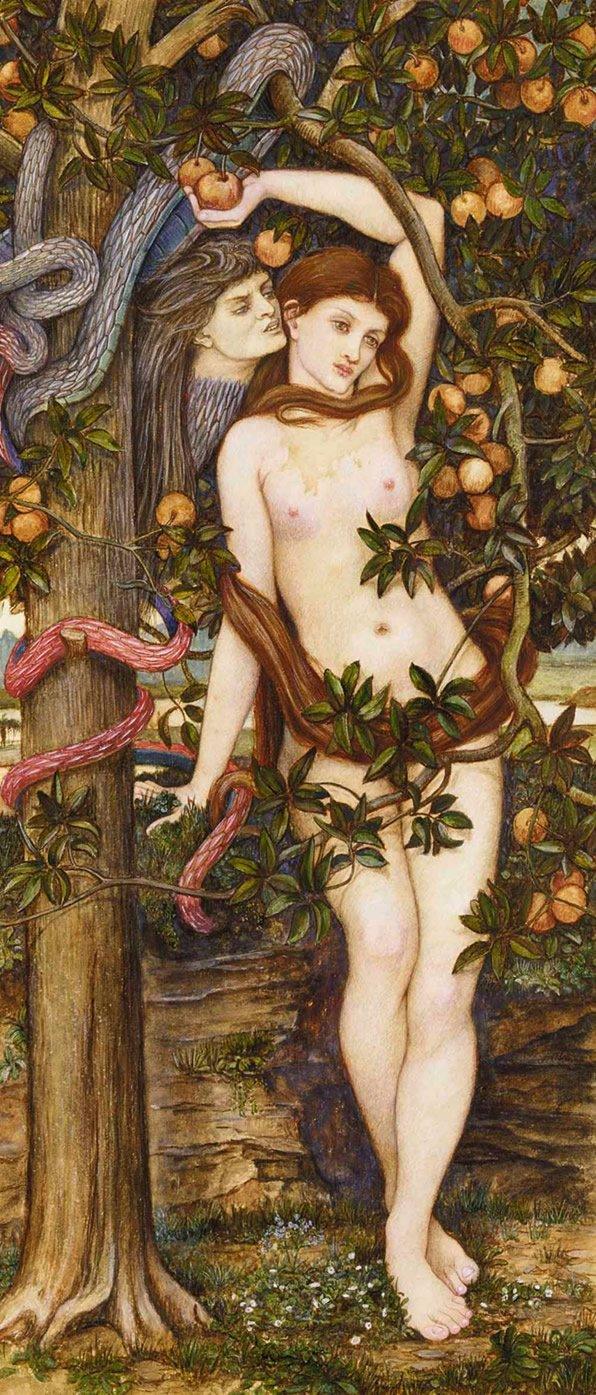
The painting shows Eve in the Garden of Eden, standing naked amid lush vegetation. Her body fills the foreground and draws the viewer’s attention as she raises her right arm among branches laden with orange-colored fruit. On the left, a sturdy trunk supports the scene’s leafy structure; a gray serpent and a reddish, serpentine form winding down toward the ground coil around it. Behind Eve, a winged human figure appears, partly hidden by the foliage. The path, grasses and small flowers in the foreground complete a dense, intimate and visually enveloping garden.
The scene alludes to the account in Genesis in which Eve, beside Adam in the Garden of Eden, is tempted by the serpent with the forbidden fruit. The episode is one of the foundational narratives of the biblical tradition: Eve’s choice and the subsequent disobedience of both of them lead to their expulsion from paradise. Here, the story is not presented as an open, spacious scene, but as a moment suspended within an abundant setting, where natural beauty and menace exist in close proximity.
The serpents wind through the tree and vegetation like lines of unease, introducing a sinuous tension around the female figure. Repeated throughout the upper part and along the sides, the fruit serves as a focus of visual desire and evokes the forbidden fruit without identifying a particular species. The dominant tree functions both as the garden’s support and as the scene’s moral axis. The winged figure lends the composition a supernatural dimension, while being partly concealed heightens the sense of a mysterious presence. Eve is thus surrounded by signs of abundance, seduction and danger.
The narrow vertical composition constricts the field of vision, bringing branches, leaves, fruit and bodies together in a dense network. The trunk on the left forms a structural column, contrasting with the curves of the serpents and Eve’s upright posture. Dark greens and browns create a deep, shadowy background, against which the orange hue of the fruit, the figure’s pale skin and the serpentine form’s rosy red stand out. The eye travels upward through the work, from the plants and lower path to the face, raised arm and tangle of branches above. This upward rhythm turns the garden into a space of both allure and entrapment.
In The Temptation of Eve, John Roddam Spencer Stanhope brings together the Pre-Raphaelite sensibility for meticulous detail, biblical symbolism and ornamental refinement. The profusion of leaves and fruit is more than a simple backdrop: it frames the body, partially conceals the winged figure and draws the eye toward the signs of temptation. The garden’s sensual palette grows increasingly claustrophobic as the serpentine forms encircle the trunk and draw closer to Eve. The work transforms paradise into a setting of intense beauty, where every element of nature contributes to the tension between desire, choice and loss.
Have questions about our oil painting reproductions? See our frequently asked questions.