

Description
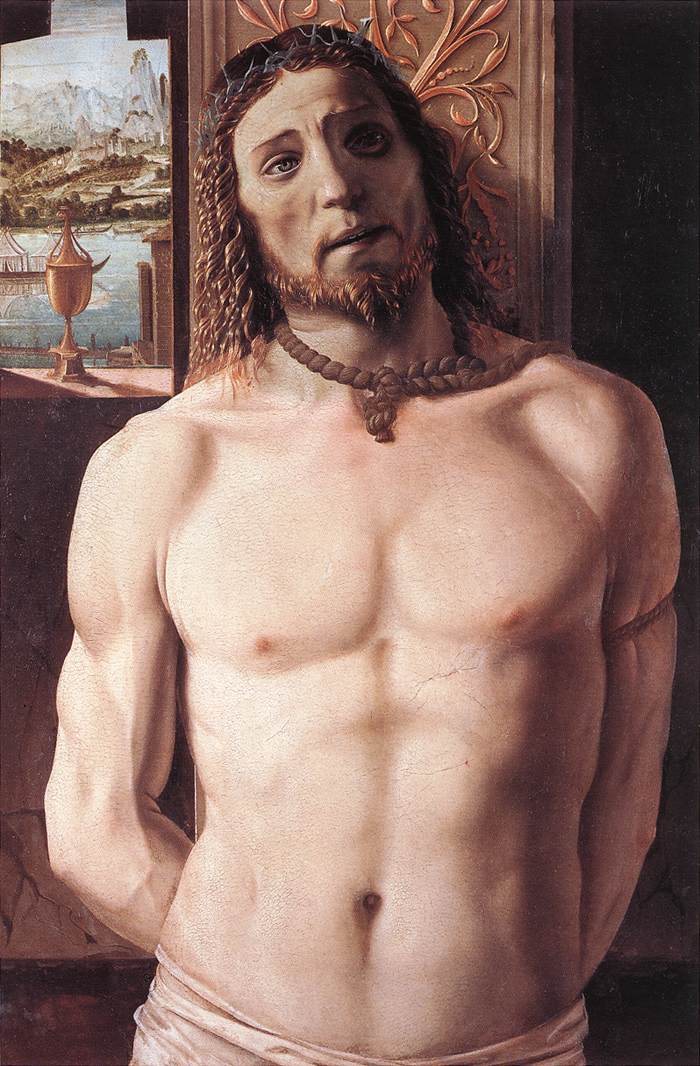
The painting presents Christ facing forward, his torso bare, with long hair and a beard framing a grave, contemplative expression. A crown of thorns encircles his head, while a thick rope wraps around his neck and descends in a knot over his chest. A light-colored cloth covers his waist, setting the vulnerability of his body apart from the dark, dense background. The figure occupies almost the entire vertical field and establishes a direct encounter with the viewer. Around him, architectural panels, vegetal ornamentation and an opening onto a landscape create a ceremonial space, where a golden vessel adds a gleaming accent on the left.
The episode belongs to the Passion of Christ, the series of sufferings, humiliations and condemnation that precede the Crucifixion. The image of Christ bound to a column belongs to a central tradition in Christian art associated with the flagellation and physical suffering. The crown of thorns recalls the mockery inflicted on Jesus before his death and turns the depicted body into a visual synthesis of pain, submission and sacred dignity. The scene does not need to recount an extended action: it concentrates the narrative on the moment when the prisoner is exposed to the viewer’s gaze.
The figure’s attributes shape an immediate iconographic reading. The thorns signify the Passion and martyrdom, while the rope intensifies the ideas of captivity and restraint. The partial nudity is not intended as display, but serves to make bodily fragility visible; the light-colored cloth acts as a reserve of modesty within a scene dominated by violence. The contrast between the shadowy background and the luminous landscape in the side opening creates a suggestive tension between confinement and transcendence. The mountains, water and distant buildings extend the space, although the figure remains physically trapped in the foreground.
The frontal, monumental composition directs attention to the face, chest, and symbols of the Passion arranged along the central axis. The lighting is concentrated on the skin, allowing the flesh and beige tones to stand out against the deep browns, blacks, and reds of the architecture. The knot in the rope creates a descending line that leads the eye from the head to the torso, while the crown forms a circular counterpoint at the top. At the sides, the vertical moldings stabilize the scene, and the landscape opening breaks the sense of enclosure with a more distant depth. The gilding on the vessel and certain botanical details add restrained glimmers to a somber palette.
In the work catalogued under the name of Donato Bramante, solemnity arises from the relationship between a body presented without protection and a carefully ordered space. The stillness of the pose does not dispel the tension: the rope, the thorns, and the gaze directed forward turn silence into a form of drama. The landscape at the side does not distract from Christ; instead, it reinforces his isolation by presenting an open world that remains beyond his reach. Thus, the painting brings together religious narrative, physical intensity, and symbolic architecture in an image of humiliation that at the same time retains a powerful sacred presence.
Have questions about our oil painting reproductions? See our frequently asked questions.