

Description
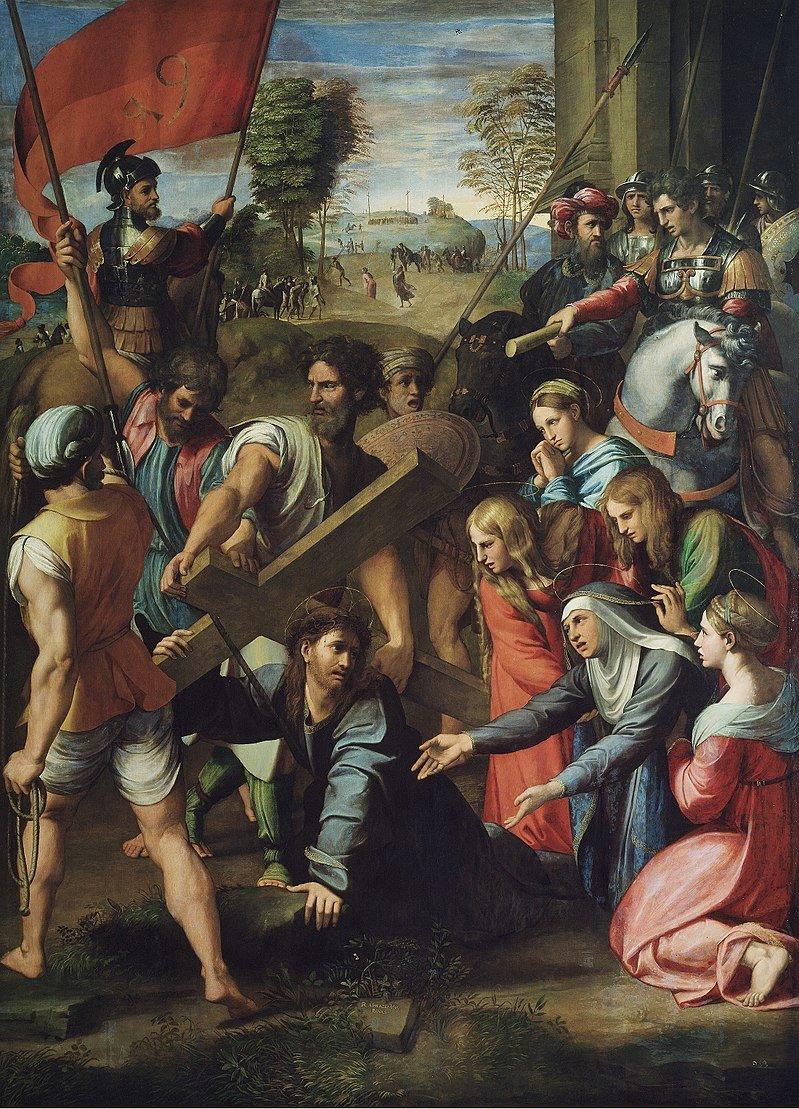
The painting shows Christ carrying a large wooden cross along the road to Calvary, surrounded by a crowd moving among soldiers, women, and attendants. The central figure bends forward and nearly kneels under the weight of the timber, while the cross stretches across the composition from the lower area to the upper right. Around him gather men in armor and helmets, carrying spears and banners, alongside several women in dresses and veils who turn their faces and hands toward the scene. A white horse rears behind the group, and a large red flag dominates the upper-left corner. Beyond the throng, a dirt road disappears among trees, meadows, and hills beneath a cloudy sky; at the right edge, a monumental stone structure visually narrows the space.
Christ Falling on the Way to Calvary belongs to the Christian cycle of the Passion of Christ and depicts the journey to Calvary, before the Crucifixion. Christ proceeds with the cross and, overcome by the effort, falls or faints along the way. The episode brings together in one space figures associated with Roman authority, the procession’s attendants, and those who witness the suffering. The women nearby offer a compassionate response to the severity of the procession: their gestures and closeness to the protagonist turn this public event into a human and painful experience as well.
The cross is both a narrative attribute and the visual axis of the work. Its diagonal divides and connects the different groups, drawing the eye toward Christ’s fallen body and, at the same time, toward the soldiers and horse surrounding him. The lances, armor, and red banner reinforce the procession’s guarded, coercive character, while the veils and the women’s outstretched hands introduce moments of tenderness and mourning. The road continuing toward the horizon extends the episode beyond the foreground: the Passion is not presented as an isolated moment, but as a procession crossing the landscape and carrying the entire community of witnesses along with it.
The vertical composition accommodates a large number of figures without losing the narrative’s overall direction. The characters overlap across several planes, forming a moving mass crisscrossed by spear shafts, arms, and folds of vivid color. The terracotta red of the banner and some garments creates accents of alarm, while dark blues, greens, ochres, and whites distribute the color weight among the groups. In contrast with this density, the landscape in the background opens up a luminous, expansive vista. The cross’s dark wood forms a dominant line that organizes the tumult, and the contrast between Christ’s inclined body and the open horizon heightens the sense of exhaustion and distance.
In Christ Falling on the Way to Calvary, Raphael combines the figures’ monumental clarity with a complex narrative, expressive gestures, and a balanced integration of the human group and the landscape. The scene combines movement and restraint: the crowd surges forward, but Christ’s figure concentrates time in a moment of collapse. Note how the cross draws the gazes, cuts across the planes, and links the violence of the procession with the women’s compassion. The emotional power of Raphael’s work lies in this tension between the armed procession, physical suffering, and the serenity of the landscape.
Have questions about our oil painting reproductions? See our frequently asked questions.