

Description
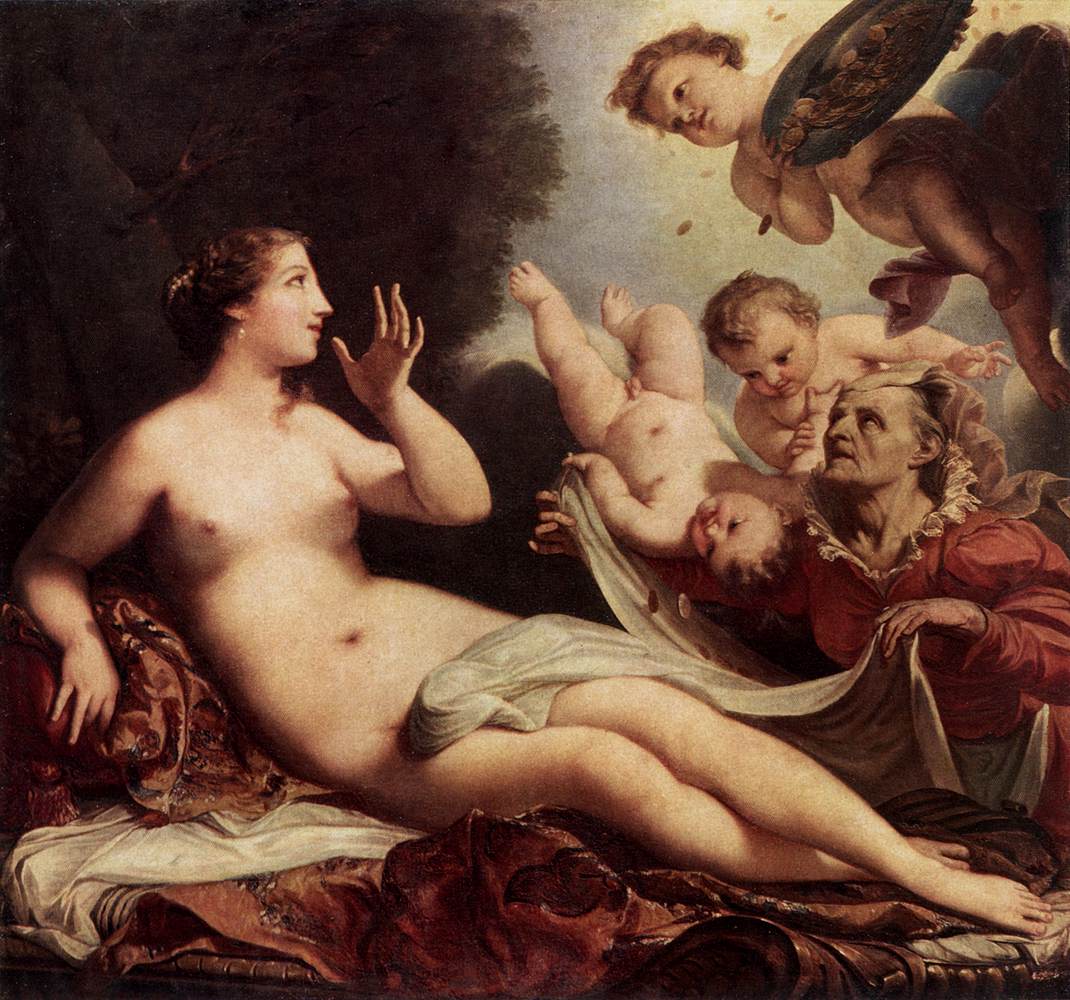
The painting depicts Danaë as a nude female figure reclining on a bed of ornate fabrics. Her body extends diagonally from the lower-left corner toward the center, while one raised hand and her upright torso animate her pose. A retinue of nude, winged child figures gathers around her. On the right, an adult man in a red tunic bends beneath them; above the group, a youthful figure spreads large, dark wings. The dense foliage in the left background contrasts with the expanse of a bright, cloudy sky, creating a natural setting of theatrical intensity.
Danaë is a princess in Greek mythology and the daughter of Acrisius, king of Argos. According to the story, Zeus joins with her in the form of a shower of gold, and Perseus is born from their union. In the pictorial tradition, the episode is usually focused on the reclining figure, surrounded by signs of wealth, desire, and supernatural presence. In Antonio Bellucci’s work, the myth unfolds as a sensual, luminous apparition: the woman occupies the emotional center of the scene, while her mythological companions heighten the extraordinary nature of the encounter.
The child figures and the winged presence are consistent with putti, whose physical energy brings movement to the scene and underscores its amorous character. The sumptuous fabrics serve as a material setting for Danaë’s sensuality, while also forming a transitional surface between her body and the landscape. The bright sky opening behind the group suggests supernatural intervention without depicting it literally. The small forms suspended above the figures add a downward rhythm and can, thematically, be associated with the golden rain of the myth. The dark foliage, by contrast, lends an almost nocturnal depth and makes the intrusion of light all the more striking.
The composition is structured around an ascending diagonal that guides the eye from the reclining woman to the winged figure in the upper-right corner. This path is broken up by curves, outstretched arms, raised legs, and billowing fabrics, making the group seem to move in a continuous flow. The red of the male figure’s tunic serves as a focal point of color within a palette dominated by browns, blacks, flesh tones, creams, and grayish blues. The light is concentrated on the bodies and the sky, while the masses of foliage remain in shadow. This contrast gives shape to the figures and turns the open space into a carefully directed stage where the earthly and celestial worlds meet.
The interpretation of Danaë thus rests on the tension between bodily abandon, the agitation of the little cupids, and the appearance of a higher light. Antonio Bellucci brings fabrics, foliage, bodies, and clouds together in a highly theatrical scene, without isolating the protagonist from the world around her. It is worth observing how the diagonal of the female figure’s body continues visually toward the wings, and how the red interrupts the continuity of the dark tones. Along this path, the myth becomes more than a narrative: it becomes a visual experience of desire, transformation, and supernatural light.
Have questions about our oil painting reproductions? See our frequently asked questions.