
Description
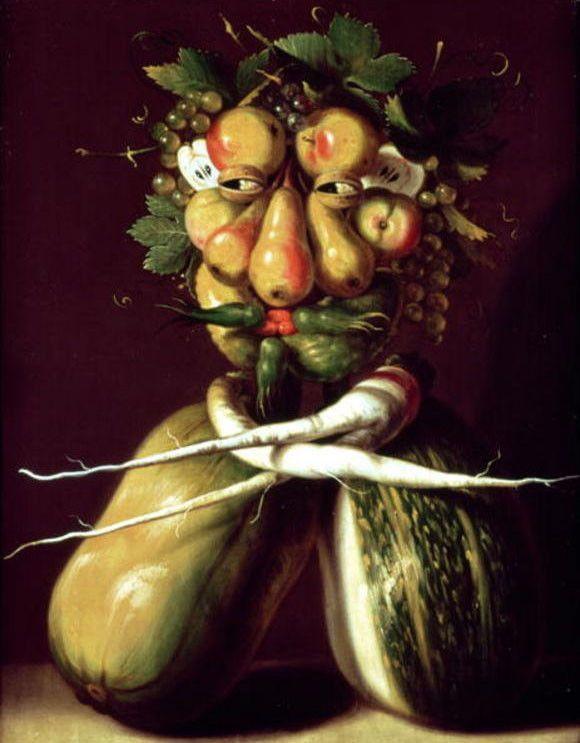
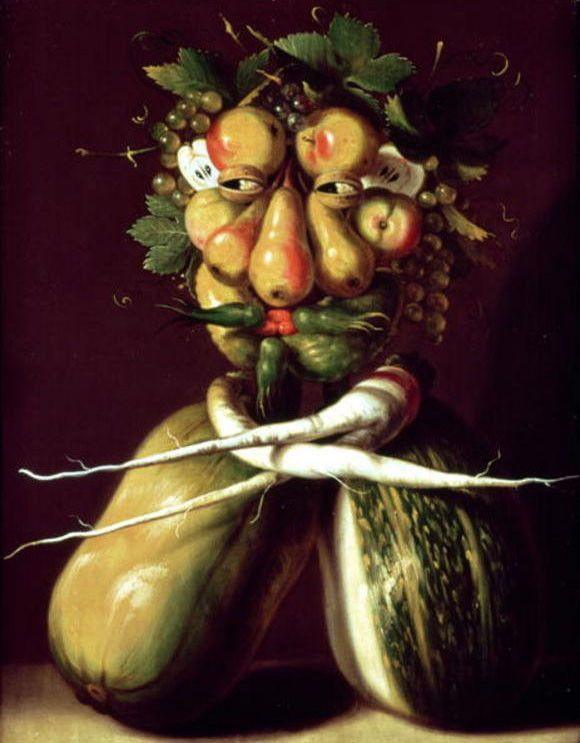
The painting shows a frontal bust constructed entirely from fruit, vegetables, bunches of grapes and leaves. At the center, two human eyes are integrated among the plant forms, while an elongated yellow and reddish shape defines the nose and several rounded fruits model the cheeks. The mouth emerges from an arrangement of green leaves and small red fruits. Bunches of grapes hang on either side of the head, and a crown of foliage frames the top like a luxuriant head of hair. A white cloth, crossed and knotted around the neck, completes the bodily appearance; below it, two large yellow and dark green plant forms balance the lower area. Everything stands out against a dark maroon background that focuses attention on the figure.
The Vegetable Gardener exemplifies Giuseppe Arcimboldo’s most recognizable approach: arranging natural elements to form a coherent human figure. Rather than depicting a face through conventional anatomy, the work turns each element of nature into a part of the portrait. The result does not depend on a specific religious, mythological or biographical story, but on a visual transformation that brings together the human and the vegetal. The accumulated objects retain their identities—grapes, leaves, fruit and vegetables—while also contributing to a single, legible image. This dual nature, observed nature and imaginary face, underpins the composition’s ingenuity.
The substitution of natural elements for anatomical features gives the portrait a fantastic, allegorical dimension. The leaves forming a crown heighten the figure’s stage presence and can be visually associated with abundance and the symbolic dominion of nature, without tying it to a specific identity. The white cloth introduces a recognizable bodily reference: it separates the vegetal head from the lower part and helps the composition read as a bust. The almost ceremonial frontal pose contrasts with the unexpected materials. Thus, the work oscillates between the solemnity of portraiture and the intellectual game of discovering how each fruit, leaf, or cluster of grapes contributes to the construction of the face.
The vertical, centered composition organizes the viewer’s gaze clearly. The eyes establish the first focal point, and from there the gaze moves across the elongated nose, cheeks, vegetal mouth, and frame of grapes and leaves. The overall symmetry lends stability, while differences in size, color, and texture keep the face from seeming rigid. The dark garnet background serves as a contrasting surface: it makes the greens, yellows, reds, and whites stand out and concentrates the visual illumination on the figure. The light-colored cloth acts as a pause between the complexity of the head and the vegetal forms below. The effect is theatrical, compact, and surprisingly legible.
In Giuseppe Arcimboldo’s work, the descriptive precision of natural objects combines with imaginative, theatrical arrangements that are deliberately surprising. The Gardener belongs to this tradition, transforming an abundance of vegetation into a human identity without losing the tangible presence of its components. It is worth observing how the face appears and dissolves at the same time: at first, a frontal figure comes into view, but then each area reveals a new relationship between fruit, leaf, grape and bodily form. The painting’s appeal lies precisely in this ordered metamorphosis, in which nature ceases to be a simple decorative repertory and becomes the portrait’s entire structure.
Have questions about our oil painting reproductions? See our frequently asked questions.