

Description
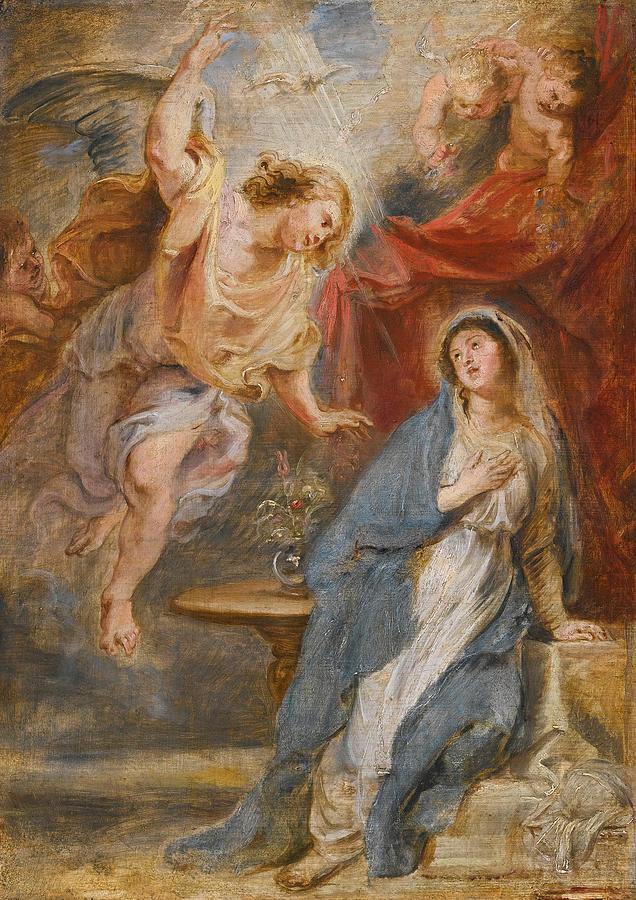
The painting shows the Annunciation as a dynamic irruption of the celestial into a space of contemplation. A winged figure descends from the upper-left area, one arm raised and light drapery extending its movement toward the center. Facing the figure, Mary appears seated or kneeling in the lower-right part, dressed in white and covered by a blue mantle. She holds one hand to her chest and receives the news with an expression of focused surprise. A small vase of flowers stands on a low piece of furniture, while the stone blocks and fabrics along the right edge create a domestic, devotional setting. At the top, other figures wrapped in red drapery extend the scene into a supernatural dimension.
The episode depicts the archangel Gabriel announcing to Mary that she will conceive and give birth to Jesus. In Christian tradition, the Annunciation holds a pivotal place because it marks the beginning of the Incarnation and precedes the birth of Christ. The composition conveys this story through two contrasting visual responses: the heavenly messenger bursts in from above with energy, while Mary remains in a more stable space, inclined toward the inward reception of the news. The encounter is not presented as an everyday conversation, but as the sudden contact between the divine world and human experience.
The attributes in the scene concentrate its meaning. Mary’s blue mantle and the circular glow around her head identify her as a sacred figure and underscore her chosen role in the story. Her hand resting on her chest turns the gesture into an image of humility, wonder, and acceptance. The flower-filled vase introduces a note of purity and renewal that complements the theme of new life; its branches and flowers also echo the brightness of her garment. The stone architecture and domestic objects anchor the event in a recognizable space, although the arrival of the winged figure and the movement of the drapery immediately elevate it to the supernatural.
The formal structure heightens this narrative tension. The vertical composition is organized around diagonals: the winged figure descends from the left, the arms and fabrics guide the eye toward the center, and the upper group opens out to the right in a surge of movement. Carmine reds and golden ochres lend drama to the upper area, while the grayish blue of the mantle provides a cool, stable counterpoint beside Mary’s ivory white. The loose, energetic brushwork keeps the figures from appearing static; wings, drapery, and arms create a continuous rhythm against a dark, cloudy background. The glow around Mary’s head acts as a luminous pause and fixes the scene’s emotional focal point.
This work by Peter Paul Rubens displays features widely associated with the Baroque: emphatic diagonals, bodies in motion, rich color, and luminous theatricality applied to a religious subject. The celestial energy does not diminish Mary’s contemplation; both registers are necessary for the announcement to be visible as an event and meaningful as an inner experience. Notice how the gaze travels from the winged figure to Mary’s hand and then descends to the vase and the architecture: this path connects heaven, the human figure, and everyday space. In this way, the painting turns the Annunciation into a balance between dramatic apparition and devotional silence.
Have questions about our oil painting reproductions? See our frequently asked questions.