

Description
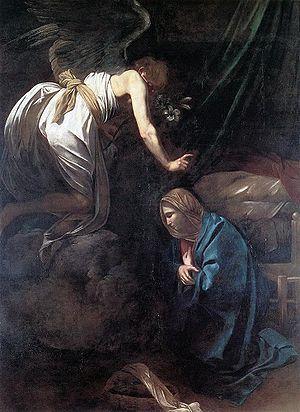
The painting shows the encounter between the Virgin Mary and the angel Gabriel in a space shrouded in gloom. Gabriel occupies the upper area, leaning to the right, with his torso partly bare and a large white cloth wrapped around his body. His great feathered wings spread out behind him, filling much of the upper part of the composition. Facing this suspended, dynamic presence, Mary appears kneeling in the lower right, her head covered and her figure wrapped in a deep blue mantle. The two figures are connected by a descending diagonal that leads the eye from the angel to the Virgin’s contemplative posture.
The scene depicts Gabriel telling Mary that she will conceive and give birth to Jesus. In Christian tradition, this episode marks the moment when divine revelation enters human experience. Mary receives the message with humility, prayer, and acceptance, while Gabriel acts as God’s messenger. The painting focuses this story on the very moment of communication: it does not present an extended narrative, but a silent exchange of gestures, inclinations, and glances. The darkness surrounding the figures separates the sacred event from the everyday world and transforms it into an intimate apparition.
The iconography is clearly conveyed through the essential attributes. The wings and pale garment identify Gabriel, whose inclination brings the message into Mary’s personal space. The blue mantle and covered head distinguish the Virgin and underscore her receptive attitude. The difference between the two figures also structures the symbolic reading: the angel stretches out and advances, while Mary turns inward, kneeling and sheltered by the folds of the fabric. The interplay of movement and stillness makes the tension of the announcement visible. The contrast between the luminous fabrics and the background, almost swallowed by darkness, reinforces the sense that the supernatural is manifesting itself within an enclosed, silent space.
The vertical composition gains energy from the diagonal descending from Gabriel’s wings and body to Mary’s blue mantle. This line prevents the scene from becoming static and draws attention to the narrative point of contact between the messenger and the kneeling figure. Light is concentrated on the fabrics, the figures, and a few contours, leaving the surrounding masses in deep darkness. Ivory white serves as the initial focal point; the deep blue then provides a second visual anchor in the lower part. The broad folds introduce rhythm and volume, while the rocky, shadowy surfaces of the ground add depth without competing with the figures. The space seems to contract around the encounter, as if the half-light were sheltering the event.
In this work by Caravaggio, the religious episode takes on a direct intensity through chiaroscuro, the naturalism of the figures, and the dramatic staging. The grandeur of the subject does not depend on a monumental setting, but on the proximity of two bodies and the contrast between the angel’s ethereal presence and Mary’s earthly humility. The result is an intimate, theatrical Annunciation, in which light transforms the folds into signs of movement and contemplation. It is worth observing how Gabriel’s diagonal, the Virgin’s blue garments, and the surrounding darkness work together: the message does not disperse across the scene, but seems to advance slowly toward Mary and hang suspended in the instant of its reception.
Have questions about our oil painting reproductions? See our frequently asked questions.