

Description
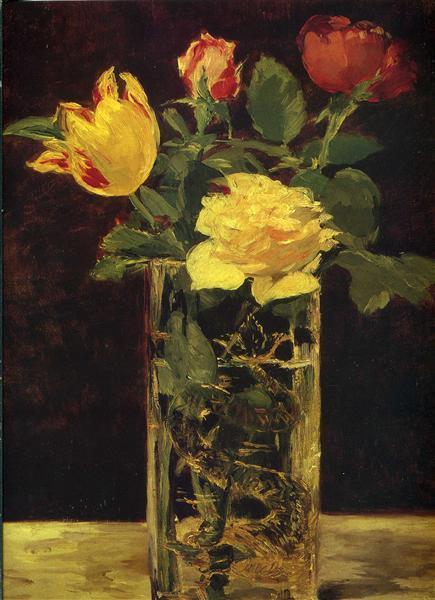
The painting shows a vertical floral still life in which roses and tulips come together in a tall, transparent glass vase. Four open flowers dominate the upper part: yellow, golden and orange tones alternate with a dark red flower, while green leaves fill the spaces between the petals. The stems descend into the vessel and visually extend the composition to the ochre surface on which it rests. The blackish-brown background eliminates all distractions and makes the arrangement emerge intensely from the darkness.
As a subject, Roses and Tulips belongs to the floral still-life genre, which focuses on the relationship between color, light, material and compositional balance. There is no figurative narrative or anecdotal setting here: attention is centered on an arrangement of cut flowers and the tangible presence of its objects. The vase, leaves and stems form a visual unity in which decoration coexists with close observation of nature. The simplicity of the subject allows each variation in color and each brushstroke to take on significance.
The open flowers evoke traditional associations with beauty, vitality and the transience of nature. Rather than appearing as isolated emblems, the roses and tulips form a lush arrangement whose fullness is heightened against the dark background. The transparent glass adds another layer of visual meaning: it reveals the bouquet’s internal structure, with crossing stems, overlapping leaves and vertical reflections that expose what would normally remain hidden. Thus, the arrangement is not simply admired for its colorful surface; it also invites us to observe its structure and material fragility.
The composition is carefully balanced around a vertical axis. The pale yellow flower at the center-right serves as the main focal point, while the flowers at the sides and top broaden the mass of color and keep the arrangement from feeling rigid. The yellows and oranges concentrate the light; the greens articulate the transition between the flowers and the vessel; the red adds an accent of depth. The visible, expressive brushwork gives the petals a vibrant texture without obscuring the differences between their forms. In contrast to this organic richness, the vase introduces a narrow, transparent geometry that leads the eye downward and establishes a rhythm between floral expansion and restraint.
The attribution to Édouard Manet is consistent with his widely recognized interest in visible brushwork, chromatic contrasts, and the physical presence of objects in his floral still lifes. In this work, the seemingly simple arrangement becomes an intense study of color and material: the luminous flowers stand out against the darkness, while the glass reveals the network of stems and leaves that supports their abundant appearance. The painting brings together two experiences in a single scene: the immediate impression of a radiant bouquet and a measured attention to its inner construction, focused on the meeting of petals, foliage, transparency, and shadow.
Have questions about our oil painting reproductions? See our frequently asked questions.