

Description
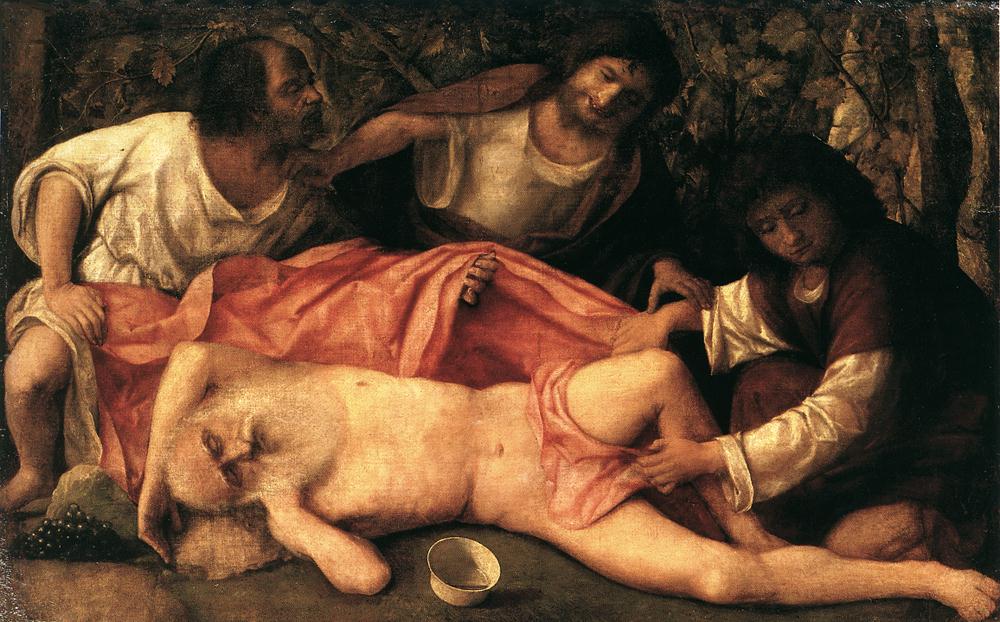
The painting shows Noah lying naked in the foreground, stretching horizontally across the lower part of the composition. His body, illuminated with a warmth that contrasts with the shadowy surroundings, is surrounded by three clothed figures. One bends over on the left, another appears behind his torso, and a third kneels beside his legs; a large reddish cloth passes between them, partially covering the patriarch. Dense vegetation of branches, trunks, and dark leaves fills the surrounding space. On the ground, a small metal vessel and a cluster of rounded forms subtly evoke wine and the vine, while a dark cloth extends the shadows on the right.
The scene comes from the account in Genesis: after planting a vineyard and drinking its wine, Noah becomes drunk and lies exposed in his tent. His sons Shem and Japheth enter to cover him without looking at his nakedness, while Ham sees it and tells his brothers. The work focuses on this episode at a moment of restrained action, concerned more with care and moral exposure than with an explicit depiction of drunkenness. Noah’s vulnerable body occupies the narrative center, and the figures around him turn the cloth into a visible sign of a filial response to shame.
The iconography is shaped by simple, effective contrasts. The patriarch’s nakedness expresses physical vulnerability and helplessness, while the light-colored garments of the clothed figures introduce a note of order into the scene. The cloth’s orange-red hue serves a dual purpose: it covers the body while also visually linking the figures with a vivid band that crosses the composition. The dark cluster of grapes and the vessel on the ground reinforce the association with the vineyard and wine without distracting from the main episode. The dense vegetation acts as an intimate, almost theatrical frame, setting Noah’s exposure apart from the outside world.
The horizontal composition of the nude body establishes a firm base for the movement of the other figures. Their poses form an irregular arch around Noah, leading the eye across the hands, the fabric, and the faces before returning to the illuminated torso. The gentle diagonals of the legs and drapery create continuity, while the vertical trunks and branches in the background introduce a structural tension that anchors the scene. Bellini concentrates warm tones in the skin, the red fabric, and the golden vessel; by contrast, the browns, muted greens, and blacks of the foliage deepen the space and heighten the group’s isolation. The light is not distributed evenly: it guides attention toward the bodies and makes the act of covering them the visual focus.
In Giovanni Bellini’s work, this integration of figures, leafy landscape, and warm light reflects the chromatic and atmospheric sensibility of Venetian painting. Here, the setting is more than a simple background: it plays a part in the intimacy of the story and envelops the human forms in shadow, making each gesture stand out. The scene transforms a biblical episode of drunkenness and shame into a visual meditation on vulnerability, the gaze, and care. As you look at it, follow the path of the red fabric: from the hands of the clothed figures to Noah’s exposed body, this movement brings narrative, color, and meaning together in a single protective gesture.
Have questions about our oil painting reproductions? See our frequently asked questions.