

Description
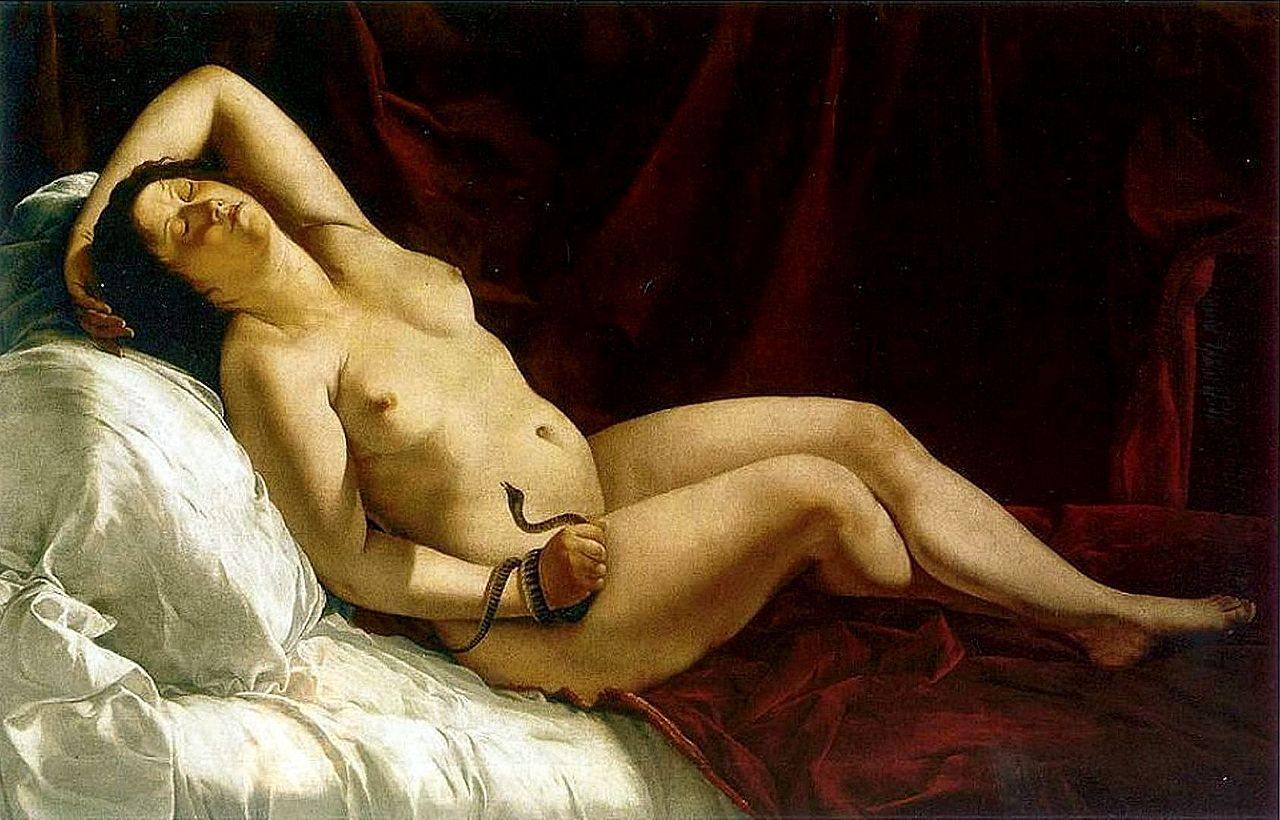
The painting shows Cleopatra reclining on a bed, her torso raised and her legs extending diagonally to the right. Her nude body stands out against a shadowy interior, while her head rests on a large white pillow and the sheets gather in the foreground. Beside her hand, a dark serpent coils around her wrist and stretches up toward her fingers. Deep burgundy-red fabrics spread beneath the figure, their folds continuing into the background and transforming the space into a closed, intimate, theatrical setting. The light is concentrated on the skin, face, and pale fabrics, leaving the edges of the composition in dense shadow.
The scene traditionally refers to Cleopatra, the last ruler of Egypt’s Ptolemaic dynasty, at the moment of her death following Egypt’s defeat by Rome. The serpent, or asp, alludes to the widely circulated account that the queen ended her life with a snakebite. Rather than presenting a conventional portrait, the work condenses a historical episode into an image of fatality: a sovereign’s power is shown confronting the vulnerability of the body and the imminence of death. The bed turns a public event into a private, almost suspended scene, in which history takes on a profoundly human dimension.
The serpent serves as the composition’s central symbol. Its proximity to the wrist establishes a direct link between the figure’s gesture and the outcome being depicted, while its curved form introduces a line of tension into the stillness of the reclining body. The white sheets and the golden glow of the skin suggest fragility, while also preserving Cleopatra’s monumental presence. By contrast, the red fabrics evoke violence, passion, and tragic ceremony. The image does not separate beauty from death; it holds them together in a depiction where luxurious textiles, nudity, and danger intensify one another.
The diagonal structure guides the eye from the head resting on the pillows to the hand holding the snake and, from there, along the length of the legs. This bodily progression organizes the entire scene and prevents the dark background from drawing attention away. The light sheets form a luminous base in the lower-left area, while the red covers create depth through layers of folds and shadows. Chiaroscuro focuses attention on the figure and models the volume of the torso, arms, and legs with an almost theatrical intensity. The interplay of smooth surfaces, creased fabric, and areas of darkness lends visual rhythm to an essentially motionless scene.
The work is consistent with traits widely associated with Artemisia Gentileschi: dramatic chiaroscuro lighting, theatrical drama, and an intense focus on female figures in historical or biblical episodes. Here, the tightly cropped composition and the proximity of the body place the viewer before the final moment, rather than at a distance from the story. It is worth noting how the snake connects the intimate gesture to the historical dimension, and how white, red, and shadow transform the bed into a space of power, sacrifice, and fate. The painting thus transforms Cleopatra’s death into an image of tragic intimacy, sustained by a powerful bodily composition.
Have questions about our oil painting reproductions? See our frequently asked questions.