

Description
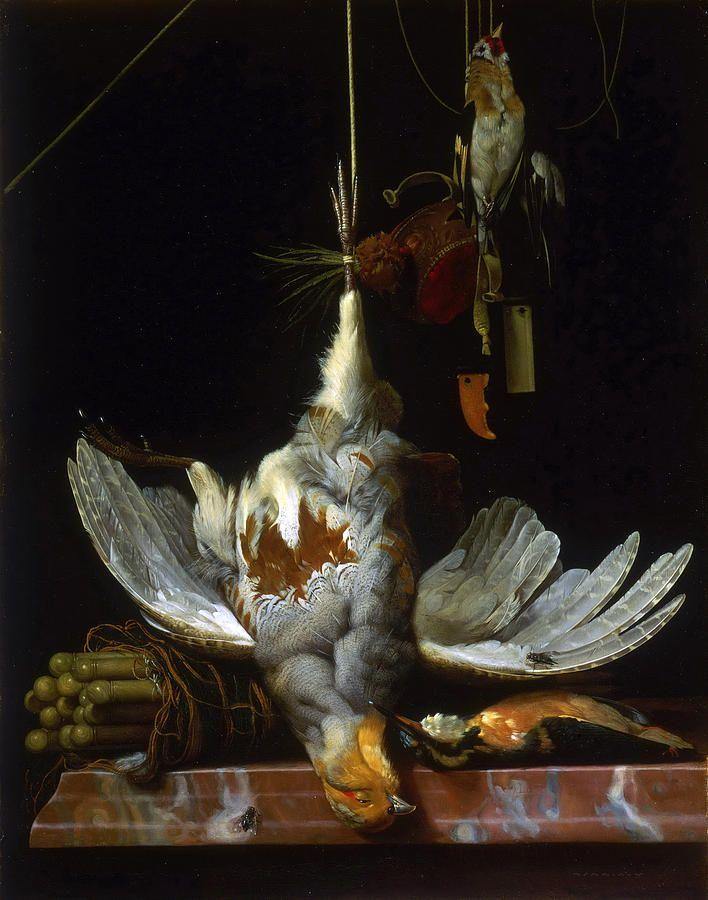
The painting depicts a hunting still life arranged around a dead bird hanging upside down in the center, its wings spread wide. Its gray, white and brown plumage fills much of the picture and stands out against an almost black background. Other hunted birds are arranged around it: a small game bird suspended in the upper-right area and another lying on the lower shelf. Among them are a reddish bag, cords, straps, a yellowish rectangular object and various hanging utensils. At the lower left, a cluster of tied green forms adds a counterpoint of color and texture, while the mottled shelf supports and organizes the objects that are not suspended.
The hunting still life genre depicts game alongside bags, accessories and objects associated with hunting. In this tradition, the inventory of animals and equipment is not merely descriptive: it transforms a scene of material possession into a carefully arranged composition. The birds, removed from their natural movement and turned into trophies, make visible the tension between abundance and loss. As is often the case in still-life painting, the presence of perishable things can evoke the transience of life, though the work also retains a direct focus on the textures, volumes and visual qualities of each object.
The suspended and reclining birds form the iconographic core of this hunting still life. Displayed with its wings spread, the central bird takes on an almost theatrical presence: it is no longer merely a game bird, but the protagonist of a silent representation. The cords, bag, and accessories broaden the reading into an inventory of hunting activity, making everyday objects part of the composition’s solemnity. The darkness surrounding the bodies underscores their fragility, while the lower shelf introduces a more tangible dimension, as if the objects were passing from suspension to rest. The concentration of elements turns the scene into a visual meditation on capture, possession, and the passage of time.
The composition is structured around a tension between verticality and horizontality. The central bird descends from the upper area, its wings opening into diagonals that draw the eye toward the center; the suspended accessories extend this vertical rhythm, while the shelf creates a stable base from side to side. The black background removes almost all spatial reference, concentrating attention on the illuminated contours, the folds of the bag, and the variations in the plumage. Silvery grays and ivory whites stand out against browns, ochres, dark reds, and olive greens. Selective lighting models the forms with precision and creates a restrained sense of depth: the objects do not disperse into a broad space, but seem to approach the viewer like a densely arranged stage.
In the work of Hendrick de Fromantiou, this painting belongs to the Dutch tradition of game still lifes, recognizable by its meticulous observation of plumage and objects, the contrast between illuminated forms and a dark background, and a staging rich in material detail. The painting turns a group of fallen birds and hunting gear into an almost theatrical image, where suspension and light make perishable matter the true protagonist. Notice how the outstretched wing of the central bird visually connects the objects above with the ledge below: along this path, the painting transforms a motionless inventory into a scene of tension, silence, and physical presence.
Have questions about our oil painting reproductions? See our frequently asked questions.